600,000 Nvidia H200 Chips Sit Idle in Hong Kong as Beijing Stalls
About 600,000 Nvidia H200 AI chips are warehoused in Hong Kong after the Trump administration cleared exports but Beijing refused large-scale import approvals, per Reuters. Nvidia has already booked $400M in write-downs tied to the backlog.
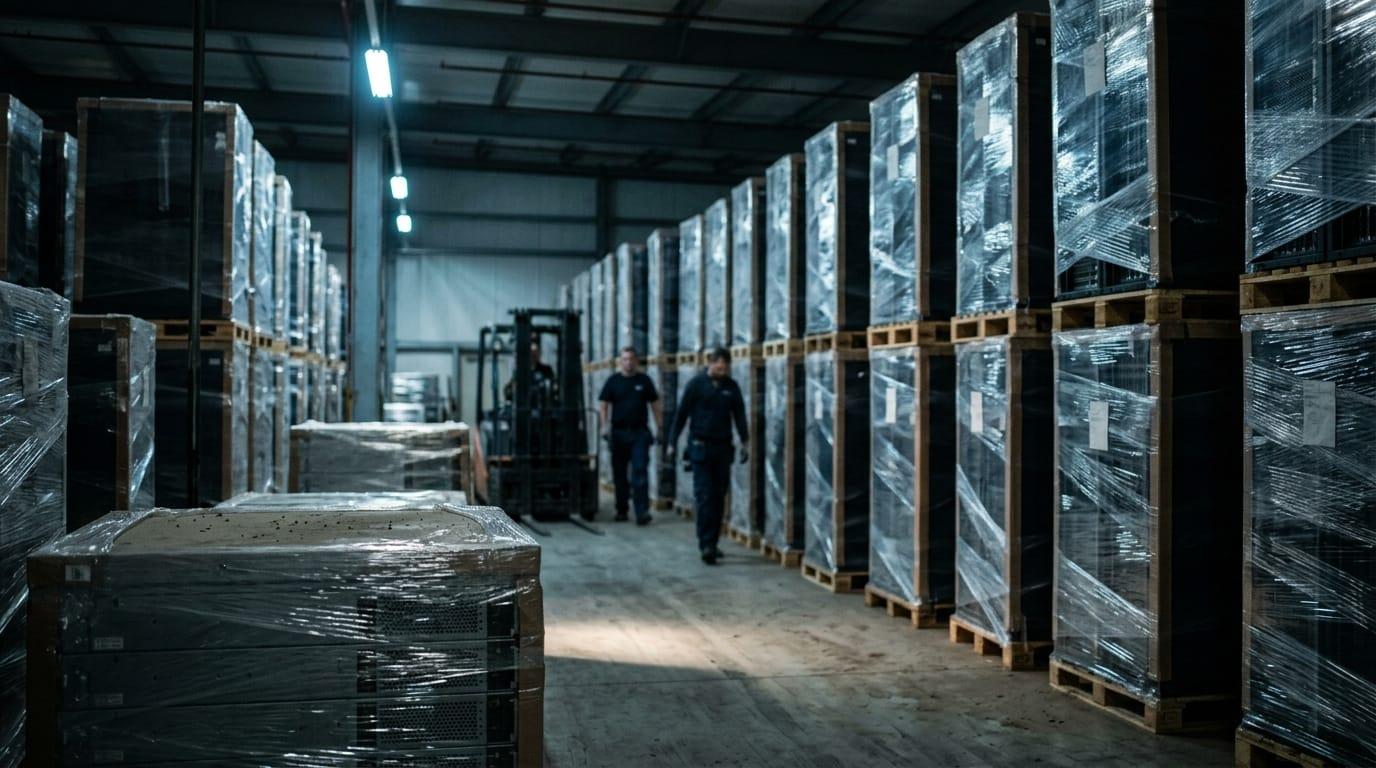
Washington cleared the export. Beijing hasn't cleared the import. The hardware sits.
Key takeaways
- About 600,000 Nvidia H200 AI chips are warehoused in Hong Kong, more than three times Beijing's reported approval ceiling of under 200,000 units, first reported by Reuters.
- Nvidia already booked a $400 million write-down for H200 excess inventory and purchase obligations in the first half of fiscal year 2027; actual licensed shipments to China were less than 1% of Data Center revenue last quarter.
- The idle stockpile puts a concrete number on a stress fracture in the AI capex supercycle: when two governments veto the same trade from opposite ends, the CapEx doesn't unwind cleanly, it stalls in a warehouse.
About 600,000 Nvidia H200 AI chips are sitting in Hong Kong storage, cleared for export by Washington but blocked from large-scale entry into mainland China because Beijing has not issued the required import approvals, first reported by Reuters on November 5, 2026, citing people familiar with the matter. The number matters: per The Information's July 2026 reporting, Beijing's total H200 approval ceiling could come in under 200,000 units, meaning the Hong Kong backlog is more than three times that figure.
Nvidia's own filings confirm the financial damage is already on the books. The company recorded a $0.4 billion charge for H200 excess inventory and purchase obligations in the first half of fiscal year 2027, per its Form 10-Q filed with the SEC for the quarter ended July 26, 2026. That same filing shows H200 licensing-program shipments to China were less than 1% of Nvidia's Data Center revenue in Q2 FY2027, a quarter in which total revenue hit $96.2 billion and the Data Center segment alone generated $89.0 billion.
Two Governments, One Broken Trade Route
The Trump administration reversed the Biden-era H200 export ban, with BIS formalizing a new licensing policy on January 13, 2026, and the 25% export tariff taking effect January 14, 2026. That opened the door on the American side. Beijing never opened its side at comparable scale.
Per Reuters sources, several large Chinese internet companies each received limited batches of roughly 10,000 H200 units through approved channels, with small additional volumes arriving through intermediaries. That trickle is what makes the 600,000-unit stockpile so striking: the demand is real, the export license exists, and the hardware is physically in transit territory. The bottleneck is a government decision that hasn't come.
The secondary market is pricing in the scarcity. Per one person familiar with the matter cited by Reuters, an eight-card H200 server was quoted in mainland China at more than 6 million yuan (roughly $900,000) by late October 2026, approximately three times its price a year prior, though that figure comes from a single source and should not be read as a confirmed market-wide price.
This isn't the first time Nvidia has eaten a write-down at the China border. The company disclosed a $4.5 billion charge tied to its H20 chip in Q1 FY2026 after the Biden administration restricted that product, per Nvidia's Q1 FY2026 earnings release. The H200 charge is smaller in absolute terms but follows the same pattern: a chip designed to thread an export-control needle, caught between two governments with competing interests.
The ghost companies and blacklist loopholes TFTC has covered previously show the pressure that builds when legitimate channels close. Capital finds a way; it's just messier and more legally exposed.
What This Means for the AI Capex Thesis
The AI buildout's energy and compute land-grab was justified by a demand story: insatiable, growing, essentially unbounded appetite for inference and training compute. That story now has a physical counterargument sitting in a Hong Kong warehouse.
The capital behind those 600,000 chips, and behind the data centers, power purchase agreements, and grid interconnections that were supposed to serve them, was deployed against a demand model that two sovereigns are actively undermining from opposite ends. Nvidia's own Q3 FY2027 guidance assumes zero Data Center compute revenue from China. That is the company telling investors not to model a resolution in the near term.
For anyone watching the AI capex cycle closely, the Hong Kong backlog is a leading indicator, not a lagging one. The energy and compute scarcity argument that justified AI's aggressive power acquisition weakens every day those chips sit idle. Bitcoin miners, who operate as flexible, dispatchable load and don't require a foreign government's import approval to run, look relatively more rational as a marginal consumer of grid capacity when AI CapEx evaporates at a border.
What to Watch
Nvidia's Q3 FY2027 guidance revision or any announcement from China's Ministry of Commerce on H200 import approvals would be the key signal. If Beijing clears a material portion of the backlog in the next 90 days, the demand thesis partially recovers. If the stockpile grows or stays static, the $400 million write-down is a floor, not a ceiling, and the broader AI capex story gets harder to defend at current multiples.
Sources
- Nvidia Form 10-Q, quarter ended July 26, 2026 (SEC EDGAR)
- First reported by Reuters, November 5, 2026: "Exclusive: Nvidia chips pile up in Hong Kong as China withholds import approval"
- The Information, July 2026: reported Beijing's H200 approval ceiling could be fewer than 200,000 units
Frequently Asked Questions
Why won't Beijing approve the H200 chips if Chinese tech companies clearly want them?
Beijing's hesitation is about strategic dependency, not price or specs. Approving large-scale imports of American AI silicon at the frontier would deepen China's reliance on US technology at the exact moment Beijing is trying to build domestic alternatives through companies like Huawei and Cambricon. Import restraint is industrial policy: slow the American chip's market penetration, give domestic champions time to close the gap.
What's the difference between the H200 and the H20, and why does the H20 write-down matter here?
The H20 was a downgraded chip Nvidia engineered specifically to clear Biden-era export controls for the Chinese market. It still got restricted in early 2026, triggering the $4.5 billion charge.
The H200 is a more capable chip that the Trump administration later approved for licensed export under a new framework. The pattern is the same: Nvidia engineers around one set of restrictions, regulators move the line, and the inventory charge follows. The H200 write-down is smaller so far, but the mechanism is identical.
If AI chip demand is stalling at borders, what does that mean for the power grid competition between AI data centers and Bitcoin miners?
The AI buildout's claim on grid capacity was premised on demand that scales smoothly and indefinitely. A 600,000-chip backlog with no import approval in sight is a direct challenge to that premise. Bitcoin mining load is flexible, location-agnostic relative to end users, and doesn't require a sovereign import decision to operate. When AI CapEx hits a geopolitical wall, the marginal-economics case for mining as a grid partner strengthens.