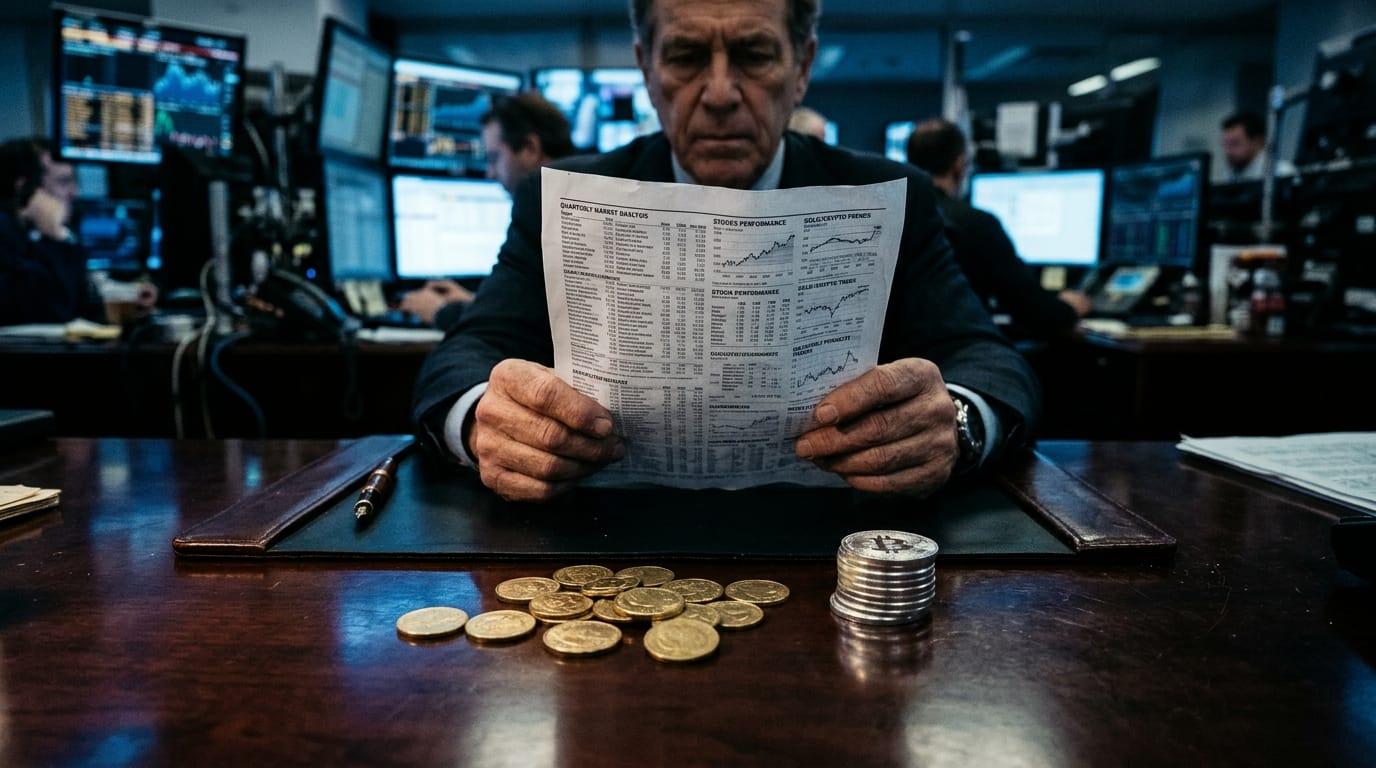
Fed's Waller Claims the Trust Layer for Tokenized Markets
Fed Governor Christopher Waller publicly filed the Fed's claim to be the indispensable settlement backbone of the tokenized economy before the architecture is set. No implementation timetable, but the pitch is clear.
Federal Reserve Governor Christopher Waller argued that central bank payment rails must sit at the foundation of all emerging tokenized asset markets, with no timetable set for implementation.
Key takeaways
- Fed Governor Christopher Waller told The Clearing House Annual Conference on November 17 that central bank payment rails should form the foundational settlement layer for tokenized asset markets, with no implementation timetable announced.
- Waller explicitly linked agentic AI to tokenization, framing the Fed as the natural "connector and convener" for both technologies as they converge.
- The speech sets up a direct conflict with permissionless settlement architectures: central bank money as a legal or practical requirement at the base layer embeds the same chokepoints Bitcoin was built to bypass.
Federal Reserve Governor Christopher Waller delivered a speech titled "Considerations at the Intersection of Payments and Tokenized Markets" at The Clearing House Annual Conference in New York on November 17, arguing that traditional Fed payment rails should serve as the settlement backbone for tokenized asset markets. The speech is a claim staked before the architecture of the tokenized economy is decided.
The core assertion: "Central bank money need not be used in every transaction or on every platform, but its presence at the foundation of the system is essential."
What Waller Actually Proposed
Waller's argument rests on a trust framing. Traditional Fed rails, he said, have "proven resilient through market events" and provide "access to the safest forms of dollars through linkages to central bank money," making them "a reliable backbone for final funds settlement on which innovative services, including tokenized markets, can develop."
He did not call for a central bank digital currency. The proposal is narrower and more durable: existing Fed infrastructure (large-value payment systems, instant payment rails) as the mandatory foundation layer for private tokenized instruments, stablecoins, and AI-agent payment flows alike.
On the AI angle, Waller was direct: "While agentic commerce is still in the early stages, tokenization and AI could be catalysts for one another." Where coordination problems exceed what market forces alone can solve, he said, "the Fed can act as a connector and convener." A prior Waller speech from September 29, 2026 laid groundwork on AI agents in payments. That speech announced no concrete implementation steps and set no timetable.
The Architecture Fight Underneath the Technocratic Language
The word "trust" does the heaviest lifting in this speech, and that is exactly where Bitcoiners should focus.
Waller's thesis is that the Fed is the trust provider for the financial system, and that this role should extend naturally into tokenized markets. Bitcoin's entire value proposition is the opposite: trustless settlement, final and permissionless, without a trusted third party in the stack. If the mainstream definition of "trust in tokenized markets" gets captured by central bank framing, the narrative battle for permissionless money gets harder.
The agentic AI vector compounds this. An AI agent operating inside a Fed-railed tokenized system is an agent whose every transaction is logged, monitorable, and reversible by the institution that "convenes" the system. That is the antithesis of what builders are working toward on permissionless rails. Fellow Governor Michael Barr separately warned in prepared remarks at an AI finance conference in Milan on November 16 that AI agents could trigger high-speed bank runs by autonomously moving customer deposits at machine speed, reinforcing why the Fed views agentic commerce as something requiring institutional guardrails rather than open infrastructure.
The window matters. Once tokenized securities, stablecoins, and AI-agent payment flows are engineered around Fed rails as the settlement layer, retrofitting a permissionless alternative becomes a regulatory and network-effects problem simultaneously. The Fed is trying to get itself baked into the stack at the protocol level.
The falsifiable thesis: If tokenized asset markets achieve broad adoption and final settlement without routing through Fed infrastructure or requiring central bank money as a foundation layer, Waller's thesis collapses. Bitcoin and permissionless settlement networks scaling to institutional volumes would be the empirical falsification.
The trigger to watch: Stablecoin legislation currently moving through Congress. If that legislation mandates Fed settlement rails as a legal requirement for dollar-denominated stablecoins, Waller's voluntary pitch becomes a statutory lock-in. If the legislation leaves settlement architecture open, the permissionless alternative stays viable.
What Comes Next
Waller closed with a commitment to "regularly engaging with and listening to industry, providing core payment and settlement infrastructure on which all market participants can build, and monitoring risks to financial stability." That language is intentionally broad. The Fed has planted a flag; the legislative and market battles over whether that flag becomes the foundation or just one option among many are still ahead.
Sources
- Federal Reserve Board, "Considerations at the Intersection of Payments and Tokenized Markets," Governor Christopher J. Waller, November 17, 2026
- Federal Reserve Board, "Payments in the Age of AI Agents," Governor Christopher J. Waller, September 29, 2026
Frequently Asked Questions
What is the difference between a tokenized asset and Bitcoin?
A tokenized asset is a digital representation of an existing instrument (a stock, bond, or dollar) on a ledger, typically issued and controlled by a private or government entity. Bitcoin is a bearer asset with no issuer, final settlement enforced by a decentralized network, and no counterparty at the base layer. Waller's speech addresses the former. His framework has no jurisdiction over the latter.
Does Waller's speech mean a U.S. CBDC is coming?
No, at least not directly. Waller is not proposing a retail CBDC. He is arguing that existing Fed wholesale payment rails should serve as the settlement backbone for private tokenized instruments. That is a distinct but adjacent threat vector: rather than the Fed issuing a consumer-facing digital dollar, it embeds itself as the indispensable settlement layer underneath private-sector tokenization, achieving similar surveillance and control properties without the political liability of a named CBDC.
What is agentic AI and why does it matter for payments?
Agentic AI refers to autonomous software systems that can initiate and complete actions, including financial transactions, on behalf of a user without human approval at each step. As these agents proliferate, they will need payment infrastructure. Whether that infrastructure is permissionless (Bitcoin, Lightning, ecash) or routed through Fed-supervised rails is an open question. Waller is explicitly arguing the Fed should be the trust layer for this emerging payment category before the defaults are set.