NATO Shoots Down Explosive Drone Over Lithuania in First-Ever Intercept
Italian NATO Eurofighters destroyed an explosive-laden drone over Lithuanian territory on September 15, 2026, the first such shootdown in the country's history, after the drone entered from Belarus and flew for 30 minutes through populated airspace.
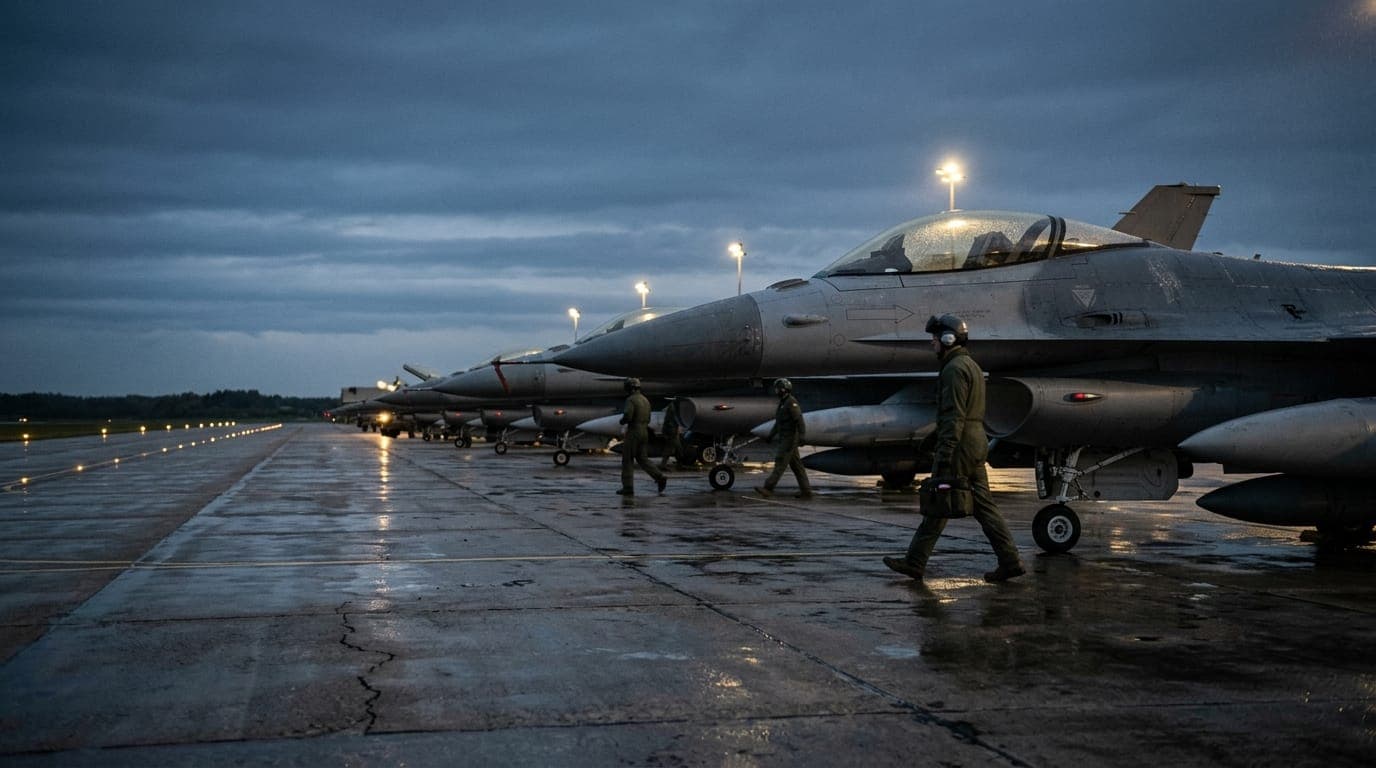
Italian Eurofighters destroyed a drone carrying an explosive device over Lithuanian territory on September 15, the first shootdown ever recorded over Lithuanian soil.
Key takeaways
- Two Italian Air Force Eurofighter Typhoons, operating under NATO's Baltic Air Policing mission, destroyed a drone carrying an explosive device over Lithuania's Kaišiadorys District on September 15, 2026, the first drone ever shot down over Lithuanian territory.
- The drone entered from Belarus, traversed populated areas near Lentvaris and Trakai, and spent roughly 30 minutes in Lithuanian airspace before being intercepted; origin and operator remain under active investigation.
- Baltic airspace violations have become increasingly frequent, drone incursions struck Lithuanian, Latvian, and Estonian airspace in March 2026, NATO shot down a Ukrainian drone over Estonia in May 2026, and now Lithuania in September, and NATO members are responding with live intercepts, a doctrine of automatic escalation that puts one crewed-aircraft incident between Europe and a potential Article 5 trigger.
Italian NATO Eurofighters destroyed a drone carrying an explosive device over Lithuania on the morning of September 15, 2026, in what Lithuanian and NATO officials confirmed is the first drone ever shot down over Lithuanian territory. The intercept marks a threshold: kinetic responses to airspace violations are no longer exceptions in eastern Europe. They are policy.
Lithuanian President Gitanas Nausėda announced the shootdown on X:
"A drone that just entered Lithuanian airspace was destroyed by NATO fighter jets. I thank Allied personnel for their swift response. With Russia intensifying its aggression against Ukraine, such readiness is vital for our region. Together with our NATO Allies, Lithuania will defend its airspace."
A NATO official confirmed the operational details to Fox News Digital: "Last night, two Italian Eurofighters deployed on NATO Air Defence mission at Siauliai, scrambled and shot down a drone over Lithuanian airspace. The operation was coordinated through NATO's Combined Air Operations Centre in Uedem, Germany. Investigations are ongoing together with national authorities." No named NATO spokesperson was identified; no standalone NATO.int press release has been confirmed at time of publication.
What Happened Over Kaišiadorys
The drone entered Lithuanian airspace from Belarus, a country that hosts Russian military assets and coordinates logistics with Moscow, and flew west through the Lentvaris and Trakai areas for approximately 30 minutes before being intercepted near Pratkūnai village, Kaišiadorys District, roughly 60 miles (90 km) northwest of Vilnius. A yellow-level air threat alert was declared before the intercept.
Lithuanian Defense Minister Robertas Kaunas confirmed an explosive device was detected and neutralized at the debris site. Bomb-disposal units worked the scene under "Operation Skydas." Lithuanian Air Force Commander Antanas Matutis confirmed wreckage was recovered. The drone's origin and operator remain officially unconfirmed; investigators are examining debris. Belarus is the preliminary entry point per Lithuanian crisis center data, but no country or group has been formally named.
The same day, a Russian frigate fired flares at a Danish military helicopter over the Baltic Sea, and Poland launched preventive aviation operations in adjacent airspace, per Euronews.
The Ratchet Nobody Is Pricing
This is not an isolated incident. A NATO jet downed a Ukrainian drone over Estonia in May 2026. Ukrainian drones entered Lithuanian, Latvian, and Estonian airspace in March 2026. Each response has been framed by alliance officials as proof "the system works", but that framing obscures what the pattern actually encodes.
NATO eastern members are now treating every airspace violation, deliberate or accidental, as a test of alliance resolve requiring a kinetic answer. Lithuanian Foreign Minister Kęstutis Budrys credited Tuesday's intercept to the strength of collective defense, per Euronews. That doctrine has a dangerous mechanical property: it removes discretion from the response loop. The alliance is one intercepted crewed aircraft away from a scenario where Article 5 consideration becomes unavoidable.
Article 5 is not automatic on a drone incursion. The North Atlantic Council must determine an "armed attack" has occurred. But the gap between drone intercepts and crewed-aircraft incidents is narrowing with each escalation cycle, and the probability function is not static.
The monetary read follows a specific sequence. A direct Russia-NATO kinetic exchange forces emergency Fed and ECB policy pivots, the kind that suspend rate normalization and restart liquidity. European energy and logistics corridor security deteriorates, feeding directly into inflation dynamics already under pressure. Defense spending mandates at 2%-plus of GDP and rising crowd out fiscal space faster, accelerating the sovereign debt spiral that NATO member balance sheets are already navigating. The Dutch central bank's gold repatriation on geopolitical risk grounds was a signal in this direction.
Bitcoin's market cap and global sovereign debt figures cited in this context are editorial framing estimates, not sourced statistics, the point being that the insurance premium on a monetary asset with zero sovereign counterparty remains historically cheap relative to the tail risk accumulating in real time over Baltic airspace.
The thesis is falsifiable. A verified, durable ceasefire between Russia and Ukraine, one that includes a verifiable NATO-Russia airspace buffer mechanism, and a sustained period of zero incursion events would materially undercut it. Absent that, each additional shootdown incrementally tightens the spring. If Bitcoin fails to rally during a genuine major escalation event (a downed crewed aircraft, say), the hard-asset insurance argument takes a real hit.
What to Watch
Investigators will need to formally attribute the drone's origin and operator before the diplomatic stakes become clear. Watch for an official NATO press release from nato.int and a statement from the Lithuanian Ministry of Defense at kam.lt. The frequency of Baltic airspace incidents over the next 30 days will tell you whether the pace is accelerating or plateauing. The UAV incident data from Iranian drone strikes reshaping infrastructure planning in the Gulf is a parallel worth tracking: drone warfare is restructuring risk calculations globally, not just in eastern Europe.
Sources
Frequently Asked Questions
Not the first ever, but the first over Lithuanian territory specifically. A NATO jet downed a Ukrainian drone over Estonia in May 2026, which was reported as the first such intercept since Russia's 2022 invasion. September 15's Lithuania shootdown extends that precedent to a second Baltic member state.
Not automatically. Article 5 requires the North Atlantic Council to determine an "armed attack" has occurred. NATO members have so far treated drone incidents as violations requiring interception rather than armed attacks activating collective defense. The risk is miscalculation, particularly if a crewed aircraft is involved, where that determination becomes far harder to avoid.
The geopolitical stability that underpins fiat currency reserve status and Fed/ECB monetary policy autonomy depends on no direct Russia-NATO military exchange. The accelerating pace of airspace intercepts raises the probability of a misstep that forces emergency monetary policy pivots and capital flight into hard assets. Gold moved on the 2022 invasion. Bitcoin, as the only monetary asset with zero sovereign counterparty, sits in the most asymmetric position relative to a tail risk markets have not yet priced.