Google's Finnish Subsidiary Faces Criminal Probe Over 815-Acre AI Site Deforestation
Finland's Oulu Police Department opened a criminal investigation into Google subsidiary Tuike Finland Oy on October 29 for clearing roughly 815 acres of forest near Muhos before completing required environmental impact assessments, a case that exposes a structural flaw in AI hyperscale capex.
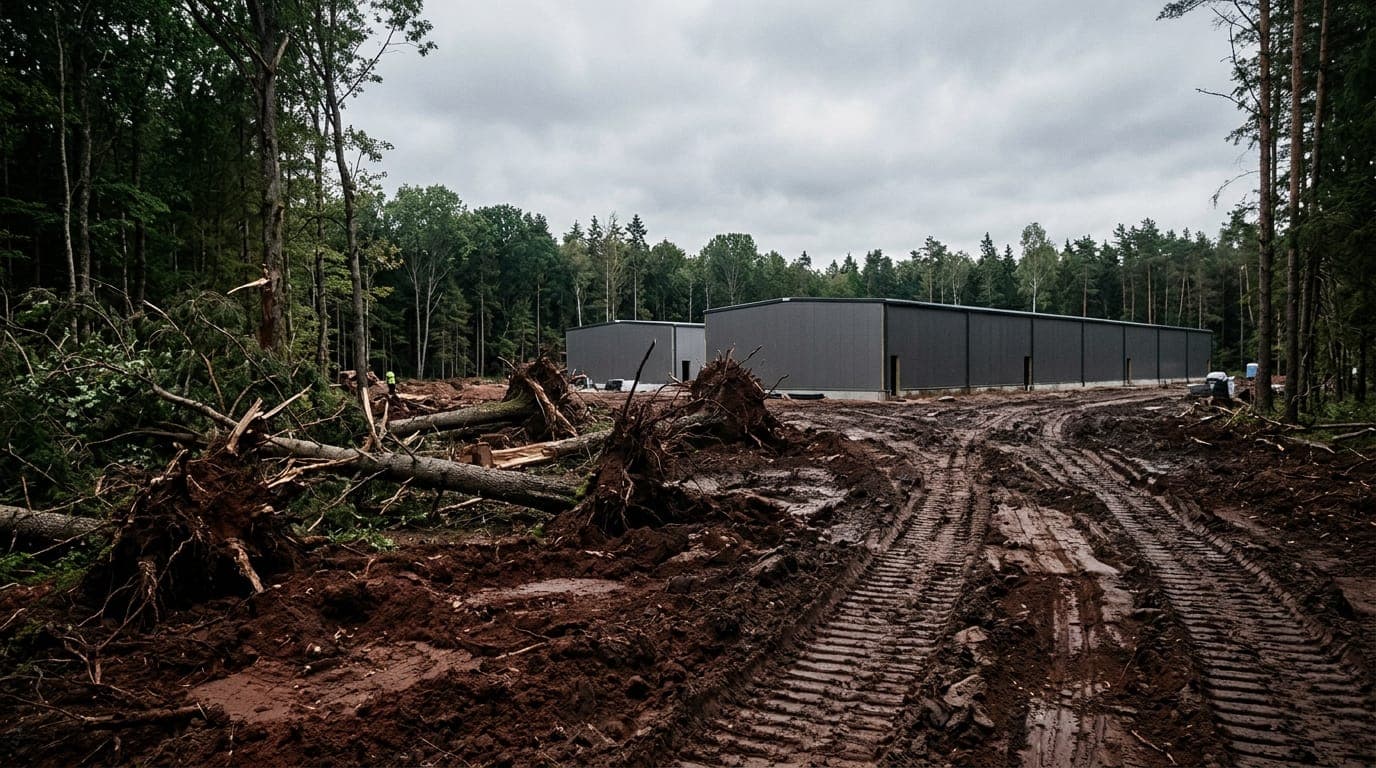
Finland's Oulu Police have opened a criminal investigation into Google for clearing hundreds of acres of forest before completing required environmental reviews at its Muhos AI data center site.
Key takeaways
- Finland's Oulu Police Department launched a criminal investigation on October 29 into Google subsidiary Tuike Finland Oy for suspected environmental law violations at its Muhos data center construction site.
- Tuike cleared roughly 330 hectares (~815 acres) near Muhos and ~200 hectares (~495 acres) near Kajaani before environmental impact assessments were completed; the probe is classified as "environmental degradation" and is expected to run into 2027.
- The case arrives as Google is mid-way through a $15 billion AI infrastructure push in Finland, which it described as its largest investment in Europe, and illustrates how AI hyperscalers are treating regulatory compliance as an afterthought when the buildout clock is running.
Finland's Oulu Police Department opened a criminal investigation on October 29 into Tuike Finland Oy, Google's Finnish subsidiary, for suspected violations of environmental law at an AI data center construction site in Muhos, northern Finland. The probe, first reported by Reuters, was triggered by five separate investigation requests, including one from Finland's Supervisory Agency (LVV).
"We are investigating whether the company's operations have breached the water act and resulted in environmental damage," Detective Superintendent Kari Pakanen of the Oulu Police Department told Reuters.
What the Police Found
Tuike cleared approximately 330 hectares (~815 acres) of forest near Muhos and a further ~200 hectares (~495 acres) near Kajaani before the required environmental impact assessments were completed. LVV ordered work halted at both sites on October 6, following its own review.
The investigation is classified as "environmental degradation." Pakanen did not rule out additional criminal classifications and declined to confirm whether individuals could be personally targeted. A guilty finding could result in a corporate fine against Tuike. The police expect the investigation to conclude in 2027, with an interim update due in December 2026.
Google responded with a cooperative posture. A company spokesperson stated: "We've partnered closely with the government and communities in Finland on infrastructure for more than a decade, and are actively responding to enquiries from LVV and other authorities. We will cooperate with the investigation announced by the Oulu police on October 29 and will continue to focus on maintaining compliance at our sites."
The Structural Problem AI Capex Is Exposing
The economics of AI infrastructure create a structural incentive to externalize costs and move fast, with the implicit bet that fines, if they arrive at all, will be rounding errors against the capex deployed.
Google committed $15 billion to Finnish AI infrastructure in September 2026, describing it as its largest investment in Europe. That capex clock creates enormous pressure to break ground and secure capacity ahead of competitors. The result, apparently, was clearing 815 acres in Muhos before anyone signed off on the environmental review. The LVV's October 6 stop-work order was the first brake; a criminal probe is the second.
The falsifiable version of that thesis: if it emerges that Google completed all required environmental impact assessments in good faith before clearing began, and the damage resulted from a genuine ambiguity in Finnish permitting law rather than a deliberate speed-over-compliance decision, the structural argument collapses. Until then, the evidence pattern points the other way.
Finland is also likely a template. Ireland, the Netherlands, and Sweden are all mid-process on major hyperscale AI permitting. Finnish regulators have now demonstrated they will escalate to criminal charges. That changes the calculus for host governments across Europe on how hard to push back when a hyperscaler moves faster than its permits allow.
The AI capex buildout's structural fragility was already visible in contract disputes and force majeure claims; regulatory blowback is now a compounding risk factor that Wall Street's AI capex models don't price in.
The contrast with Bitcoin mining is worth stating plainly. Bitcoin miners pay directly for every joule they consume, which means operational efficiency is financially self-enforcing. The environmental and energy footprint is transparent and market-priced.
AI hyperscalers, backed by equity markets, government subsidies, and political goodwill, have a different incentive structure: grow now, absorb the externalities later. The Muhos probe is "later" arriving ahead of schedule.
What to Watch
The December 2026 police update will indicate whether additional criminal classifications are added and whether individual executives move into scope. Watch also for LVV decisions on Kajaani: if the second site faces its own criminal referral, the pattern widens from a single incident to a systemic compliance failure across Google's Finnish footprint.
Sources
- Reuters via Yahoo News, Finland launches criminal probe, October 29, 2026
- Oulu Police Department (Poliisi), poliisi.fi, specific October 29 press release URL not confirmed; readers can locate it at poliisi.fi
- Data Center Dynamics, Google statement and investigation detail
Frequently Asked Questions
What is Tuike Finland Oy and how does it relate to Google?
Tuike Finland Oy is Google's Finnish operating subsidiary, the legal entity through which Google holds and develops its data center assets in Finland. Using a local subsidiary is standard practice for multinational infrastructure investment; it also means the criminal investigation is formally directed at the Finnish corporate entity rather than at Google LLC or Alphabet Inc. directly, though the reputational and financial exposure flows up to the parent.
Can Google executives face personal criminal liability?
Detective Superintendent Pakanen explicitly declined to confirm whether individuals could be targeted by the investigation. The probe is currently directed at Tuike Finland Oy as a corporate entity. Finnish criminal law does allow for personal liability in environmental offenses under certain conditions, so the question remains open until the investigation progresses further.
What penalties could result from a guilty finding?
Pakanen indicated a corporate fine is a possible outcome. Under Finnish law, corporate fines for environmental offenses are set by the court within a fixed statutory range; Finnish law also allows for imprisonment of responsible natural persons in environmental offense cases, with the severity depending on the classification of the offense. The specific outcome will depend on what additional criminal classifications, if any, are added as the investigation proceeds toward its expected 2027 conclusion.