Microsoft Demanded to Halt NJ AI Data Center Running 45 Unpermitted Gas Generators
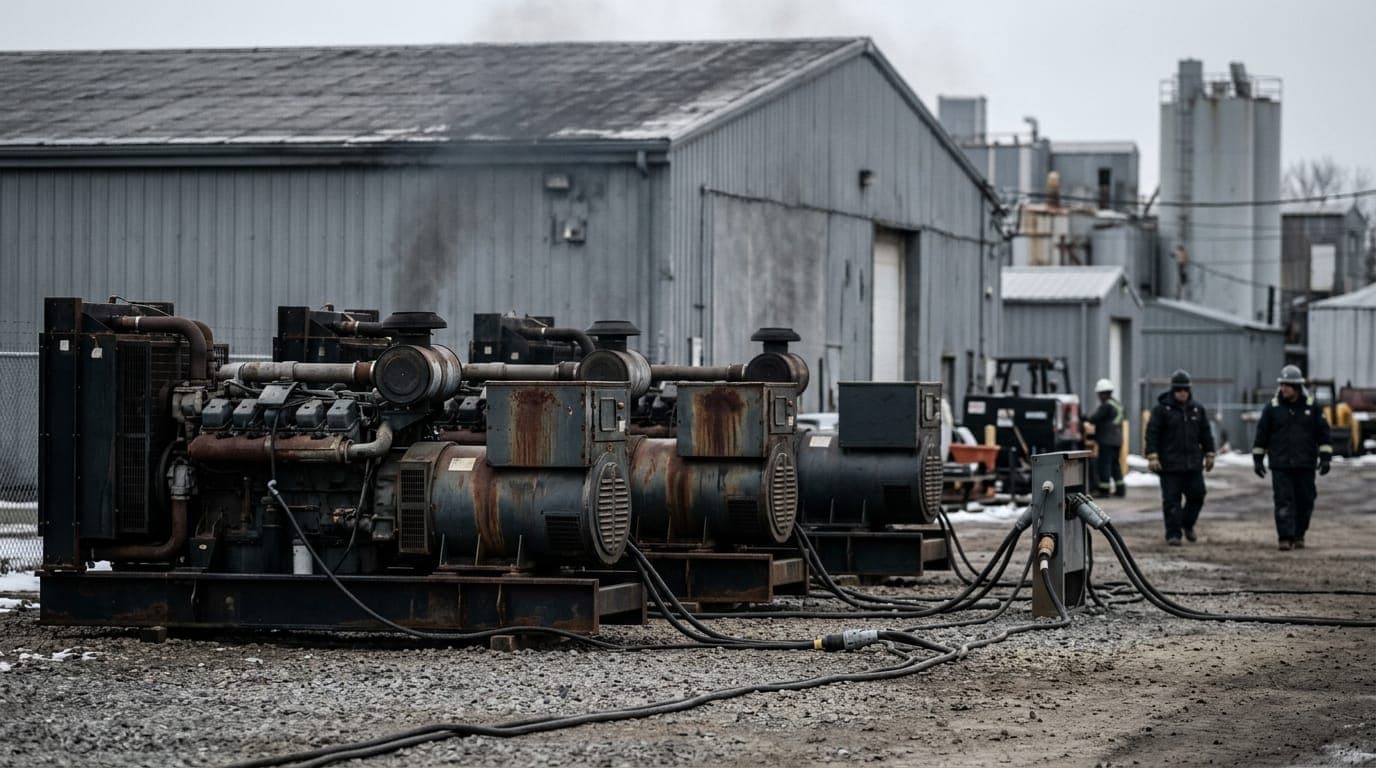
Environmental groups demand Microsoft cease operations at a 300 MW Vineland, NJ AI data center after a Floodlight thermal drone investigation documented at least 45 of 62 gas generators running without air permits, a situation the NJDEP confirmed and has not enforced against.
Stand.earth and allied community groups say the $17.4B Nebius compute deal is no excuse for running illegal, polluting generators in an overburdened South Jersey community.
Key takeaways
- A Floodlight thermal drone investigation found at least 45 of 62 gas generators operating without air permits at the DataOne facility in Vineland, NJ, a situation the New Jersey Department of Environmental Protection confirmed and has not yet enforced against.
- The facility, approved at approximately 300 MW in its first phase, is being built by DataOne for Nebius Group under a $17.4 billion Microsoft compute deal (Nebius SEC 6-K, September 8, 2025); the city of Vineland issued two separate stop-construction orders in August for additional unpermitted energy infrastructure.
- The pattern mirrors xAI's unpermitted gas turbines in Mississippi, pointing to a systemic dynamic where AI hyperscalers bypass permitting because the financial stakes of a major cloud contract dwarf any regulatory fine they are likely to face.
Stand.earth and allied community groups are demanding Microsoft cease operations at the DataOne AI data center on South Lincoln Avenue in Vineland, New Jersey, after a Floodlight thermal drone investigation documented at least 45 of 62 gas-powered generators running at the site with no air permits. The New Jersey Department of Environmental Protection confirmed it has issued no permits, and no permit applications are under review for power generators at the facility.
The site is the largest planned AI data center in New Jersey, approximately 300 MW in its approved first phase, built by DataOne for Nebius Group (NASDAQ: NBIS) under a $17.4 billion deal that gives Microsoft the facility's compute capacity (Nebius SEC 6-K, September 8, 2025).
What the Drones Found
Floodlight's mid-August 2026 thermal drone footage showed at least 45 of 62 generators operating at the site. Earlier footage from late June reportedly showed generators already operating at the site. The NJDEP noticed the generators during a site inspection on July 29 and told Floodlight it had not yet made "a full compliance determination." The EPA, for its part, told Floodlight that New Jersey's regulators are responsible for air permitting over DataOne, a jurisdictional pass that left enforcement in the hands of an agency still working toward a determination weeks after its own inspection.
The city of Vineland has moved faster than the state. It issued a stop-construction order on August 6 for an LNG tank installation with no prior approvals, and a second on August 10 for Bloom Energy fuel cell units, also unpermitted, as first reported by Hunterbrook Media (note: Hunterbrook Capital discloses it is short $BE). Vineland's city council had earlier tabled a $6.2 million loan it had planned to issue to DataOne (Cape May County Herald, January 2026). DA Davidson cut its Nebius price target 30%, to $175 from $250, citing Vineland construction delays that threaten 2026 guidance.
The community around the site has been vocal. Andrew Groetsch, a neighbor living less than a mile away, described the noise as "just constant. It never goes away." Zac Landicini, founder of the grassroots group Sustain SJ and a resident roughly three miles from the data center, put the dynamic plainly: "For these corporations that have all this money, they can eat the fines and basically do whatever they want."
DataOne said it "remains committed to meeting all applicable environmental and permitting requirements" and did not respond to questions about the unpermitted generators. Nebius did not respond to requests for comment. Microsoft declined to comment.
The Permitting Layer That Only Applies to Some
This is not a one-off compliance slip. xAI ran unpermitted gas turbines in Southaven, Mississippi to power its Colossus 2 data center. The EPA ruled those generators were used illegally; the NAACP sued. The Vineland situation is the same playbook: get the generators spinning to meet contractual compute commitments, sort out the permits later, and count on regulatory timelines being slower than revenue.
New Jersey's 2020 environmental justice law is one of the strongest in the country. Vineland qualifies under its criteria, with households meeting the law's low-income and minority resident thresholds. Under that statute, permits for new facilities in overburdened communities can be denied outright. That law was on the books when DataOne broke ground. The NJDEP confirmed no application has been filed.
The phantom load problem plaguing AI data center grid requests nationwide is well documented. What is less discussed is the parallel permitting problem: data centers securing power commitments before infrastructure approvals exist, then operating in the gap. Grid operators like PJM have already moved to curtail AI data centers first during shortages precisely because the sector has expanded faster than any oversight structure can track. The Vineland case illustrates what happens at the local level when that same logic plays out with air permits instead of megawatt allocations.
The contrast with Bitcoin mining is direct. Miners operate in public. Their energy consumption is priced by the market, visible to grid operators, subject to interconnect queues, noise ordinances, and public zoning hearings from day one. The "environmental" argument against Bitcoin mining was never cleanly about the environment. It was about controlling the permission layer for energy use. When the politically connected skip that layer entirely, the enforcement apparatus finds reasons to wait.
What to Watch
The NJDEP's "full compliance determination" is the immediate trigger. If the agency levies fines meaningful relative to project economics, rather than a rounding error against a $17.4 billion contract, and requires the generators to cease before permits are issued, this is a functioning enforcement story. If the determination arrives after the facility is operational and the fine is manageable, Landicini's read is confirmed: they can eat it. The planning board hearing on DataOne's proposed expansion, including Bloom Energy fuel cells and an LNG tank, was continued to August 17 with no approval as of the last confirmed date.
Update, August 29, 2026
While the generator enforcement standoff continues, Vineland's planning board has since approved DataOne's second-phase site plan, which covers the very infrastructure at the center of two prior stop-construction orders. The city approved a site plan that paves the way for the 300 MW facility to generate its own energy using fuel cells and to store liquefied natural gas on site. That includes a 1.5-million-gallon LNG storage tank as backup in the event pipeline access is interrupted, with the facility to be powered by Bloom Energy fuel cells that convert natural gas into electricity through an electrochemical process.
The planning board approval covers the Bloom Energy and LNG infrastructure Vineland had previously halted with stop-construction orders in August. It does not resolve the air permitting situation for the 62 temporary gas generators, which remain the subject of an open NJDEP compliance review. The sequence, build first, get stopped, then win planning approval for the underlying infrastructure, fits the same pattern as the unpermitted generator story: DataOne moves fast, regulators respond slowly, and the approvals eventually catch up to work already underway.
Construction on the data center had already begun before Nebius signed its multi-year agreement to deliver dedicated capacity to Microsoft, with DataOne's own CEO acknowledging at a January 2026 town hall that community outreach should have started months earlier. The planning board's green light on phase two does nothing to change the fact that 62 generators are still running without air permits a mile from two schools, and the NJDEP still has not made a final compliance determination.
Sources
- Floodlight investigative reporting on DataOne Vineland
- Stand.earth
- Hunterbrook Media stop-work order reporting (Hunterbrook Capital discloses it is short $BE)
- Nebius Group SEC 6-K filing, September 8, 2025
Frequently Asked Questions
Who is responsible for permitting the generators at the DataOne Vineland facility, the EPA or New Jersey?
Air permitting for the DataOne facility falls under New Jersey's jurisdiction, not the EPA's. The EPA confirmed this to Floodlight. The NJDEP is the relevant agency and has acknowledged the generators exist, having observed them during a July 29 site inspection, but has not issued a compliance determination as of the time of reporting.
What happens to Microsoft's compute commitments if DataOne is forced to shut down the unpermitted generators?
The $17.4 billion deal gives Microsoft capacity from the Vineland facility (Nebius SEC 6-K, September 8, 2025). If the NJDEP orders the generators offline before grid power or permitted on-site generation is operational, DataOne cannot deliver that capacity on schedule, which is already reflected in DA Davidson's 30% price target cut on Nebius citing construction delays threatening 2026 guidance.
Can New Jersey's environmental justice law be used to block or revoke permits for the DataOne facility outright?
Yes. New Jersey's 2020 environmental justice law allows the NJDEP to deny permits for new or expanded facilities in overburdened communities when cumulative environmental impacts are found to be significant. Vineland qualifies under the law's criteria. Because no air permit applications have been filed, DataOne has not yet gone through that review. The law gives the agency authority to deny outright, not just condition approval.