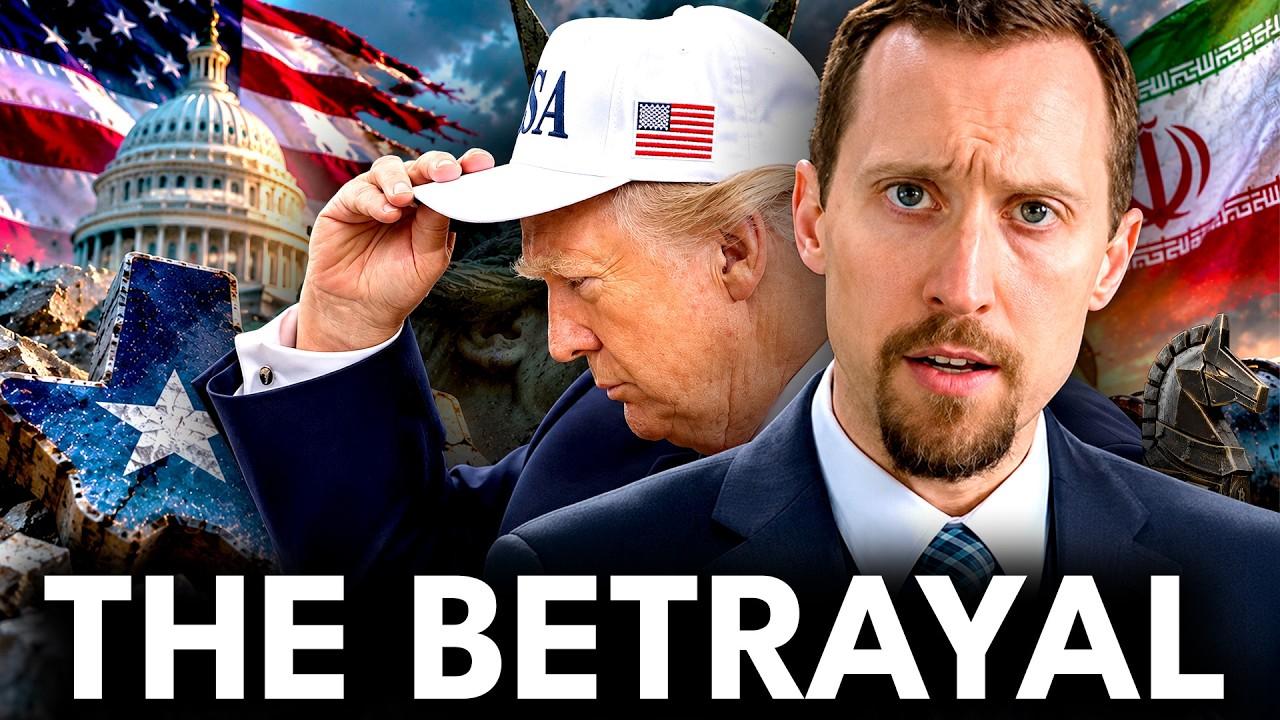
Mark Mitchell: The USS Trump-Tanic Is Sinking
Pollster Mark Mitchell called D+13 months before the midterms. So did Trump's own pollster. Nobody pivoted. Independents swung 20 points left, DOGE got traded for a pork bill, and the USS Trump-tanic is going down.

↓ Jump to the video and timestamps
Mark Mitchell called this months ago. So did Tony Fabrizio, Trump's own pollster, who reportedly had Democrats up 13 points before election day. The White House knew. They didn't pivot.
And now we're staring at what Mitchell called the USS Trump-tanic, his phrase, and I ran with it the second he said it, because it's exactly right.
I came into this conversation already disgusted. The Trump coin launching the night before the inauguration. DOGE uncovering the golden platter of waste, fraud, and abuse and then getting traded away for a pork bill two months in. Susie Wiles running the White House not to execute the mandate voters gave Trump, but to manage him on behalf of the interests that funded the operation.
And now the electoral invoice has arrived, the kind of historic shellacking that in any sane political organization would trigger an immediate, honest reckoning. We're not seeing that reckoning. We're seeing Trump bang on about election fraud while his own pollster's numbers were sitting at D+13.
This conversation is about what the data actually said, who suppressed it, what the looting cost the country, and whether the Republican Party can be fixed from the inside. Mitchell's answer to that last question is unambiguous. Mine is too.
Key takeaways
- Independents handed Democrats a mandate, not a blank check. Forty percent of the electorate identifies as independent, unaffiliated, or third party, and they broke 20 points for Democrats, a 30-point swing from 2024, not because they went left, but because Trump didn't deliver on affordability and corruption.
- Trump's own pollster saw this coming. By Mitchell's account, Tony Fabrizio had Democrats up 13 points months before election day. The White House knew. They chose not to pivot anyway.
- The consultant class killed the Trump mandate from the inside. Susie Wiles' job, as Mitchell describes it, was to keep the interests happy and the calendar full, not to execute what voters actually sent Trump in to do. DOGE getting traded for a pork bill was the clearest proof of that.
- The polling industry remains broken, with a few exceptions. Most major pollsters clustered around the RCP aggregate to avoid controversy. Republican pollsters who took PAC money actively suppressed accurate numbers. Mitchell says he was told directly that his name was raised by Wiles' operation as someone who would not receive Trump PAC allocation because he refused to stay silent.
- The GOP has a generational clock ticking. Gen Z and millennials are approaching majority-electorate status, they are economically shut out in what Mitchell calls a stealth depression, and there is no serious infrastructure on the right to bring them in.
- The Republican Party cannot be fixed from within. The structural conclusion Mitchell reaches, and I don't push back on it, is that you need an outside organization, new capital flows, candidates willing to primary Republicans, and a movement that is okay with the GOP losing seats in the short term.
The midterm verdict, what the numbers actually said
Mitchell's framing of the election is clean and brutal. Americans gave Trump a mandate in 2024 to fix affordability and government corruption with Republicans in charge. After a year and a half, they looked at what actually happened and gave Democrats a mandate to pursue the same two things, this time as a check on Trump. That's the whole story.
The mechanics underneath it are worth understanding. Turnout was down across all groups from 2024. No magical new Democrat coalition appeared. What shifted was independents, who make up roughly 40% of the electorate by Mitchell's data, measuring who people actually identify with, not just their registration. For the previous three cycles, independents had been breaking roughly even. In this one, they broke 20 points for Democrats. That's a 30-point swing from 2024.
Mitchell compares this to 2010. Obama got shellacked, came out the next morning, said he accepted responsibility, and started listening. What we're seeing from Trump is the opposite. He's questioning the results while his own pollster reportedly had the same number Mitchell did. That is not a situation with a clean exit.
Mitchell's read on where this ends: Nixon resigned at around 25% approval. Trump, by his estimate, is heading for the low 30s. The rats are going to start fleeing the ship. The Democrat investigations and subpoenas are coming.
And JD Vance, the only figure who showed any real introspection in the immediate aftermath, looks, to Mitchell, like a man operating under duress. He was elected by the American people to be independent. What we're seeing is something different.
The polling industry's corruption problem
Mitchell walked me through the taxonomy of the polling failure, and it's worth laying out clearly because most people don't understand how the sausage gets made.
About 65% of the industry clustered around the RealClearPolitics aggregate. Mitchell's read is that they're either being cowards, avoiding a controversial call that could damage their business, or they're banking Republican-leaning error now so they can shade Democrat next cycle. Either way, the people whose job is to measure public opinion spent this cycle doing anything but.
Then there are the Republican pollsters who took PAC money and produced propaganda. Harvard Harris reportedly put out Republican +2 in August, by Mitchell's account, when he had Democrat +11, a national poll, with a tighter margin of error than a state poll, off by that magnitude. Mitchell points out that's a bigger sigma miss than Ann Selzer's famous Iowa poll, the one she got raked over the coals for being off by 17 points. Selzer was doing a state poll with a 4-point margin of error. A national poll with a 2-point margin of error that's off by 13 is a worse miss by any statistical measure.
For those who don't follow polling methodology: when Mitchell explains why using 2024 presidential turnout weights in a 2026 midterm cycle is wrong, the answer is simple. A whole different set of people show up in a midterm than in a presidential year. The electorate's composition changes, partisan leanings, enthusiasm levels, who stays home. If you apply the 2024 electorate's shape to a completely different political environment, you're not measuring what people think now. You're measuring what people from two years ago would think about now.
Those aren't the same thing, and by Mitchell's account, Rasmussen reportedly bragged about using D+2 weights, the 2024 presidential figure, in this cycle. They came out at D+4. Mitchell had D+13.
The more personal part of this is what Mitchell told me directly. He says his name was raised by Susie Wiles' people, along with Rich Barris's, as someone who would not receive Trump PAC allocation because he wouldn't agree to stay silent. He had to leave Rasmussen over this.
The pollsters who stayed on Sean Hannity talking about a silver wave that never came were, in his account, taking checks in exchange for not telling the truth. The good faith actors, Mitchell, Barris, a handful of others, called it accurately. The industry mostly didn't.
Susie Wiles and the looting of the administration
This is the part that disgusts me most.
Wiles came into the Chief of Staff role with a long lobbying background, including ties to Ballard Partners. By Mitchell's description, and what I'd already been piecing together from other sources, her job in the White House wasn't to execute the agenda voters sent Trump in to execute. It was to manage Trump's calendar, control his access, and protect the interests that had funded the operation.
Anything that looked like systemic change got shut down internally. Appointments got blocked. The consultants got paid.
The midterm strategy, as Mitchell describes it: keep the interests happy, stay flush with capital, redistrict everything, and hope that covers for doing nothing on affordability and corruption. James Blair and Chris Lasavita greasing the consultant gravy train. Ads that did nothing. A Republican Congress whose singular accomplishment was extending tax cuts that heavily benefited corporations, in a moment when, by Mitchell's data, Americans increasingly believe big business gets too many breaks already.
My first signal that something was rotten was the Trump coin launching the night before the inauguration. That was simply looting. When you start the administration by running a meme coin for personal enrichment 24 hours before taking the oath, you've told the country who you're actually there to serve. And it set the tone for everything that followed. The soft targets on their backs were enormous, and when the blue wave finally came, they hit.
DOGE was the most enraging part of all of it. I called it the golden platter when I brought it up with Mitchell, and that's exactly what it was. For the first time in modern political history, there was an actual austerity platform that the Republican base and a significant chunk of the broader public were genuinely behind. People were watching waste, fraud, and abuse get surfaced in real time. There was real momentum.
And then, two months in, it got sidelined, traded away to pass the pork bill. By Mitchell's account, tying DOGE spending cuts to that bill is exactly what made the establishment freak out. They needed their pork. They needed their favors. DOGE was collateral damage to get there.
As Mitchell put it on tape, that was a historic betrayal of the American people. I believe him.
The USS Trump-tanic, where this ends
Mitchell's Nixon parallel is not hyperbole. Nixon resigned at around 25% approval. Trump, by Mitchell's projection, is heading for the low 30s. The 56-57 vote threshold for Senate conviction, by Mitchell's estimate of where the math is heading, represents how many Republican squishes would be open to trading their impeachment vote for benefits from the next Democrat pork bill. That is the kind of situation we are in.
JD Vance posting something with any hint of introspection in the immediate aftermath was notable precisely because it was the only moment like it from anyone inside the administration. But Mitchell reads it as a man under duress, not a man with freedom to actually say what he thinks. The VP was elected by the American people to operate independently. What we're seeing from inside that White House is something more constrained than that.
The plan trusters are the people I have the least patience for right now. When Mitchell laid out his assessment of them, that at this point you're either a smooth brain or you're paid, I didn't push back. Because it's true. Some of them are audience-captured. Some of them are literally on a payroll. Mitchell told me he was approached by Wiles' people and offered a check with one condition attached: he couldn't criticize Trump. He turned it down. The people who didn't turn it down spent the cycle on Sean Hannity selling a silver wave.
I raised the question of whether Trump even understands what's happening, whether his hubris is such that he genuinely believes his own polls. Mitchell's read is that Trump probably does tell the truth unintentionally sometimes, and that he genuinely seems to believe he can fly off to Israel and at least get a celebration there. I called it the president of Israel framing. Mitchell agreed with that read.
The consultant class and the special interests that captured this administration are the actual enemy here. Not Trump's voters. The people who were supposed to serve those voters and instead used the access to serve themselves.
They will fight tooth and nail to maintain control over whatever comes next. That's the meta-question the Republican Party has to answer, and so far, the answer is not encouraging.
The GOP's generational problem and the Fuentes question
I'm a millennial. I've got a wife, three kids, a house, and I've done okay. But I can still feel the frustration among my peers, and especially among people five, six, seven years younger than me. A lot of them don't have hope. The economics are brutal in ways that don't show up in the stock market or in GDP prints that the White House was busy bragging about.
The 18-to-29 age group, by some exit poll estimates, shifted dramatically left in this cycle. That's not a rounding error. And Mitchell puts the tipping point where Gen Z and millennials become the majority voting bloc at around 2034, also, not coincidentally, around when the social services math starts failing catastrophically.
The boomers in silence will still own multiples of the wealth that younger generations have access to. The stealth depression Mitchell describes is real. The civil war risk metric he tracks, measuring how likely Americans think economic hardship will cause an uprising against the government, has ticked up to the high 50s by his data.
The right has no serious infrastructure to address any of this. Turning Point's annual America Fest is now, by Mitchell's description, a Trump cult-of-personality event. He wasn't invited to speak this year after being on the stage last year. The Daily Wire and the established commentariat are already positioning to blame Trump personally rather than interrogate the structural betrayal. And the only figure actually converting young people to anything on the right right now is Nick Fuentes.
I raised Fuentes without dismissing him, because you can't dismiss what's happening here. He called the midterms accurately. He's been building a following among exactly the demographic the GOP is hemorrhaging.
Tim Pool, by Mitchell's account, has said Fuentes is the future of Republican politics. The Wall Street Journal reportedly ran pieces about Ted Cruz being unable to hire staffers because so many applicants were connected to that orbit. That's not a fringe story anymore.
The right has a choice: figure out how to build something that can coexist with the fact that a lot of young people on the right are watching Fuentes, or keep pretending the problem doesn't exist and lose another generation. AmFest is not going to solve this. Ben Shapiro blaming Trump personally is not going to solve this. The gap between what the establishment is offering and what younger voters are actually experiencing is too wide.
You need to get your head out of your ass. That's my view, and I said it on tape.
The Fourth Turning, the stealth depression, and what actually comes next
Mitchell's macro frame is worth sitting with, even if the destination it points toward is bleak.
The wealth concentration in this country right now is, by his account, worse than under the trust-busting era of the early 1900s or the Great Depression, with worker share of national income at historic lows. That's what makes the political moment feel so volatile. The music is stopping. It might not be this year or next year, but the trajectory is clear, and any attempt to monetize the debt further is going to worsen the societal fabric at exactly the wrong moment.
The FDR parallel he draws is sobering. America in the early 1930s didn't necessarily want FDR. They just knew they didn't want Hoover anymore. The 2026 midterm generic ballot swing, by Mitchell's read, is approaching that territory.
Democrats are going to get power. They're probably going to misread their mandate, do things that piss off independents, and set up another pendulum swing. The question is whether the country can survive the interval without something much worse happening.
The Fourth Turning frame, which Mitchell references and which Neil Howe and William Strauss laid out in their book, describes a cycle of institutional failure followed by a snapback, where out of necessity Americans rediscover that values and cohesion matter more than the factional fights consuming them right now. Mitchell thinks we're in the failure phase. The snapback requires the kind of leaders who can tell the truth when it's unpopular. We don't have many of those right now.
My closing line to Mitchell was about the government and the central banking system, a brief one, because I didn't need to say more than that. Everything Mitchell described, the wealth concentration, the wage suppression, the looting, the consultant class's ability to capture political movements and bleed them dry, all of it is downstream of broken money.
Fix the money and you change the incentives. That's always been my frame, and nothing about this conversation changed it. If anything, it sharpened it.
The simple platform isn't complicated: family formation, strong economy, secure the border. Mitchell would add strong economic progressivism for common good capitalism, his phrase, and he's not wrong that the era of one-income families buying everything they needed required conditions the right refuses to acknowledge creating. That's a conversation worth having. The consultant class doesn't want to have it, because honest policy debates don't pay as well as culture-war ads that do nothing.
Healthcare costs are one of the most direct economic pressures Mitchell is describing when he talks about the stealth depression. My family and I have been using CrowdHealth (CrowdHealth, a TFTC sponsor I've used since 2021) since 2021.
Through that period, my wife and I brought two new children into the world. CrowdHealth has been there for all of it, helped negotiate our bills lower, and saved us a significant amount of money compared to traditional insurance. If you're feeling the economic squeeze, go to joincrowdhealth.com/tftc and use code TFTC for $99 a month for the first three months.
About Mark Mitchell
Mark Mitchell is a pollster and public opinion researcher who built a following by calling the 2026 midterms accurately at a time when most of the industry was clustered around the RealClearPolitics aggregate. He has worked with Rasmussen Reports and subsequently departed over methodological and editorial disagreements he describes in this episode. He has been a vocal public critic of the Trump administration's approach to the midterm cycle on X and in various media appearances.
Sources mentioned
- E.J. Antoni: Why Republicans Lost Texas (TFTC): the prior episode with the Heritage Foundation economist Mitchell and I reference on the pre-Iran economic trajectory
- Saylor Calls 2026 Midterms a Bipartisan Bitcoin Reserve Mandate (TFTC): related midterm coverage and what the results mean for Bitcoin policy
- Trump Is Telling You to Own Bitcoin (TFTC): the monetary frame Mitchell and I close on, why the looting and the fiscal rot are downstream of broken money
- RealClearPolitics polling aggregator: the aggregator Mitchell recommends as the best in the industry, and against which he contrasts the clustered polling misses this cycle
Watch the conversation
Timestamps
- 0:36 - Intro and what Mitchell prophesied
- 5:18 - Independents, the 40% bloc, and what the midterm actually meant
- 17:07 - Why presidential weights in a midterm are idiotic
- 28:34 - The stock market, wealth concentration, and the stealth depression
- 32:29 - DOGE was the golden platter and they threw it away
- 43:03 - Turning Point, Nick Fuentes, and who's left on the youth right
- 51:04 - The economic turn before Iran and what it needed
- 53:18 - Trump's hubris and the president of Israel problem
- 56:30 - Paid shills, bot networks, and what the consultant class heard
- 59:08 - What smart Democrats would do and what the Fourth Turning says happens next
- 1:03:19 - The government and the central banking system
Sponsors
- Cash App: For a limited time, new customers can get $21 added to their balance. Just use code TFTC10 when you sign up, and send at least $5 to a friend in the first two weeks. cash.app/app/TFTC
- Square: For up to $200 off eligible Square hardware. square.com/go/tftc
- Bitkey: Use code TFTC10 for 10% off the new Bitkey. bitkey.world
- Aven: aven.com/bitcoin
- CrowdHealth: joincrowdhealth.com/tftc
- Simple Mining: simplemining.io/tftc
- Salt of the Earth: drinksote.com/tftc
Frequently Asked Questions
Who is Mark Mitchell and why does his polling matter?
Mark Mitchell is a pollster who, by his own account, called this midterm at Democrats +13 months before election day, the same number Tony Fabrizio, Trump's own pollster, reportedly reached. He had to separate from Rasmussen after being told that his name was raised by Wiles' operation as someone who would not receive Trump PAC allocation because he refused to suppress his findings. He's one of a small handful of pollsters who prioritized accuracy over access this cycle.
What does "USS Trump-tanic" mean?
Mitchell coined the phrase on this episode to describe the Trump administration's current trajectory: a sinking ship whose captain still insists the polls are the best they've ever been, surrounded by advisors being paid to tell him so. Rats are starting to flee. Democrat investigations and subpoenas are coming. And the administration shows no signs of the kind of honest reckoning that might change the outcome.
Why did independents swing so hard against Republicans in 2026?
Mitchell's data shows independents, now roughly 40% of the electorate by identification, not registration, had been breaking roughly even for the previous three cycles. This time they broke 20 points for Democrats, a 30-point swing from 2024. His explanation: they expected Trump to deliver on affordability and government corruption, watched him deliver neither, and voted for gridlock as a check. It wasn't ideological conversion. It was a performance review, and Trump failed it.
What is wrong with Rasmussen's midterm polling methodology?
Mitchell's core critique is that Rasmussen reportedly used 2024 presidential turnout weights, a D+2 electorate, for a 2026 midterm cycle. The composition of who shows up to vote in a midterm is fundamentally different from a presidential year. Using the wrong electorate model means you're applying 2024 voters' opinions to a 2026 political environment.
Mitchell had D+13. Rasmussen came out at D+4. That's a 9-point miss, and by his account they reportedly bragged about their methodology while it was producing that result.
What was DOGE and why did its failure matter so much politically?
DOGE was, as I described it, the golden platter, the first time in modern memory that there was genuine bipartisan public appetite for cutting government waste, with the Republican base actively cheering austerity. Mitchell describes it as the only plausible scenario where Republicans could have delivered on fiscal reform with public support behind them. Instead, by his account, Wiles and others inside the administration sidelined it to get the pork bill through. That single decision destroyed the one mandate item that could have changed the electoral math.
What is America Fest and why does it matter to conservative politics in 2026?
America Fest is Turning Point USA's main annual conference. Mitchell describes it as having turned into a Trump cult-of-personality event. He was on the stage last year; this year he was not invited.
His concern is whether anyone at that event will actually tell the truth about what the midterms meant, that Trump was repudiated for failing at economic populism, or whether it will function as a pump event for a movement that can no longer absorb honest feedback. His read is that it cannot, and that this inability to tell the truth is the core disease of the current establishment right.
Can the Republican Party be fixed from within?
Mitchell's answer is no, and I don't disagree. His argument is that the interests have so thoroughly captured the existing apparatus, the consultants, the donors, the influence networks, that no internal reform can displace them. What's needed, by his read, is an outside organization with its own capital flows, its own candidate pipeline, and a willingness to primary Republicans and in some cases run candidates as Democrats.
That organization needs to be explicitly okay with Republicans losing in the short term. Nothing inside the current structure can deliver that.