Iraq-Syria Kirkuk-Baniyas Pipeline Could Route Around Hormuz Within 3 Years
Syria's state oil CEO set a 30-month-to-three-year timeline to revive the Haditha-Baniyas pipeline at up to 2 million bpd. With a signed MoU, U.S. endorsement, and Chevron in the mix, the Hormuz bypass is no longer a rumor.
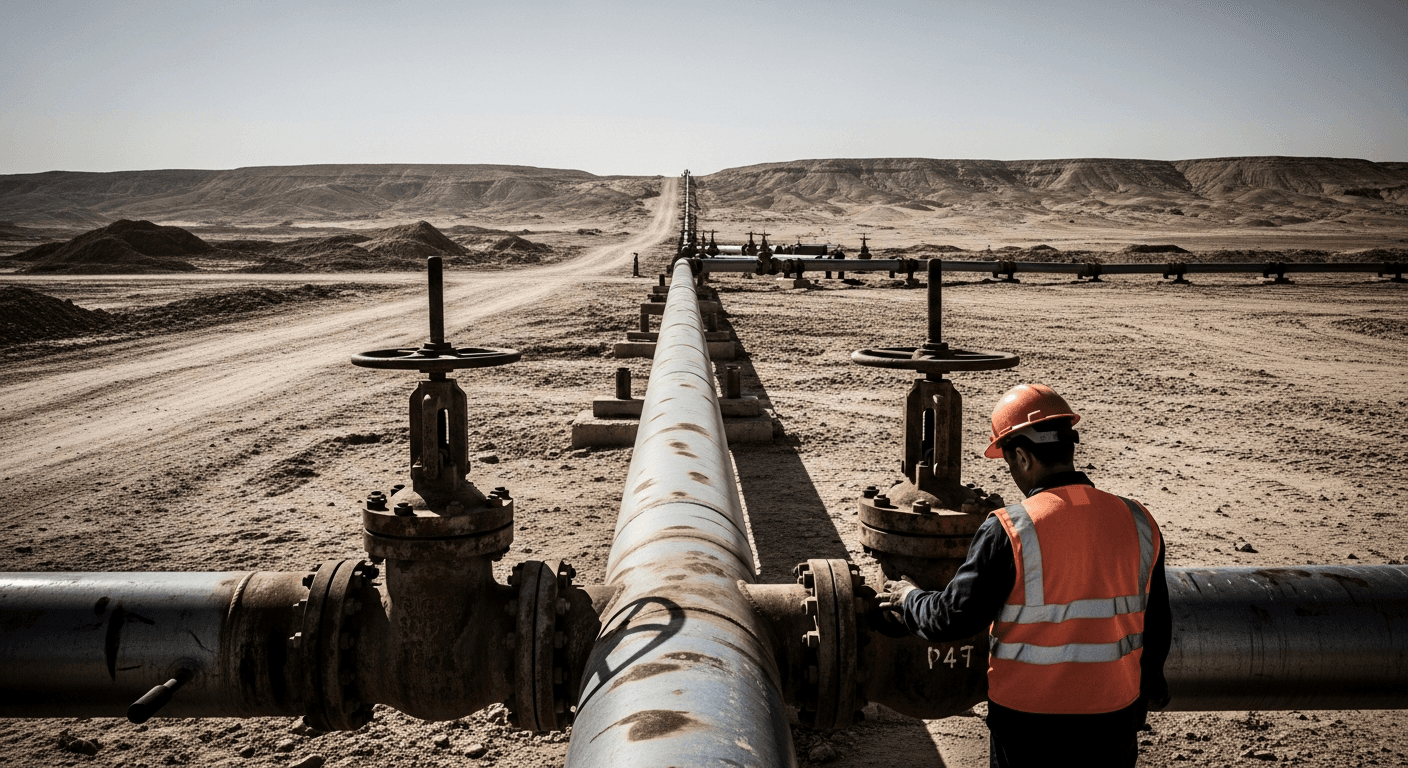
Syria's state oil CEO put a hard timeline on the Hormuz bypass, and Washington is backing it.
Key takeaways
- Youssef Qablawi, CEO of the Syrian Petroleum Company, said on August 4 that the Haditha-to-Baniyas pipeline will be operational within 30 months to three years, with a planned capacity of up to 2 million bpd.
- Iraq and Syria already signed an MoU in July 2026, with a U.S.-backed consortium including Chevron assigned to conduct feasibility studies; contract finalization is expected within three months.
- A working Hormuz bypass at stated capacity permanently weakens Iran's single most powerful leverage point and chips at the military underpinning of dollar-denominated oil settlement.
Youssef Qablawi, CEO of the Syrian Petroleum Company, told reporters at the Rmeilan oil field in Hasakah province on August 4 that restoring the pipeline from Haditha, Iraq to the Syrian Mediterranean port of Baniyas will take "30 months to three years at most" after contract finalization. The project is planned as two parallel pipelines with a combined capacity of 1.5 million to 2 million barrels per day.
"Engineering studies and the purchase of materials will then begin, followed by construction. Implementation will take between 30 months and three years at most, after which the pipeline will be ready," Qablawi said, per The New Region. He described it as "a vital project" that "will generate substantial revenues" for both countries.
From MoU to Contract Table
This is not a fresh idea being floated. Iraq and Syria signed a memorandum of understanding on July 17, 2026, at a Washington D.C. Chamber of Commerce summit, in the presence of U.S. Energy Secretary Chris Wright, per SyriacPress. A consortium including Chevron and Qatari firm UCC Holding was assigned to prepare technical and financial feasibility studies.
The U.S. State Department has publicly endorsed the effort, with an official describing the pipeline as "of bilateral and regional strategic significance," per a U.S. State Department official, as reported by Reuters. Qablawi added that contract negotiations are underway and he expects them to conclude within three months, per Asharq Al-Awsat.
The pipeline corridor has been dormant since 2003. Reconstruction cost estimates range from $4.5 billion to $8 billion across multiple reports. The engineering challenge is significant: the original line was rated at roughly 300,000 bpd; the new project targets a combined capacity roughly 20 times that original ceiling across two pipes.
The urgency is real. Roughly a fifth of the world's petroleum transits the Strait of Hormuz, per EIA data. Iraq depends on that strait for the overwhelming majority of its crude exports. The ongoing Hormuz disruptions in 2026 have put Baghdad's primary export route under severe strain, strengthening the political will to build a credible alternative.
What the Petrodollar Loses If This Gets Built
The standard read on this story is that Iraq gains a new export route and Syria gets reconstruction revenue. That's accurate. It's also incomplete.
The petrodollar system rests on one durable foundation: the U.S. military's credible commitment to keeping Hormuz open. That guarantee is what makes dollar-denominated oil settlement the rational default for Gulf producers. Every barrel that exits through Baniyas on the Mediterranean can be settled in any currency the buyer and seller agree on. No U.S. Navy required. A working bypass at 1.5 to 2 million bpd is a proof of concept that major producers can structurally route around both the chokepoint and its dollar denominator.
The second-order effect: a weakened Hormuz-leverage calculus accelerates Gulf states' ongoing hedging into non-dollar settlement frameworks. That means less petrodollar recycling into U.S. Treasuries, more global dollar liquidity returning to domestic markets, and a harder sovereign budget constraint for Washington. The Gulf bond boom already signals that regional sovereigns are building the financial infrastructure to match.
There is also a strategic paradox worth naming. Washington is actively backing the infrastructure that reduces its own Hormuz leverage, because the alternative, another military commitment to keep the strait open, is now the higher-cost option. That admission is not priced into the strong-dollar consensus. OFAC has spent the year sanctioning Iran's Hormuz insurance racket; the pipeline is the structural complement to that pressure campaign. The U.S. is playing both sides of the board.
The falsifiable thesis: if this pipeline reaches its stated capacity, it permanently dilutes Iran's chokepoint leverage and accelerates non-dollar oil settlement. The trigger that disproves it is straightforward, the project stalls at feasibility studies, never breaks ground, or delivers a fraction of the 1.5 to 2 million bpd target. The original line's 300,000 bpd ceiling and the post-war state of Syrian infrastructure make that outcome entirely possible. Watch the contract signing date and the first confirmed construction milestone.
What to Watch
Contract finalization is the near-term gate. Qablawi said he expects that within three months. If that slips, the 30-month construction clock hasn't started. The feasibility studies by Chevron and UCC Holding will also surface the real capacity numbers and cost figures, the gap between 300,000 bpd (historic) and 2 million bpd (claimed) is where the project's credibility lives or dies. Any sovereign looking to price hard, seizure-resistant assets as a hedge against dollar recycling disruption should be watching this closely.
Update, September 14, 2026
Saudi Arabia shut down the East-West pipeline late Friday after drone attacks caused damage to pumping facilities, knocking out the one route the kingdom had been using to move crude while Hormuz stays closed. For the past six months, the pipeline had spared Saudi Arabia from the brunt of Hormuz's wartime shutdown, rerouting roughly 4 million barrels per day to the Red Sea port of Yanbu -- about 4% of global supply.
The drones were reported to have been launched from Iraq, where an investigation is under way.
Brent jumped as much as 3.6% above $108 and WTI traded near $103 as supply risks flared.
Sources gave varying estimates on repairs, with one saying the damage could take as long as five to six weeks to fix, while another said partial pumping could resume sooner.
Gulf developments over the weekend prompted Bernstein analysts Neil Beveridge and Brian Ho to warn that Brent could rally to between $120 and $150 a barrel as East-West pipeline disruptions collide with ongoing troubles along the Strait of Hormuz. The IEA said Saudi oil supply already fell to a more than three-decade low in August, and that world oil supply will decline this year by 5.7 million bpd, or roughly 6%.
Houthi forces, described as Iranian allies, also seized the strategic island of Perim in the Bab el-Mandeb Strait over the weekend, tightening their grip on that waterway.
Saudi oil purchasers warned that the kingdom will exhaust its export inventories in mere days without a functional conduit. The convergence of events -- Hormuz closed, the East-West bypass now offline, and Bab el-Mandeb increasingly contested -- is no longer a theoretical scenario for the Iraq-Syria Baniyas pipeline project. It is the real-time case for why that Mediterranean route exists and why the three-year build clock matters.
Update, September 15, 2026
With the East-West pipeline down and Yanbu export stocks running thin, Riyadh has made an operationally striking pivot: Saudi Arabia is now seeking to boost oil supply through the Strait of Hormuz itself, the contested waterway it has spent six months routing around, having already raised Hormuz shipments in the first ten days of September above August levels. The pipeline is not just an export conduit -- it also feeds refineries along Saudi Arabia's west coast that export oil products like diesel -- meaning the outage is simultaneously squeezing crude export volumes and refined product supply to global markets.
Saudi Arabia could run out of exportable oil within days, with the kingdom holding enough crude stored at Yanbu to maintain current export levels for roughly five to seven days without new supplies flowing through the East-West Pipeline, according to Reuters citing Saudi oil buyers and traders.
Saudi crude supply had already fallen by about 2.3 million barrels per day from July to roughly 6 million barrels per day in August 2026, per the IEA's September Oil Market Report, which attributed the decline to attacks on Saudi energy infrastructure and described output as the lowest in more than three decades.
The downstream price signal is already printing. The U.S. national average diesel price topped $6 a gallon for the first time last week per AAA, and Lipow Oil Associates warned in a Monday note that a prolonged East-West shutdown could push that past $6.50. The EIA's September Short-Term Energy Outlook put crude production shut-ins at 6.7 million bpd in August, up from 5 million bpd in July, and projected that if Middle East flows remain constrained beyond end of 2026, global distillate crack spreads would run materially higher than current forecasts. Every week the Baniyas pipeline remains unbuilt, these are the conditions Baghdad and Damascus are operating in.
Update, September 16, 2026
Saudi Aramco is engineering a bypass around the damaged pumping section of the East-West pipeline, with a person familiar with the matter telling Bloomberg that the kingdom expects to restore roughly half the pipeline's capacity within days, and full capacity in approximately six weeks. U.S. Energy Secretary Chris Wright told Bloomberg TV earlier this week that the critical pipeline would be restarted "very soon." The partial-restart news was enough to knock crude off its highs: WTI futures fell to $101 a barrel around midday in New York on the report.
The relief is partial and the underlying exposure is not gone. The timelines for the East-West pipeline's resumption and the volume of oil it can carry are being closely watched by traders, given that the link turned into a lifeline during the Iran war as Saudi Arabia used it to circumnavigate the severely disrupted Strait of Hormuz.
A successful restart of the pipeline, which can carry 7 million barrels of crude per day to Yanbu while bypassing the Strait of Hormuz, would provide welcome relief for Europe, which had crude cargoes for this month canceled because of the disruptions.
Meanwhile, U.S. diesel crack spreads showed no relief, still averaging around $116 a barrel around midday in New York.
What the partial restart actually confirms is the fragility of every single point in the existing bypass architecture. Saudi Arabia's Hormuz workaround was taken offline by drones in roughly 72 hours, and the world watched crude rip above $108 and diesel cross $6 at the pump within days. Ample global inventories and stockpiles have historically acted as a crucial buffer to keep a lid on oil prices during previous crises, but analysts have raised the alarm that these safety nets are rapidly evaporating due to the ongoing Middle East conflict. The Iraq-Syria Baniyas corridor, if built to its stated 1.5-to-2 million bpd capacity, would add a second independent Mediterranean outlet that no single drone strike on a Saudi pumping station could neutralize. The argument for building it faster just got a live demonstration.
Sources
Frequently Asked Questions
The Kirkuk-to-Baniyas corridor is a pipeline route that carries crude from Iraqi oil fields through Syria to the Mediterranean port of Baniyas, offering an export path that bypasses the Strait of Hormuz entirely. The pipeline has been inactive since 2003, when it was damaged during the U.S. invasion of Iraq. The route is commonly called Kirkuk-Baniyas after the crude's source and its destination port; the actual Iraqi pipeline origin point is Haditha in Anbar province.
Roughly a fifth of the world's petroleum passes through the Strait of Hormuz, per EIA data. Iraq relies on that chokepoint for the vast majority of its crude exports. When Hormuz faces disruption, Baghdad has no significant alternative route, production cuts and revenue losses follow directly. A working Haditha-Baniyas pipeline at even half the claimed capacity would give Iraq a real alternative, weakening Iran's ability to use the strait as geopolitical leverage.
The U.S. State Department has publicly endorsed the pipeline as "of bilateral and regional strategic significance." Energy Secretary Chris Wright attended the July 2026 MoU signing in Washington D.C. Chevron has been named in the consortium assigned to conduct technical and financial feasibility studies, alongside Qatari firm UCC Holding. Washington's backing reflects a calculated bet that reducing Hormuz dependency is cheaper than guaranteeing the strait militarily, a significant shift in how the U.S. is managing its Middle East energy posture.