Kazakhstan Decree Lets Bitcoin Miners Burn Flare Gas, Bypass the Grid
President Tokayev's July 2026 decree creates a legal path for oil producers to sell waste gas directly to Bitcoin miners at below-market prices, bypassing Kazakhstan's national grid entirely and unlocking an estimated 1.2-1.3 TWh across 40-60 oil fields.
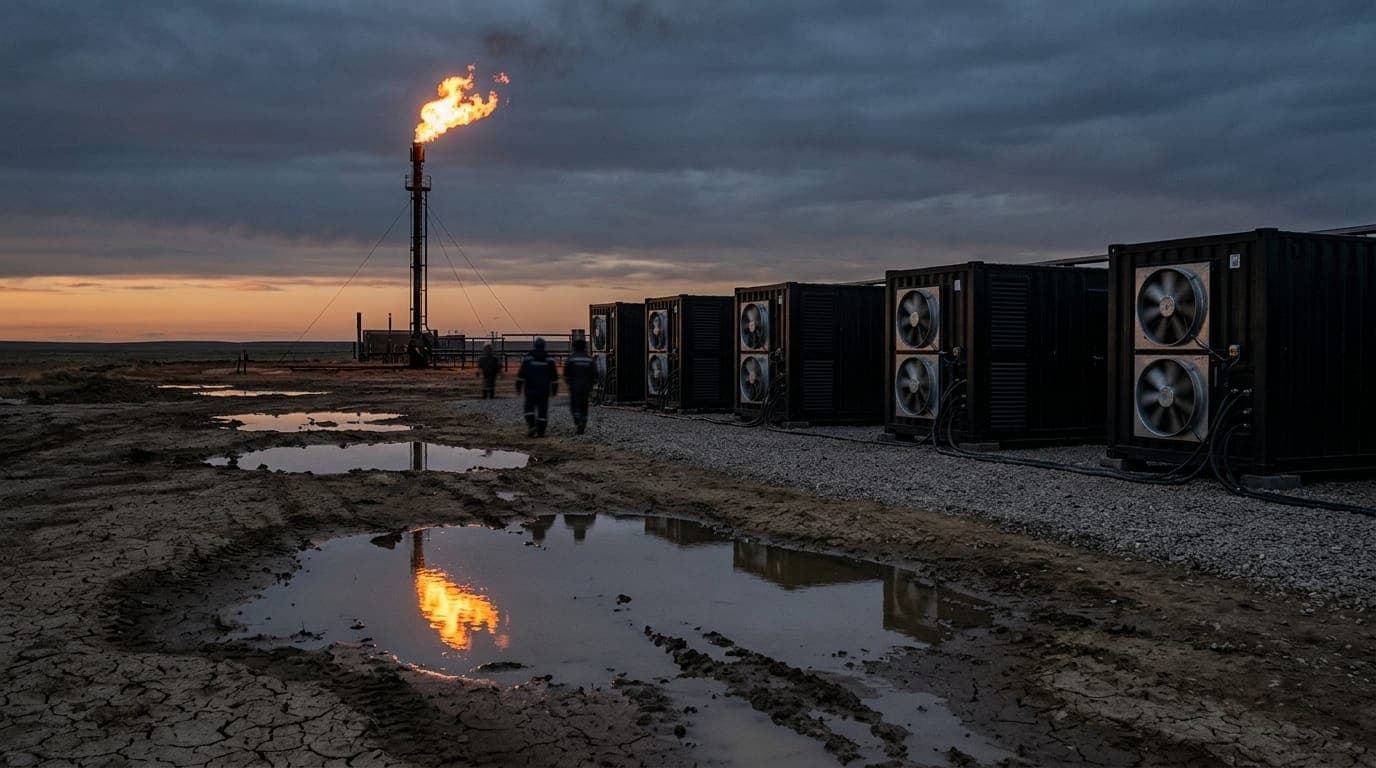
President Tokayev's July 2026 decree hands oil producers a legal path to sell waste gas to Bitcoin miners at the wellhead, off-grid, turning an environmental liability into sovereign revenue.
Key takeaways
- Kazakhstan's July 2026 presidential decree establishes the framework for oil producers to sell associated petroleum gas, previously flared as waste, directly to Bitcoin miners at below-market prices.
- Kazakhstan's Ministry of Energy estimates 40-60 oil fields currently produce flare gas; Daniyar Mubarakov of the Blockchain and Digital Mining Association estimates converting that gas to electricity would yield 1.2-1.3 TWh of mining power.
- The governing legal framework is still being written; its tariff and compliance structure will determine whether miners actually deploy capital or repeat the 2021 exit.
President Kassym-Jomart Tokayev signed the decree "On Measures to Stimulate and Develop the Digital Asset Industry in the Republic of Kazakhstan" in July 2026, per the AIFC's official announcement and the decree text published on Kazakhstan's official legal information system, adilet.zan.kz. The decree calls for a legislative mechanism enabling oil and gas companies to sell associated petroleum gas to digital miners for off-grid power generation. Miners were flaring roughly 300-340 million cubic meters of that gas in 2024 alone, a volume that Daniyar Mubarakov, Head of the Blockchain and Digital Mining Association, estimates would have generated 1.2-1.3 TWh of electricity if converted, as first reported by Euronews.
The Deal Structure
The mechanics are straightforward. Miners finance and install gas-to-power equipment at the wellhead. Oil producers sell the gas, previously worthless and a regulatory liability, at prices well below commercial-grade market rates. "For us, the gas that was previously flared has no alternative cost, so we are prepared to sell it at a price significantly lower than the market price of commercial-grade gas," said Batyr Bauyrzhan, Technical Director of WES LLP, a technology partner providing an integrated solution covering gas conditioning, power generation, and a mining farm and data center, via Euronews.
Oil companies avoid significant environmental fines. Miners lock in multi-year power price certainty, independent of Kazakhstan's national tariff system. A third-party engineering contractor handles gas-piston units, permitting, and servicing.
The Ministry of Energy puts the opportunity set at 40-60 oil fields. Mubarakov estimates a minimum 5 MW per field is required to justify infrastructure spend, and pegs greenfield power station construction at €1.7M, €2.2M per MW with a build time exceeding three years, making the wellhead model orders of magnitude faster and cheaper than conventional alternatives.
Why Off-Grid Is the Entire Point
Kazakhstan became one of the world's largest Bitcoin mining destinations after China's 2021 ban. That boom ended badly. Miners drew from the national grid, strained aging infrastructure, created a political flashpoint, and the government responded with an auction-based rationing system that priced most operators out.
Flare gas mining at the wellhead removes that attack surface entirely. There is no grid draw to regulate, no auction system to game, no domestic constituency complaining about brownouts. The architecture of the deal eliminates the political lever that ended the last wave.
This is also the energy-as-money thesis running at nation-state scale. Flared gas is textbook stranded energy: no pipeline, no buyer, no infrastructure to move it, so it burns. Bitcoin mining is the only monetization mechanism that travels to the energy rather than moving the energy, requires no grid connection, demands no long-term commitment from the producer, and settles in a globally liquid asset.
The ESG-attack framing on Bitcoin also gets harder to sustain when a sovereign government adopts mining as its explicit methane remediation tool. When a nation-state shows the math and calls it an environmental win, the "Bitcoin wastes energy" narrative collides with inconvenient policy reality.
What to Watch
Gizzat Baitursynov, Kazakhstan's Vice Minister of AI and Digital Development, confirmed to Euronews that a legal framework governing the arrangements is still under development. No published draft or timeline has been confirmed. That framework's tariff schedule, environmental compliance costs, and any grid-integration requirements will determine whether the economics hold. If per-kilowatt levies or mandatory reporting costs erode the price advantage over on-grid auction power, miners will stay away, exactly as they did after 2021. The decree creates the opening; the regulations write the actual outcome.
Sources
Frequently Asked Questions
Why did Kazakhstan crack down on Bitcoin mining before, and why is this different?
The 2021 boom put miners on the national grid, which exposed them directly to political pressure when electricity shortages emerged. The flare gas model is physically off-grid at the wellhead. Miners draw power from gas that would otherwise be burned on-site. There is no grid load to regulate and no utility rationing system to exploit.
What is associated petroleum gas and why can't oil fields just sell it normally?
Associated petroleum gas is a byproduct of crude oil extraction. At remote fields without pipeline infrastructure or compression capacity, there is no economically viable path to market. The gas gets flared. Bitcoin mining is unique in that the "buyer" travels to the energy source and monetizes it without requiring a grid connection or commodity pipeline.
How does this compare to the U.S. flare gas mining model pioneered by companies like Crusoe Energy?
The mechanics are similar: gas-to-power equipment at the wellhead, below-market fuel, off-grid operation. The Kazakhstan model differs in that it is state-directed rather than private-sector-led, and the scale potential, 40-60 fields across a major oil-producing nation, is being structured from the top down by presidential decree rather than field-by-field commercial negotiation.