DOE's $2.7B Uranium Bet Has a 30x Capacity Gap Nobody Is Talking About
The DOE handed $900M each to Centrus, General Matter, and Orano to rebuild US uranium enrichment capacity before the 2028 Russian import waiver deadline. One recipient is promising nearly 30x the annual output of another for the same check.
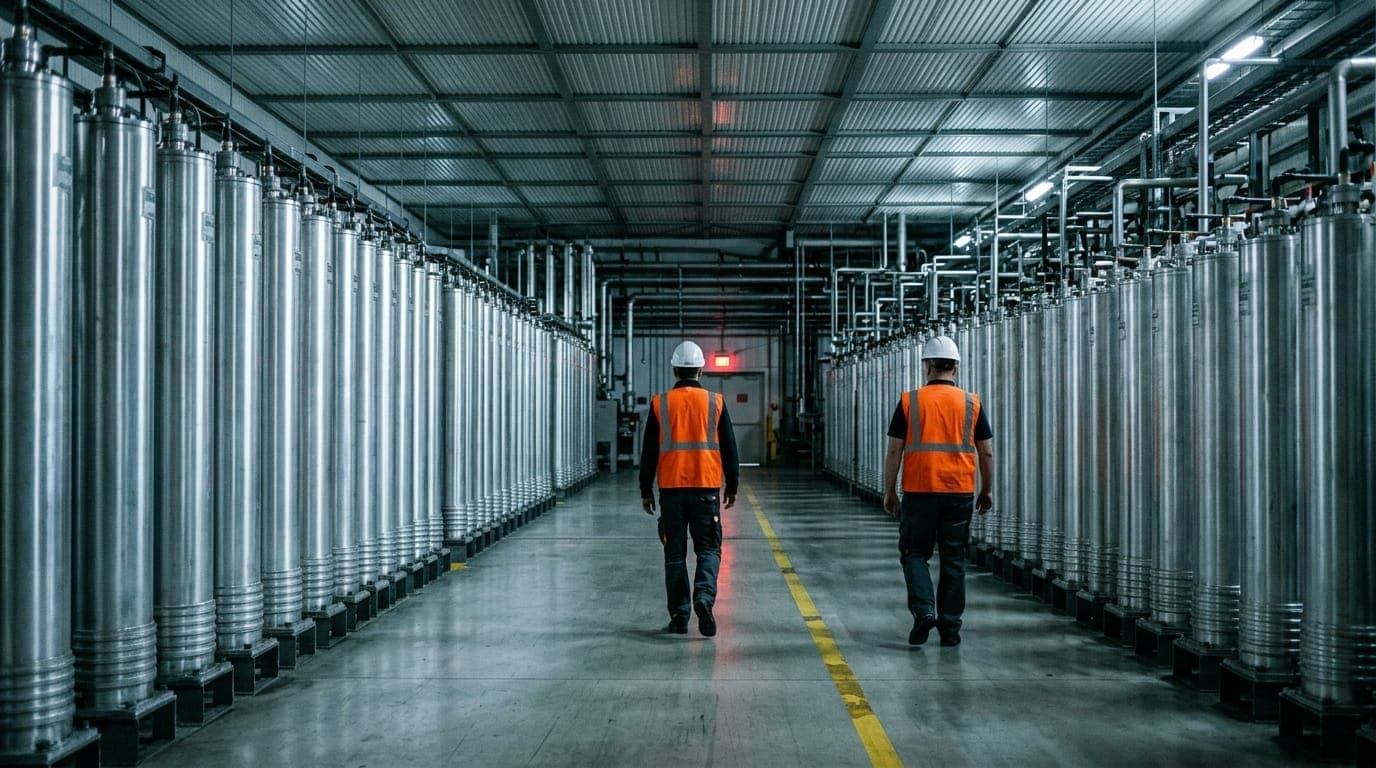
The DOE is pressing Centrus, General Matter, and Orano to move faster. The equal $900M awards hide a wildly unequal ambition.
Key takeaways
- The DOE awarded $900M each to Centrus Energy, General Matter, and Orano in January 2026, totaling $2.7B, to rebuild domestic uranium enrichment capacity ahead of a hard January 1, 2028 waiver deadline on Russian uranium imports.
- Per reporting first published by Politico, one person familiar with the DOE contracts said General Matter offered 355 metric tons of HALEU annually for its $900M; Centrus committed to 12 metric tons annually at first, scaling up after 2030. That is nearly 30x the output ambition for equal taxpayer dollars, as reported.
- For US Bitcoin miners and grid-dependent energy operators, the success or failure of this buildout has a direct bearing on domestic electricity prices: more dispatchable nuclear baseload means a more predictable cost floor.
The DOE is pressing Centrus Energy, General Matter, and Orano to accelerate their uranium enrichment buildout programs, per Reuters, as a hard statutory deadline bears down. Russian uranium import waivers expire January 1, 2028, with no extensions on the table.
The DOE's $2.7B award announcement came in early January 2026: three task-order awards of $900M each, one for Centrus Energy (through its subsidiary American Centrifuge Operating), one for the Peter Thiel-backed startup General Matter, and one for French state-owned Orano Federal Services. A separate $28M went to Global Laser Enrichment for next-generation SILEX laser enrichment development. The DOE's waiver guidance, signed by DOE's Michael Goff, states plainly there are no plans to extend the waivers past the statutory deadline established by the Prohibiting Russian Uranium Imports Act.
Equal Dollars, Unequal Ambition
The headline number is $2.7B. The number that actually matters is buried inside the award details.
According to Politico's reporting (first reported by Politico, Francisco Camacho byline), one person familiar with the DOE contracts said General Matter offered 355 metric tons of HALEU annually for its $900M. Centrus, per the same reporting and its own investor communications, committed to delivering 12 metric tons annually at first, with the full rate expected after 2030. Both companies are targeting 2029 for initial production.
That is a roughly 30x gap in annual capacity ambition for identical funding, as reported. Centrus deserves credit for what it has already done: it is currently the only NRC-licensed facility in the US producing HALEU-grade uranium, with nearly three years of production and close to one metric ton delivered as of summer 2025. It also holds $2.3B in LEU purchase commitments from utilities, contingent on financing. But the output targets, as reported, are not close.
General Matter is a Founders Fund-incubated startup led by Scott Nolan, a Founders Fund partner and former SpaceX employee. The company has signed a DOE lease on a 100-acre parcel at the former Paducah Gaseous Diffusion Plant in Kentucky, shuttered in 2013. Peter Thiel joined the board. Nolan has said publicly that the US now does less than 0.1% of global enrichment. The Paducah site, he noted, was once the center of American enrichment capability.
Orano, the French state-backed operator, is pursuing a separate expansion in Tennessee targeting LEU enrichment. It has supplied France's large reactor fleet for decades and is attempting its second run at a US footprint after a post-Fukushima-era failure.
What the 2028 Cliff Actually Means
The Russian uranium waiver regime was a pressure-release valve. After the US banned Russian LEU imports following the start of the Russia-Ukraine war in 2022, waivers were granted broadly to utilities and importers to avoid supply disruption. Those waivers terminate no later than January 1, 2028, with the Federal Register instructions making clear there is no extension mechanism built into the law.
If domestic enrichment capacity is not online by then, US reactors face tighter spot markets, higher fuel costs, and supply uncertainty. That is not an abstraction. Fuel cost pressure at the reactor level flows through to electricity prices at the grid level.
Nuclear is 24/7 dispatchable baseload. More enrichment capacity upstream unlocks more reactors running at full output, which is the kind of firm, cheap power that makes large-scale US Bitcoin mining economically durable rather than dependent on curtailment arbitrage. The diesel price environment and broader supply-shock inflation dynamics are already squeezing energy-intensive operations. A domestic enrichment gap that persists past 2028 adds another layer of structural cost pressure.
What to Watch
The falsifiable version of the DOE's thesis: if General Matter receives NRC licensing for its novel enrichment process and begins production at or near its 355 MTU ambition by 2029 to 2030, the US enrichment picture changes materially. If it does not, if licensing delays or operational shortfalls mean Centrus's 12 MTU is the effective ceiling for HALEU supply in the near term, the gap persists well past the waiver deadline. Watch NRC licensing milestones for General Matter, Centrus's quarterly production reports, and whether Orano's Tennessee facility clears permitting on schedule. The DOE urgency posture, per Reuters, suggests Washington already sees slippage risk.
Sources
- DOE $2.7B Uranium Enrichment Awards Announcement
- DOE Russian Uranium Ban Waiver Guidance
- Federal Register, Waiver Instructions, May 24, 2024
- Centrus Energy IR Press Release, $900M Award, January 6, 2026
- Centrus Energy 10-K FY2025 (SEC Filing)
- Politico, Francisco Camacho, General Matter Paducah facility details (first reported by Politico; paywalled)
Frequently Asked Questions
What happens to US nuclear reactors if domestic enrichment isn't online before the 2028 waiver deadline?
Without replacement domestic supply, US utilities relying on Russian LEU face tighter spot markets and higher fuel costs after January 1, 2028. Higher fuel costs at the reactor level flow through to electricity prices across the grid. The statutory ban on Russian imports has no extension mechanism, per the Federal Register and DOE waiver guidance.
What is HALEU and why does advanced nuclear require it?
HALEU stands for High-Assay Low-Enriched Uranium, enriched to between 5% and 20% U-235. Most existing US reactors run on LEU enriched below 5%. Next-generation advanced reactor designs, including many small modular reactors, require HALEU to achieve their performance targets. Centrus is currently the only NRC-licensed US facility producing it, as of current reporting.
How does uranium enrichment capacity affect Bitcoin mining economics?
Bitcoin miners are large, price-sensitive electricity consumers. Dispatchable baseload power (nuclear, natural gas) sets the floor on grid electricity costs. More domestic enrichment capacity supports more nuclear plants running at full output, which expands firm baseload supply and puts downward pressure on wholesale electricity prices over time. A supply gap that keeps fuel costs elevated does the opposite.