TFTC - Truth for the Commoner
Bitcoin Brief
|
|
Sup, freaks.
Japan's 30-year bond just breached 4% for the first time in history. The 20-year hit an all-time record. The 10-year is at levels not seen since 1997. This isn't a slow drift anymore, it's an acceleration, and today also happens to be the day Kevin Warsh officially takes over as Fed Chair. Welcome to the job, Kevin.
|
|
LEAD STORY
|
Japan's Bond Market Just Broke. The 30-Year Hit 4% for the First Time Ever.
This is a story that has been building for months, and I've been covering it here in the Brief because I believe it's one of the most important macro stories in the world right now. Yesterday we talked about sovereign debt markets screaming. Today, they're screaming louder.
Japan's 30-year government bond yield breached 4% on Friday for the first time since the bond was created in 1999. The 20-year yield climbed to its highest level since 1996. The 10-year JGB hit 2.73%, a level not seen since May 1997. NHK confirmed the 10-year is the highest in 29 years. These aren't small moves. The 10-year has surged nearly 20 basis points in three days alone. 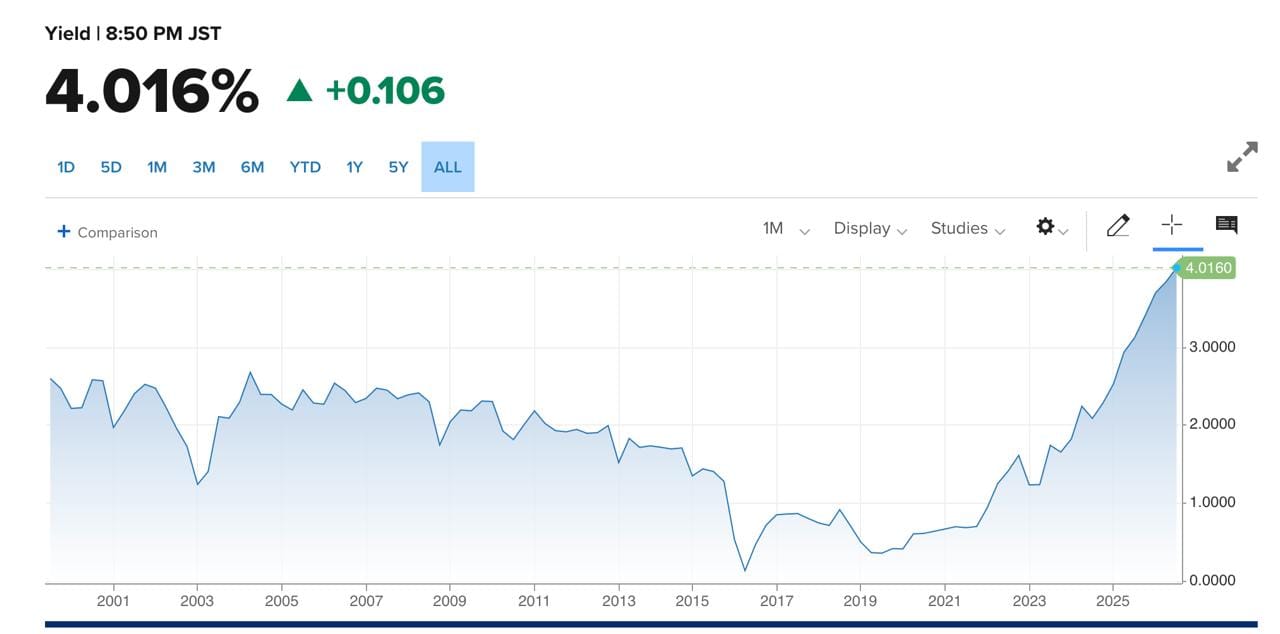
Japan 30-year JGB yield since 2000. The vertical spike on the right is what "breaking records" looks like.
The catalyst is a combination of factors that are all feeding on each other. Wholesale inflation data came in hot, with yen-based import prices up 17.5% year-over-year in April, the fastest pace since December 2022. That's the Strait of Hormuz energy shock transmitting directly through the weakened yen into Japanese prices. BOJ board member Masu has joined the hawkish chorus calling for an early rate hike, and markets are now pricing a 75% probability of a June hike.
Here's why this matters for everyone, not just Japan. The Bank of Japan is trapped. They can hike rates to fight inflation and defend the yen, but hiking into an energy shock risks crushing an already fragile economy. Or they can hold steady and watch the yen depreciate further, which makes imported energy even more expensive and accelerates inflation. There is no good option.
And the contagion channel is real. Japan holds over $1 trillion in US Treasury securities. Japanese life insurers and pension funds are among the largest holders of foreign bonds globally. If Japanese yields continue to rise, the math changes for these institutions. Why hold US Treasuries yielding 5% when you can get 4% at home with no currency risk? As we covered in the global bond rout story, when one sovereign debt market cracks, the stress propagates. Japan is the world's largest creditor nation. If their bond market reprices violently, the rest of the world feels it.
I've been beating this drum for weeks because I genuinely believe we're watching the beginning of a sovereign debt repricing event that will define this decade. Governments around the world borrowed at near-zero rates for years, and now the bill is coming due. The only way out is to either cut spending (politically impossible) or print money (inevitable). This is why Bitcoin exists. And if you look at where it's trading right now, around $80,000, you're getting it at bargain prices relative to where this macro picture is headed. The sovereign debt crisis is accelerating. Bitcoin is the exit. Act accordingly.
|
|
|
SIGNAL
|
Australia Just Pulled the Rug on Bitcoin Capital Gains
Why it matters: A preview of what desperate governments will do to every country's Bitcoiners.
James Check from Checkonchain published a devastating breakdown of the Australian government's new budget. The 50% capital gains tax discount on assets held longer than one year has been abolished, replaced with a CPI indexation method that effectively doubles the tax rate on high-growth assets like Bitcoin. They dressed it up as helping young Australians buy homes. In reality, it kicks out the rungs of the asset ladder that young people need to climb before they can even think about housing. As Check puts it: "For anyone on the lower to middle end of the income spectrum, the new tax policy has outsized impacts on your balance sheet. It doesn't tax the rich, nor does it help young Australians. It literally targets them." The only assets that benefit under the indexation method are those that barely outpace inflation, like government bonds. Funny how that works. Every country running unsustainable deficits will reach for this playbook eventually. Australia is just first.
|
|
Warsh Takes the Fed Chair Today. Good Luck.
Why it matters: The first Bitcoin-friendly Fed chair inherits one of the worst macro setups in modern history.
Jerome Powell's term as Fed Chair ends today, and Kevin Warsh officially takes the reins. The Senate confirmed Warsh 54-45, with John Fetterman as the only Democrat to vote yes. Financial disclosures revealed Warsh held an equity stake in Flashnet, a Bitcoin payments startup focused on Lightning-style infrastructure, making him the first Fed chair with direct exposure to Bitcoin. He inherits a mess: inflation running above the 2% target for 62+ consecutive months, the 30-year Treasury yield above 5%, and Japan's bond market melting down in real time. Trump wants rate cuts. The bond market is demanding discipline. Good luck threading that needle, Kevin.
|
|
Strategy's STRC Hits Record $1.5B Volume, Funds 11,707 BTC Purchase
Why it matters: Saylor's capital machine is buying more Bitcoin than all ETFs combined.
Strategy's preferred stock STRC logged $1.5 billion in trading volume on Thursday, more than four times its 30-day average of $331 million. The volume came ahead of the ex-dividend date for its 11.5% annual yield. According to River data, STRC proceeds have funded approximately 77,000 BTC in purchases in 2026 alone, compared to just 8,000 BTC in net inflows across all US spot Bitcoin ETFs during the same period. Strategy now holds roughly 820,000 BTC. As Saifedean Ammous put it perfectly: "$10,000 in long-term US government bonds 10 years ago would be worth $8,550 today. $10,000 in bitcoin would be $1,700,000." The bond market is the biggest wealth destruction vehicle in human history. Saylor figured that out before everyone else.
|
|
Open-Source AI Agents Are Eating the Software Stack. Here's What That Means.
Why it matters: Self-improving AI agents that live on your server are going mainstream, and they need permissionless money.
If you're not paying attention to what's happening in the open-source AI agent space, you should be. Hermes Agent, built by Nous Research, just passed OpenClaw to become the #1 most-used AI agent globally, processing 224 billion tokens per day on OpenRouter. It has 135,000 GitHub stars and an NVIDIA partnership. So what is it? It's an AI assistant that runs on your own server, connects to your messaging apps (Telegram, Discord, Signal, etc.), and gets smarter the longer you use it. Every time it completes a complex task, it saves what it learned as a reusable "skill file." It remembers across sessions. It schedules work autonomously. It self-improves.
This matters because the trajectory is clear: AI is moving from cloud-hosted chatbots to persistent agents that live on your hardware, manage your data, and act on your behalf. The fact that the most popular one is open-source, self-hosted, and model-agnostic is a good sign. It means the personal AI layer doesn't have to be controlled by Google or OpenAI. You can run it yourself, on your own terms, with your own data. That's a principle Bitcoiners should appreciate.
|
|
Sanders and AOC Want to Pause All AI Data Center Construction
Why it matters: The US is trying to win the AI race while simultaneously kneecapping its own infrastructure buildout.
Senators Sanders and AOC have introduced a bill to pause all AI data center construction in the United States. According to Y Combinator CEO Garry Tan, over 300 local bills targeting data center development have also been filed, and half of planned 2026 data centers are facing delays or cancellation. Look, I'm not going to pretend there aren't legitimate concerns here. Nobody wants a massive data center humming next to their neighborhood. The noise, the heat, the strain on local power grids. These are real issues that affect real people.
But the answer isn't a blanket construction pause while China races to build out AI infrastructure at scale. The answer is being intentional about where you put them. The Bitcoin mining industry has spent the last decade learning this lesson the hard way. Miners figured out that the smart play is to go where the energy is, not where the people are. Remote locations. Stranded energy. Behind-the-meter generation. Here's the idea that should be obvious by now: build dedicated power generation, coal, natural gas, nuclear, in remote areas with no residential or commercial activity, and put the data centers right behind the meter. You solve the NIMBY problem, you solve the grid strain problem, and you actually create economic activity in areas that need it. The Bitcoin mining industry already proved this model works. The AI industry should be taking notes, not waiting for Congress to tell them where they can and can't build.
|
|
"Beneficial Bloodsucking": Professors Argue for Engineering Ticks That Force Veganism
Why it matters: The "trust the experts" pipeline has reached "release genetically modified ticks to make you allergic to meat."
A peer-reviewed paper published in the journal Bioethics by two professors at Western Michigan University School of Medicine argues it is "morally obligatory" to genetically engineer ticks to spread alpha-gal syndrome, a permanent condition that makes you violently allergic to red meat. Their paper is called "Beneficial Bloodsucking." They want to gene-edit lone star ticks to enhance their ability to carry the syndrome and expand their range into urban environments to infect more people. They call this a "moral bioenhancer." They frame releasing genetically modified disease-carrying ticks into cities as a "vaccination" for the planet. I'm including this because it's important to understand that this is where the intersection of institutional academia and ideological capture leads. These are medical school professors publishing in peer-reviewed journals. This is the "trust the science" pipeline operating exactly as designed.
|
|
|
Block's Spiral Launches AI Vulnerability Scanner for Bitcoin Open Source
Why it matters: AI is making attacks cheaper. Now defenders get the same tools, for free.
Spiral, the open-source Bitcoin development arm of Jack Dorsey's Block, just launched Loupe, a free AI-powered vulnerability scanner built specifically for open-source Bitcoin projects. The tool does continuous scanning at no cost to the small teams and solo developers who maintain critical Bitcoin infrastructure. The timing matters: AI has dramatically shifted the economics of vulnerability discovery, with over 00 million stolen in crypto hacks in 2026 alone. AI-generated code is being shipped faster than humans can audit it. Loupe is the defensive counterpart, giving Bitcoin developers the same AI firepower that attackers already have. This is Spiral doing what Spiral does best: funding the unsexy but essential infrastructure that keeps Bitcoin secure. Paired with their Lightning Development Kit (LDK) and Bitcoin Development Kit (BDK), the security layer was the obvious missing piece.
|
|
|
PRESENTED BY
|
Unchained
Your bitcoin deserves more than a single point of failure. Unchained gives you collaborative custody with a multisig vault that you control. No single party can move your bitcoin. Not Unchained, not a hacker, not a rogue employee. You hold two of three keys. That's real self-sovereignty with a safety net.
Watch: The Age of Debasement
Sponsor
|
|
|
|
|
⚡ FREEDOM TECH CORNER
|
Run Your Own AI Agent on a Raspberry Pi
Your AI assistant should run on your hardware, not someone else's cloud.
After covering the open-source AI agent explosion in today's Signal section, here's the actionable step: you can run one yourself. Install Hermes Agent on a Raspberry Pi, old laptop, or any Linux box. Point it at a local model (Ollama) or a paid API (OpenRouter, Anthropic), connect your Telegram or Signal, and you have a persistent AI assistant that remembers your context, schedules tasks, and answers your messages. No cloud dependency. No data leaving your network. Your keys, your compute, your agent.
|
|
|
DATA SNAPSHOT
|
| Bitcoin Price | $80,392 |
| Sats per Dollar | 1,244 |
| Block Height | 949,497 |
| Network Hashrate | 994 EH/s |
| Priority Fee | ~3 sat/vB |
|
| On-Chain Metrics |
| MVRV Ratio | 1.50 Fair value range, not overheated |
| SOPR | 1.00 Break-even, coins moving at cost basis |
| STH Realized Price | $78,704 Short-term holders barely in profit |
| NUPL | 0.33 Hope zone, not euphoria |
| Realized Cap | $1.09T Aggregate cost basis of all coins |
| LTH SOPR | 0.81 Long-term holders spending at a loss (capitulation) |
|
|
|
|
|
|
|
|
|
If this landed, forward it to someone who could use more signal and less noise. The Bitcoin Brief is free, always will be.
See you on Monday,
Marty Bent
|
|
|
Follow: @MartyBent · @TFTC21
Nostr: primal.net/marty
YouTube: TFTC · Podcast: tftc.io/podcast
|