Goldman Says AI Debt Bubble Is Real, Their Own Data Says Otherwise
Why it matters: The disconnect between enterprise failures and consumer demand growth reveals where the real AI value is.
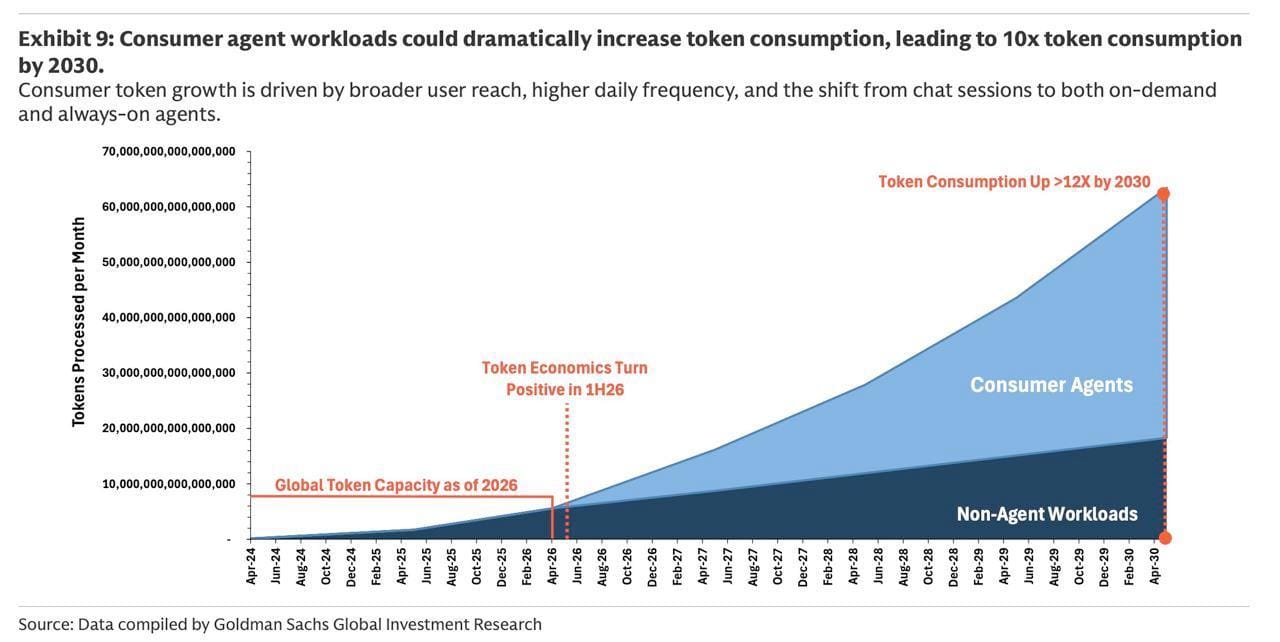
Source: Goldman Sachs Global Investment Research, Exhibit 9
Goldman Sachs just published their "AI Spend vs. Benefit" report, marking their views to market two years after asking whether there was "too much spend, too little benefit." On enterprise AI: 95% of organizations are getting zero return on $30-40 billion in GenAI investment. Meta just raised $25 billion in bonds to fund AI capex after burning through cash flow. JPMorgan created a CDS basket specifically to hedge AI debt risk.
But Goldman's own Exhibit 9 tells a different story: consumer agent workloads are projected to drive 12x token consumption growth by 2030, with token economics turning positive in H1 2026. Global token capacity sits at roughly 10 trillion tokens per month today. Consumer agents, driven by broader user reach, higher daily frequency, and the shift from chat sessions to always-on agents, are the hockey stick on Goldman's own chart. The demand is real and accelerating.
The question is not whether enterprises capture all the value, but whether it all accrues to chips. As @bitcoinsbanker pointed out, inference is a commodity, and the market may be overpricing hyperscaler equity as if these companies have the same customer retention profile as traditional big tech. Open-source LLMs and open-source agent harnesses are the wildcard. If they can deliver a user experience and cost curve that lets consumers, small businesses, and individuals route around hyperscalers and their proprietary models, the value capture shifts dramatically. The real AI wave is not legacy enterprises bolting AI onto existing workflows and getting zero ROI. It is upstarts who start from scratch and leverage these tools to be 10x more efficient from day one. There is an arbitrage in the market between enterprise failure and startup efficiency. And as LLMs continue to progress and agentic frameworks like MCP mature, the user experience pain points that currently limit adoption will dissolve.
One more factor: Trump invoked the Defense Production Act for AI, energy, and infrastructure sectors. There is an implicit government backstop here. Yes, there will be capital misallocation. But the fears of a full AI bust are overblown when demand genuinely outstrips supply and the federal government is treating the sector as critical to national security.
|