Iran Strikes Kuwait Oil and Desalination Plants as Hormuz Stays Shut
Iran struck Kuwait Petroleum Corporation oil infrastructure and a second power/desalination plant on Saturday July 18, causing fires and injuries, as Hormuz tanker traffic grinds toward zero and Brent crude tops $87 per barrel.
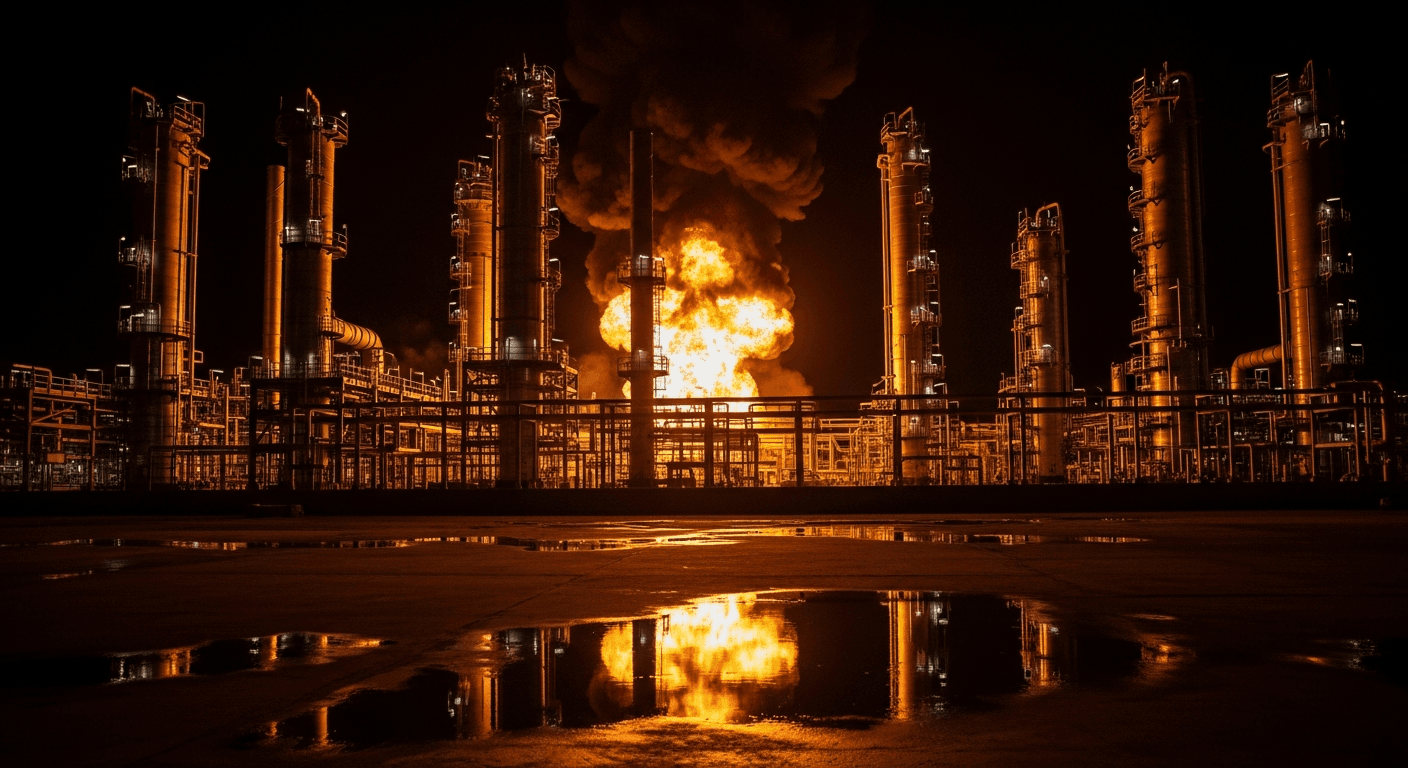
The June 18 US-Iran ceasefire is gone. Iran hit Kuwait's oil sector and civilian water infrastructure on Saturday, Hormuz tanker traffic has nearly halted, and Brent is above $87.
Key takeaways
- Kuwait Petroleum Corporation confirmed Iranian strikes on a vital oil facility on Saturday July 18, causing fires, injuries, and significant material damage, per state news agency KUNA.
- A second power and desalination plant was struck Saturday, one day after a Kuwait electricity and desalination complex was hit Friday; Kuwait relies on desalination for approximately 90% of its drinking water.
- The June 18 US-Iran ceasefire has collapsed. Hormuz tanker traffic has nearly ceased, Brent crude topped $87 per barrel Friday and is up more than 10% for the week, reversing the peace-premium that had pushed prices back below $70 per barrel in early July.
Iran launched a heavy missile and drone barrage on Kuwait on Saturday July 18, striking a Kuwait Petroleum Corporation oil facility and a second power and desalination plant, according to KPC and the Kuwait Ministry of Electricity and Water via KUNA. Kuwait International Airport suspended flights, nationwide warning sirens sounded for a fourth time, and the General Firefighting Force reported simultaneous fires at two separate locations.
The KPC statement to KUNA was direct:
"A vital location in the oil industry was struck by repeated brutal Iranian attacks that resulted in a number of injuries and significant material losses."
The Kuwait Ministry of Electricity and Water confirmed the second infrastructure hit:
"Another electricity and water distillation plant was targeted by a hostile attack that led to a fire erupting in one of the plant's components."
Kuwait's Foreign Ministry condemned the "repeated targeting of these vital facilities" as "a systematic hostile approach targeting civilian sites and vital infrastructure" and reserved Kuwait's "full right to take all necessary measures to preserve its security and defend its territories and vital facilities, based on its inherent right to self-defence," per KUNA. Jordan's army intercepted 10 Iranian missiles Saturday with no casualties reported, and Bahrain repelled a separate wave of Iranian attacks, per Gulf News and The Peninsula Qatar. The US launched its seventh consecutive night of strikes against Iranian military targets on Friday, per U.S. Central Command.
The Ceasefire Math
The June 18 US-Iran memorandum of understanding briefly repriced oil markets. Brent fell back below $70 per barrel by July 1. That reprieve lasted less than a month.
Conflict re-erupted after an Iranian drone strike on a cargo ship in the Strait of Hormuz on June 25, triggering the current escalation cycle. The EIA's Short-Term Energy Outlook issued July 7 assumed the MOU held and traffic was resuming. That model is now obsolete. Production shut-ins that peaked at 11.2 million barrels per day in May and recovered to an average of 8.3 million barrels per day in June are heading back up. The strategic petroleum reserves drawn down during the first closure are not fully restored. There is less buffer this time.
Bloomberg transponder data shows Hormuz tanker traffic has all but ceased. Rory Johnston of Commodity Context described the situation to Al Jazeera as traffic "grinding to a halt, back to, or even below, our immediate pre-MoU pace." Roughly 130 vessels per day transited Hormuz before the war. That corridor moves approximately 20% of the world's traded crude oil and LNG. Brent topped $87 per barrel Friday, up more than 10% for the week, per TradingEconomics data. Prior Hormuz strikes already demonstrated how quickly the chokepoint reprices global energy. The Treasury market felt it too.
What Hitting Desalination Plants Signals
Striking oil infrastructure is one escalation. Striking desalination plants is another category entirely.
Kuwait produces approximately 90% of its drinking water through desalination across eight coastal facilities generating more than 2.2 million cubic meters per day, per Al-Monitor and AP reporting. Two of those facilities have now been targeted in consecutive days. When a belligerent starts hitting the infrastructure that keeps 4 million people alive, the conflict has moved past military leverage into civilian coercion. That shift changes the insurance calculus for every energy-dependent, water-stressed sovereign in the Gulf. Saudi Aramco export terminals, UAE LNG facilities, and Qatar's North Field all sit inside the same threat radius.
There is also a second chokepoint in play. Reuters reported on July 16, citing three sources, that Iran has asked Houthi forces to stand ready to close the Bab el-Mandeb if the US strikes Iranian power infrastructure. The US has now struck Iranian energy and transport infrastructure for seven consecutive nights. If that threat executes, two of the most critical maritime energy corridors on earth close simultaneously. The global shipping repricing from that scenario has no modern precedent to benchmark against.
For anyone holding wealth in dollar-denominated oil revenues, Treasuries, or Gulf sovereign funds: the physical infrastructure those assets depend on is now a declared target. That is not a risk a price-to-earnings multiple can absorb.
What to Watch
The falsifiable thesis here is that the MOU was a repricing event, not a durable settlement, and Iran's deliberate shift to civilian infrastructure signals the conflict will not self-limit before forcing a structural reorganization of Gulf energy supply chains. That thesis breaks if a verified ceasefire reopens Hormuz within 30 days, Brent retreats sustainably back below $70 per barrel, and Iran pulls back from civilian infrastructure targeting. Watch Hormuz transponder data, Bab el-Mandeb shipping alerts, and whether CENTCOM publicly confirms or denies the Jordanian airbase claim before treating it as fact.
Update, July 18, 2026
Brent crude settled at $88.10 on Friday, a 4.6% single-session gain, while WTI closed at $82.49, up roughly 4.5%.
That brings Brent's weekly advance to more than 14 percent.
CME FedWatch futures markets put the probability of a Federal Reserve rate hike at the September 16 FOMC meeting at 73%, up from just 26% in mid-June. The energy shock has crossed into monetary policy territory, and the Fed is now being priced as a reactive instrument to a war premium rather than a domestic demand signal.
Tanker crossings through the Strait of Hormuz fell to just eight on Thursday, down from a pre-conflict daily total of more than 100.
The premium for prompt Brent delivery over the sixth-month contract has widened to its largest backwardation since June 10, 2026, a structure that signals the market sees near-term barrels as scarce, not just expensive. The buffers that cushioned the first Hormuz closure are gone: strategic reserves were drawn down in May and June and are not restored, and production shut-ins are rising again.
On the military side, the picture is expanding beyond nightly strike packages. The Trump administration notified Israel it plans to send dozens more aerial refueling aircraft to the country in the coming days, restoring deployment levels to those seen at the start of the war, following a White House Situation Room briefing Tuesday during which Trump was presented with several new military plans, per Axios. Options under consideration include strikes on Iranian infrastructure, further attacks on nuclear facilities intended to bury enriched uranium stockpiles, and an operation targeting the underground Pickaxe Mountain site.
Trump has not yet made a final decision, but US and Israeli officials said such an escalation could be ordered within the coming days. Iran's adviser Mohsen Rezaei has already drawn the line: "If U.S. strikes continue for several days, we will move into a phase of full-scale offensive operations."
Update, July 20, 2026
Iran's targeting doctrine has expanded explicitly to US military AI and drone infrastructure. The IRGC claimed it destroyed a US unmanned surface vessel depot in Bahrain, burning many of the drones, and separately claimed it "completely destroyed" Bahrain's "main artificial intelligence center," stating the facility was used by the US "to assist the enemy in target selection for committing war crimes." The claim was reported via Anadolu and picked up by the Middle East Monitor.
The strikes on Bahrain did not stop there. Sirens sounded in Bahrain for the fifth time in a single day on Sunday evening local time, according to the country's Interior Ministry.
Bahrain, which hosts the US Navy's Fifth Fleet, has reported near-daily attacks since June 8.
Tehran claims it is targeting US military installations, but it has also been striking civilian infrastructure, including Bahrain's civil aviation navigation systems.
The human cost is now directly hitting American forces. An American service member was killed in northern Iraq during the controlled detonation of a downed Iranian drone, and a separate Iranian attack in Jordan left two US troops dead and one missing in action.
Trump warned Iran "will pay" for the deaths, and the US is increasing the number of fighter jets in the Middle East as Trump considers how to proceed.
The US carried out its eighth consecutive night of strikes on Iran in response.
Sources
Frequently Asked Questions
Why does an Iranian strike on Kuwait matter for global oil prices beyond Kuwait's own output?
Kuwait is an OPEC member and a significant producer, but the more important factor is geography and signal. Strikes on Kuwait demonstrate Iran is willing to hit any Gulf Cooperation Council state hosting US military infrastructure. That threat radius covers Saudi Aramco's export terminals, UAE LNG facilities, and Qatar's North Field, which together represent the core of global energy supply. A single degraded export terminal in Saudi Arabia would dwarf Kuwait's output in terms of price impact.
What happens to inflation if both Hormuz and Bab el-Mandeb close simultaneously?
Hormuz handles roughly 20% of the world's traded crude oil and LNG. Bab el-Mandeb, connecting the Red Sea to the Gulf of Aden, handles a significant share of container shipping and additional energy flows. A simultaneous closure would strand tanker fleets, spike freight rates, and push energy prices through the roof with strategic reserves already drawn down from the earlier 2026 closure. That supply shock transmits directly into food, manufacturing, transport, and electricity costs globally. Central banks cannot hike their way out of a supply-side war shock.
Does this conflict have direct implications for Bitcoin's value proposition?
Not mechanically in the short term. The longer-cycle relationship is the relevant one: persistent oil-driven inflation erodes real yields, pressures central banks caught between inflation and economic weakness, and accelerates currency debasement across sovereign reserve holders. Gulf states whose sovereign wealth is denominated in dollar oil revenues are watching their physical infrastructure become a declared military target. Assets that exist entirely outside the physical world, with no pipelines, no desalination plants, and no port facilities to strike, price that exposure differently over a cycle.