DOE Closes $3.26B Texas Grid Loan as AI Demand Rewrites Power Queue
The DOE's Office of Energy Dominance Financing closed a $3.26B loan to AEP Texas on July 8, explicitly targeting transmission capacity for AI data centers, advanced manufacturing, and Permian Basin operations, tightening the structural squeeze on Bitcoin miners competing for the same marginal
The federal government just put its balance sheet behind the transmission backbone AI data centers need to scale in Texas, and Bitcoin miners are in the same queue.
Key takeaways
- The DOE's Office of Energy Dominance Financing closed a $3.26B loan to AEP Texas on July 8, funding approximately 100 transmission projects across roughly 2,800 miles to serve surging AI, advanced manufacturing, and Permian Basin demand.
- AEP Texas holds letters of agreement for up to 41 GW of potential new load additions through 2030, representing a fraction of what is reportedly a vastly larger interconnection queue, signaling a sustained, multi-year transmission bottleneck ahead.
- Bitcoin miners in Texas retain a structural edge through flexible, curtailable load profiles that continuous AI workloads cannot replicate, but every quarter of accelerating AI capex narrows the grid arbitrage window further.
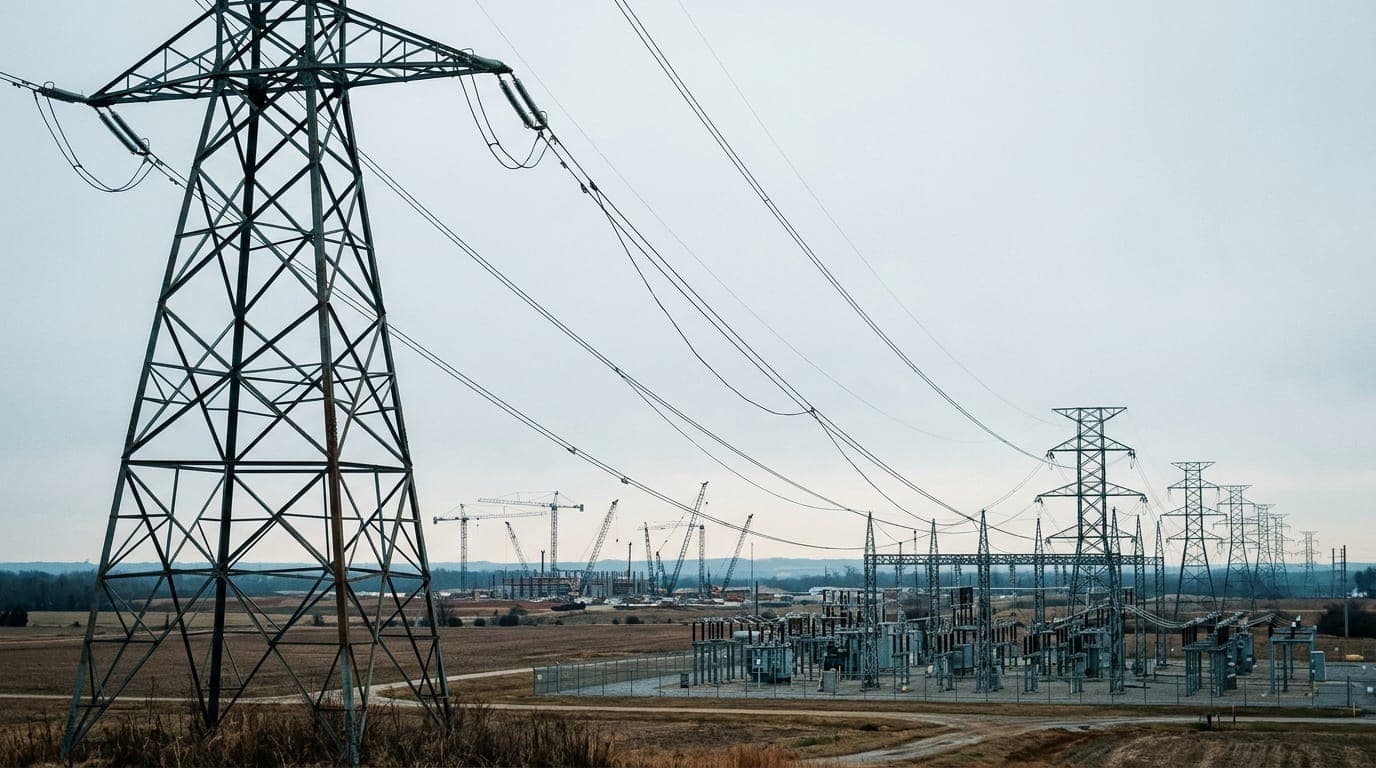
The U.S. Department of Energy's Office of Energy Dominance Financing (EDF) closed a loan of up to $3.26 billion to AEP Texas on July 8, 2026, funding approximately 100 transmission projects covering roughly 2,800 miles of rebuilding, reconductoring, and new construction, according to the DOE's official release. The explicit beneficiaries named by the DOE: AI data centers, advanced manufacturing, and Permian Basin oil and gas operations.
According to the DOE, this is the third concurrent conditional commitment and financial close, and the third utility financing completed through the Energy Dominance Financing Program, following a $1.6B loan to AEP Transmission (AEP's multi-state subsidiary covering Indiana, Michigan, Ohio, Oklahoma, and West Virginia) in October 2025, and $26.54B in loans to Southern Company's Alabama Power and Georgia Power in February 2026. Some outlets count AEP Texas as the fourth utility to secure EDF financing, reflecting a separate June 2026 close with DTE Gas that DOE counts differently in its concurrent-commitment tally.
What the Loan Actually Does
Per EDF program rules, the office can cover up to 80% of eligible project costs at Treasury-rate lending, with AEP responsible for the remainder. The subsidized interest rate, passed through to customers, is the basis for a projected $685 million in savings for more than 1 million households and businesses over 30 years, per the AEP Texas press release. That figure is a net-present-value estimate over three decades, not cash in anyone's pocket today. The upgraded lines are said to double the power-carrying capacity of the specific infrastructure being reconductored, not AEP Texas's system as a whole.
Energy Secretary Chris Wright framed the purpose plainly: "This investment will modernize Texas' electric grid, support the energy needed for AI, advanced manufacturing, the Permian Basin, and help keep electricity costs down for Texans."
Adrian Rodriguez, President and COO of AEP Texas, put the operational reality in fewer words: "This loan supports critical updates to our transmission infrastructure to strengthen reliability, connect new load and generation resources and manage affordability."
AEP Texas has signed letters of agreement supporting up to 41 GW of potential new load additions through 2030. Letters of agreement are not firm interconnection contracts. AEP's own spokesman confirmed the full project list is not yet finalized, meaning the total loan draw remains undetermined. The 41 GW figure represents potential, not committed, load.
The Squeeze Bitcoin Miners Are Already Feeling
The energy-scarcity story in Texas is about wires and queue position, not generation capacity.
The Stargate AI buildout has already been repricing power beneath Bitcoin miners for months. This $3.26B loan makes the federal commitment to AI infrastructure explicit: Treasury-rate capital is now flowing directly into the physical transmission layer that hyperscalers need to scale their Texas footprint. That is a capital subsidy to the AI industry's infrastructure, ultimately socialized across ratepayers' 30-year bills.
Bitcoin miners got to Texas first. They built the demand-response and flexible-load models that utilities used to justify large-load interconnection at scale. The miners who own the power gold rush built a case that is now being used to finance infrastructure that competes against them.
Miners bidding for firm, continuous power contracts are now sitting across the table from hyperscalers backed by federal debt. Miners with curtailable, interruptible load profiles retain a grid-service value that continuous AI workloads structurally cannot replicate. That moat is real. It is also narrowing.
The EDF has more than $250 billion in available loan authority. This is a programmatic federal commitment to U.S. energy infrastructure under the Trump energy dominance framework, not a one-off. Every additional loan accelerates the timeline at which marginal transmission capacity gets spoken for before Bitcoin miners can access it.
The DOE's own emergency orders earlier this year illustrated how acute the supply-demand tension on the grid has already become. Texas is the epicenter of that pressure.
What to Watch
The 41 GW in AEP LOAs is the number to track. If those letters of agreement fail to convert to firm interconnection agreements, whether from AI capex pullback, regulatory friction, or credit tightening in the tech sector, the demand-scarcity thesis breaks. Miners would re-emerge as the dominant large-load customer class rather than a contested second-tier user. If the LOAs convert and the broader interconnection queue continues to build, the transmission bottleneck deepens and the federal lending pipeline that just closed its latest deal becomes the primary mechanism determining who gets power access and when.
Sources
Frequently Asked Questions
What is the DOE's Office of Energy Dominance Financing, and how is it different from the Biden-era Loan Programs Office?
The EDF is the renamed successor to the Biden-era Loan Programs Office, rebranded under the One Big Beautiful Bill Act signed by President Trump on July 4, 2025. The statutory change shifted the office's mandate explicitly toward energy infrastructure supporting U.S. economic and industrial competitiveness. The lending mechanics, Treasury-rate loans repaid in full, are structurally similar. The strategic framing and prioritization of projects changed under the new administration.
Does this federal loan give AI data centers a grid advantage over Bitcoin miners in Texas?
Directionally, yes. The loan finances transmission infrastructure that AI data centers need to connect at scale, and it does so at subsidized federal borrowing rates that private capital alone would not provide on this timeline.
Bitcoin miners are competing for interconnection in the same queue. The structural advantage miners retain is flexible, curtailable load: grid operators value demand-response capability that AI inference and training workloads, which require continuous uptime, cannot easily provide. That distinction keeps miners relevant as grid partners, but it does not insulate them from the queue backlog or from competing against hyperscalers for the same marginal megawatts.
What are ERCOT letters of agreement and do they guarantee AEP Texas actually connects 41 GW of new load?
Letters of agreement are early-stage expressions of intent between a utility and a prospective large-load customer. They do not constitute firm interconnection agreements and carry no guarantee of connection.
AEP's own spokesman confirmed the project list tied to this loan is not yet finalized. The 41 GW figure reflects potential demand AEP has agreed to evaluate, not load that has cleared the full interconnection process. Conversion from LOA to firm agreement depends on project viability, grid capacity studies, and the customer's continued commitment, none of which are certain.