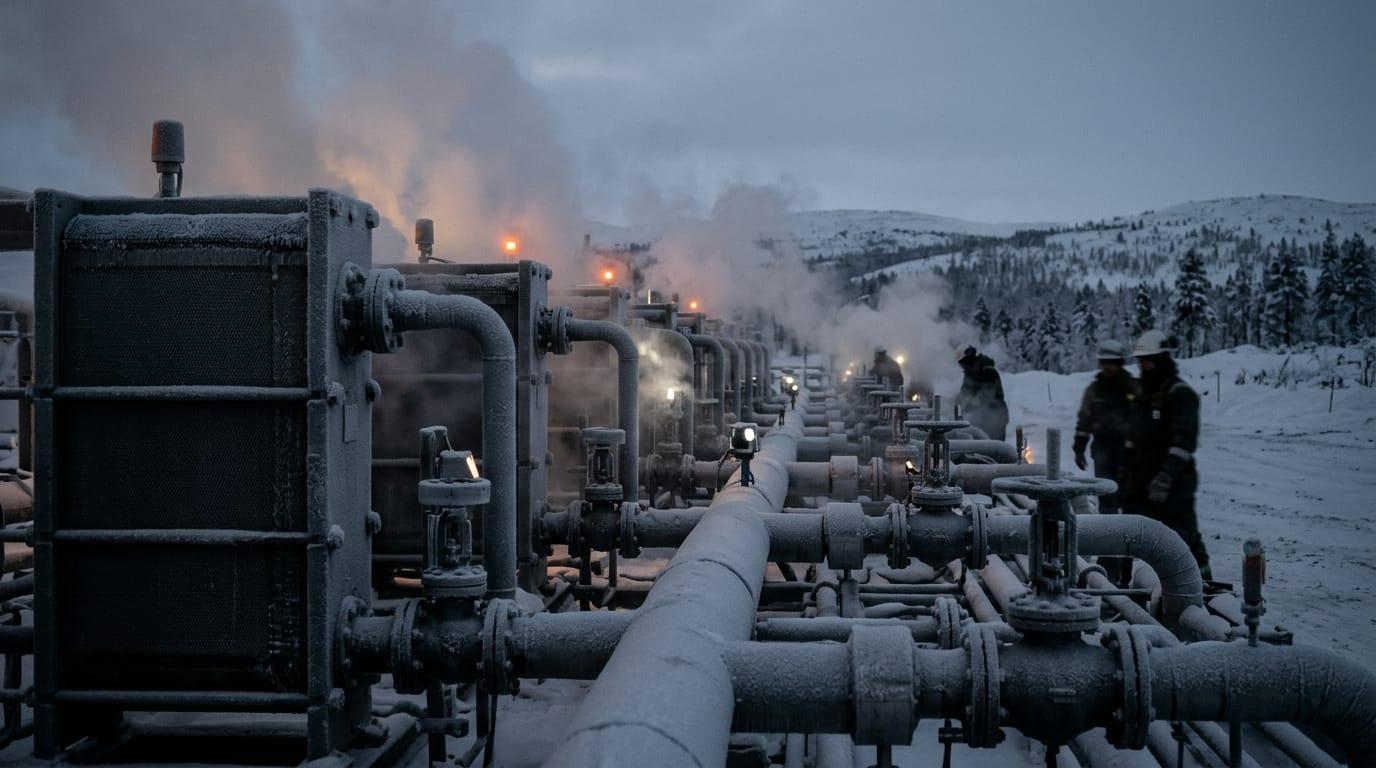
Iran Kills Two Italian Rheinmetall Engineers in Kuwait; Tankers Burn in Hormuz
Iranian drones killed two Italian Rheinmetall Italia technicians servicing Kuwait's Skyguard air-defense network on November 26, the same day IRGC-laid mines set at least two tankers ablaze in the Strait of Hormuz and sent Brent crude up more than 1.5%.
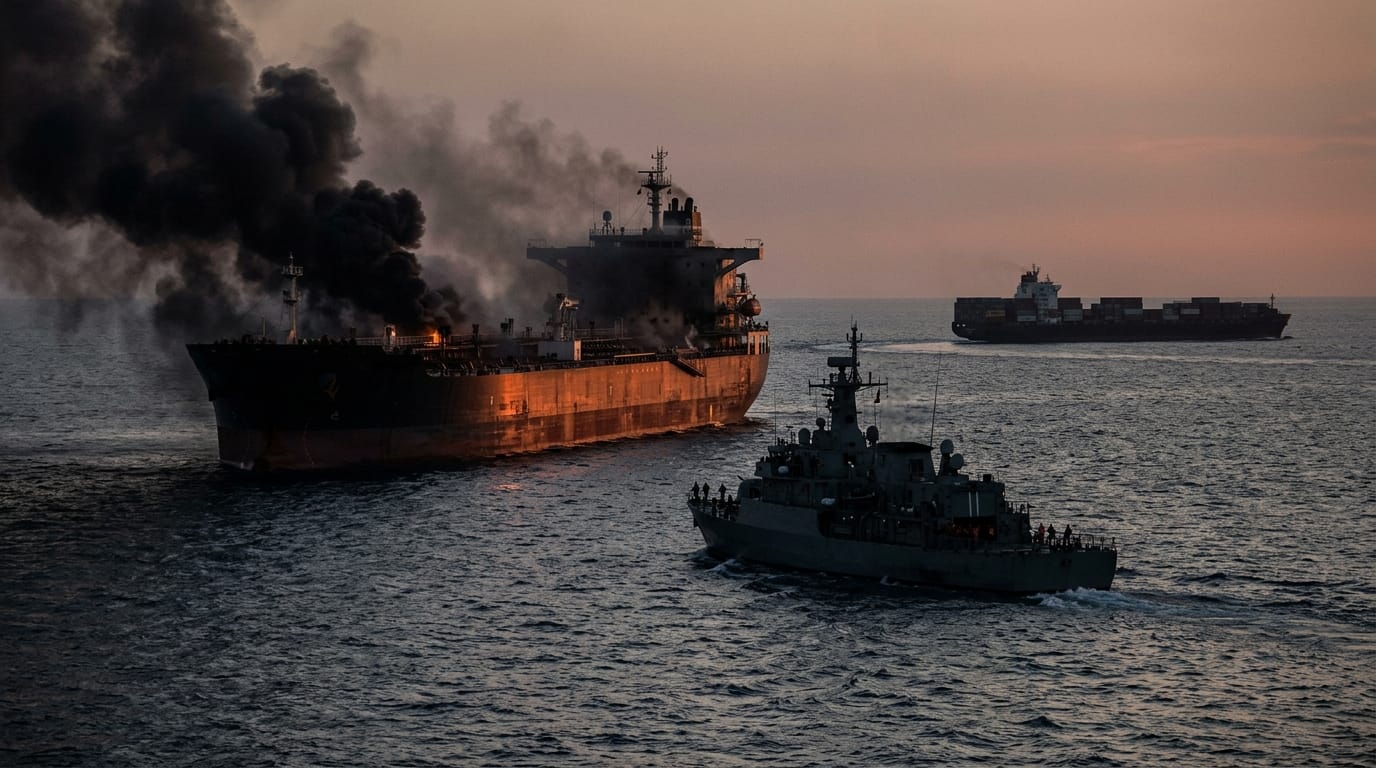
Iranian drones and IRGC-laid mines escalated the Hormuz crisis on two fronts simultaneously, killing NATO-linked civilian contractors and torching crude carriers in the world's most critical oil chokepoint.
Key takeaways
- Two Italian civilian engineers from Rheinmetall Italia were killed on November 26 when Iranian drones struck a Kuwaiti air-defense monitoring station, confirmed by Italian Foreign Minister Antonio Tajani in Senate testimony.
- Separately, at least two oil tankers, one carrying more than 2 million barrels of crude, struck IRGC-laid mines and caught fire north of Oman's Khasab Port in the Strait of Hormuz; a third vessel was hit by an unknown projectile the same day.
- Brent and WTI futures rose more than 1.5% on the news at time of initial reporting; verify current levels before citing as a settled figure, with IRGC Navy commander Rear Admiral Ali Azmaei claiming Iran has "full operational control" of the strait.
Iranian drones breached Kuwaiti airspace on Thursday afternoon, targeting what Kuwait's armed forces described as a "vital site" connected to the Skyguard air-defense detection network operated by the Kuwaiti military. Two Italian civilian technicians from Rheinmetall Italia, the Rome-based subsidiary of German defense group Rheinmetall, were servicing the system's detection antennas when the attack hit. Both were killed. A Kuwaiti army captain and a Pakistani national were injured, per Italy's Foreign Minister Tajani in Senate testimony and ANSA's report of the Farnesina statement. All commercial air traffic in the area was diverted south.
Tajani told the Italian Senate: "A powerful explosion occurred, and, according to reports reaching us from Kuwait, both of our fellow citizens have unfortunately died." He specified: "An air defence detection station where two Italian technicians from Rheinmetall Italia were working."
The Hormuz Strike
Simultaneously, the IRGC claimed two oil tankers struck naval mines north of Oman's Khasab Port in the Strait of Hormuz. One was a supertanker carrying more than 2 million barrels of crude; it was abandoned while still on fire. Reuters via The Print confirmed the IRGC statement, carried by Tasnim news agency. UKMTO, the British Royal Navy-linked maritime authority, separately reported a third vessel struck by an "unknown projectile" the same day, which typically indicates a drone attack. Whether a reported LNG tanker incident constitutes a fourth separate event or is the same UKMTO vessel is not confirmed; this piece reflects the two confirmed mine strikes and the UKMTO third vessel.
The IRGC framed the targeted tankers as transiting "an unauthorized route" with navigation systems switched off. That is an IRGC claim, not an independently verified fact.
IRGC spokesman Hossein Mohebbi: "We will not allow the continued naval, land, and air blockade imposed on our country." He added: "We will not accept the continuation of the current status quo, a state of neither war nor peace, or a war of attrition." IRGC Navy commander Rear Admiral Ali Azmaei declared Iran has "full operational control of the Strait of Hormuz."
This is the same theater where the IRGC struck Bahrain's radar infrastructure weeks earlier. The Bahrain radar strike followed a similar pattern: IRGC claims a successful hit, CENTCOM disputes it, oil reacts, and the cost of "the American route" quietly rises regardless of who wins the press battle.
What This Signals
Killing Italian civilian engineers inside Kuwait's airspace is a different category of provocation than mining shipping lanes. These were not soldiers. They were contractors servicing a Rheinmetall-made radar system under a defense export agreement, inside a Gulf ally's territory, doing the technical labor that keeps NATO-adjacent air-defense infrastructure functional. Italy is a NATO member. Rheinmetall is NATO's largest defense manufacturer by some measures.
That's the second-order effect the oil price move alone doesn't capture. The Hormuz mine campaign, running since February 2026, functions as a managed cost imposition. Tankers transiting "the American route" do so through ship-to-ship transfers, with higher freight costs and insurance premiums baked into every barrel. It doesn't produce a dramatic single-day price spike; it grinds into CPI month after month as a structural energy floor. That's exactly the kind of inflation the Fed has the least cover to call transitory, because it isn't demand-driven and rate hikes won't fix it.
Roughly 20% of global oil supply and approximately 25% of global LNG transits the Strait of Hormuz. The strait isn't closed. The U.S. Navy is escorting a reduced flow on the American route. But the assumption embedded in every oil price model, that the petrodollar security architecture keeps Gulf oil flowing at scale, is being tested in real time. Prior Hormuz tanker burns have shown the market's reflex is to price in a risk premium and partially fade it. The fade gets harder each time the IRGC demonstrates it can reach further: into Gulf airspace, onto defense contractor personnel, with apparent impunity.
Persistent, structurally-driven energy inflation keeps real rates negative for longer. That is the monetary environment where Bitcoin has historically accrued the most purchasing-power gains. The thesis doesn't require a dramatic Hormuz closure; it requires the slow erosion of confidence that the architecture holds.
The trigger that disproves it: U.S. Navy escorts re-establish unimpeded high-volume tanker transit within 30 days, Brent retreats below pre-attack levels, and 5-year inflation breakevens don't move on this event. If that happens, the market has correctly priced this as a contained probe, not a structural supply shock, and the hard-asset hedge thesis doesn't hold for this escalation.
What to Watch
Italy's response matters. Rome has defense personnel killed by an Iranian state action on allied soil. Whether Meloni's government treats this as a bilateral consular matter or escalates it to NATO is the near-term variable. Watch for a Kuwait Armed Forces statement on its official channels confirming final casualty figures, and watch the UKMTO advisory feed for confirmation on the third vessel's identity and the LNG tanker incident. Oil's initial move was the opening print; where it settles over the next 48 hours will tell you whether the market is pricing this as an escalation or filing it as noise.
Sources
Frequently Asked Questions
What is the Skyguard system, and why were Italian civilians maintaining it in Kuwait?
Skyguard is a Rheinmetall-designed radar and air-defense detection system. Kuwait operates it under a defense export agreement with Germany. Civilian contractors from the manufacturer routinely service and maintain foreign-military systems under such agreements. The engineers were not combatants; their presence reflected standard practice in defense equipment exports.
How much of global oil supply transits the Strait of Hormuz?
Approximately 20% of global oil supply and 25% of global LNG passes through Hormuz daily. A sustained blockade or significant reduction in transit capacity would constitute the largest single-route supply disruption in modern history. The strait is not currently closed; the U.S. Navy escorts a reduced commercial flow, but at materially higher insurance and freight cost than pre-conflict levels.
Has Iran actually closed the Strait of Hormuz?
No. The IRGC claims "full operational control," but tankers are still moving through the American route under U.S. Navy escort. The dispute is about sovereignty, cost, and signaling. Iran's mine campaign and drone attacks raise the cost of every barrel transiting the route without fully interdicting flow, which is the point: it's attrition, not closure.