Canaan's Nordic Bitcoin Heat Network Reaches 1,350 Units and 8,000 Homes
Two new purchase orders from existing customers push Canaan's Nordic hash-to-heat deployment to 1,350 units and nearly 12 MW, with capacity to heat roughly 8,000 homes, repeat-customer validation, not pilot-stage interest.
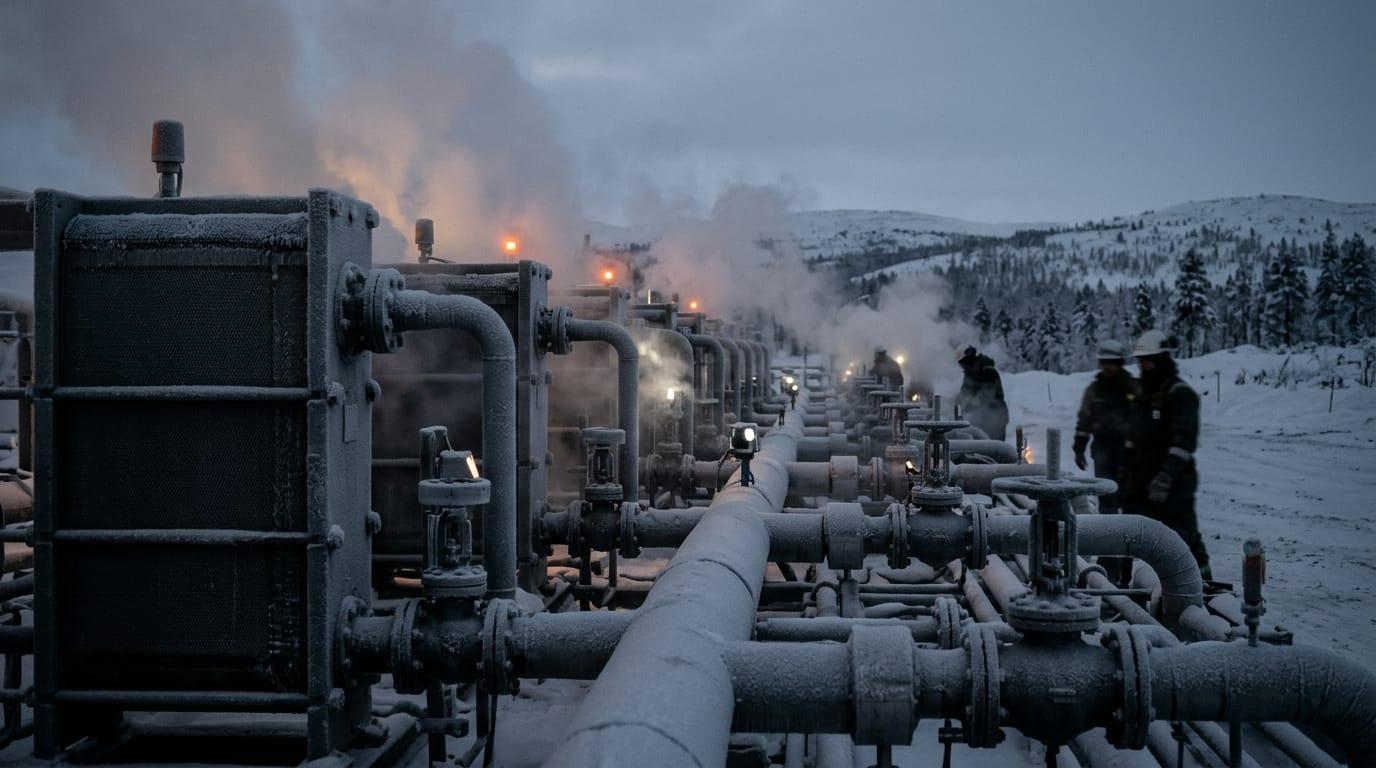
Repeat customers, competitive vendor selections, and 80°C water: Bitcoin mining is now infrastructure.
Key takeaways
- Canaan (NASDAQ: CAN) secured two new orders for 430 hydro-cooled Avalon A1566HA-500T miners from existing Nordic customers on November 25, lifting combined regional capacity to nearly 12 MW with potential to heat roughly 8,000 homes.
- Both orders followed more than four months of technical evaluation and competitive vendor selection processes; one customer cited live performance at an existing Canaan site as the deciding factor.
- Each unit produces 500 TH/s of hashrate AND ~80°C hot water from a single electricity input, directly displacing fuel combustion in existing heating networks.
Canaan Inc. announced November 25 that it has secured two additional purchase orders for 430 customized Avalon A1566HA-500T hydro-cooled mining units from existing Nordic customers, per the company's PR Newswire release, lifting its combined Nordic district heating portfolio to nearly 12 MW with the potential to serve roughly 8,000 homes. This is an operational model being renewed by operators who already have the data.
From 2,800 Homes to 8,000: How the Build-Out Stacked
Canaan's Nordic presence started with a 2 MW installation of 228 units, already operational before May 2026. A follow-on order for 692 additional machines representing 6 MW of capacity was announced in May 2026, bringing the original project to 920 units and 8 MW total, with Canaan estimating it could heat approximately 2,800 homes.
Wednesday's announcement adds 430 more units across two separate district heating locations. Total unit count across all Nordic contracts now stands at 1,350. The combined portfolio reaches nearly 12 MW. Estimated residential heating potential has nearly tripled from the original figure.
The 430 new units collectively represent 215 PH/s of aggregate compute. Each machine is engineered to output hot water at approximately 80°C (176°F). That thermal energy feeds directly into existing district heating networks, replacing heat that would otherwise come from fuel combustion.
Canaan Chairman and CEO Nangeng Zhang called it "an encouraging validation of our computing and heat-reuse solutions." That is an understatement. Both orders came through competitive vendor selection processes after more than four months of technical and commercial discussions. One customer explicitly cited performance at an already-operating Canaan site as the reason for selecting the manufacturer again.
That is a renewal decision based on live performance data.
Bitcoin Mining Competing as Heat Infrastructure
The standard framing on stories like this treats hash-to-heat as a quirky PR angle: miners find a clever use for waste heat, good for optics. That framing misses the structural point.
When a district heating operator runs a competitive vendor selection against conventional boiler suppliers and selects a Bitcoin miner, it is making an infrastructure procurement decision. The miner is winning on economics and reliability, which represents a category shift.
The second-order effects compound from there. Each new hash-to-heat contract normalizes the model for the next operator evaluating it. The EU's ongoing policy shift toward lower-carbon district heating creates a regulatory tailwind that few people are pricing into the mining sector: if non-combustion heat sources become preferred or required in public infrastructure tenders, Bitcoin miners become eligible candidates by default. Canaan's release explicitly references evolving EU policy as a backdrop.
There is also the reliability question that always comes up: conventional boilers are dispatchable; miners throttle with hashprice. The parallel-unit architecture across multiple independent sites, and the fact that existing customers keep reordering, suggests the thermal output has been consistent enough for heating grid operators to commit to expansion. That is the market giving its answer.
The "Bitcoin wastes energy" critique does not survive contact with a Nordic boiler room where an Avalon rack is now the heat source. The argument gets made in steel and water pipes, not in press releases. For the broader case that Bitcoin hashrate can serve as productive grid infrastructure, Canaan's build-out is proof-of-concept becoming proof-of-scale.
What to Watch
Canaan did not disclose customer identities, financial terms, or an installation timetable for the new orders. The thesis that Bitcoin mining is a stable, economically competitive heat source hinges on what happens at contract renewal. If heating operators decline to extend after this cycle because thermal output proved unpredictable relative to spot fuel costs, or if a sustained hashprice crash causes miners to underclock so aggressively that thermal delivery falls below grid requirements, the reliability argument breaks. Watch for any public disclosures from Nordic district heating operators on heat-pricing arrangements versus conventional fuel benchmarks, and whether any of the unnamed customers expand further or walk away.
Sources
Frequently Asked Questions
How does hydro-cooled Bitcoin mining actually heat homes?
Hydro-cooled miners circulate liquid coolant directly across the ASIC chips instead of using air. The coolant absorbs the heat generated by computation and exits the system at high temperature, around 80°C in Canaan's Nordic deployment. That hot water feeds into a district heating network's existing pipe infrastructure, which distributes thermal energy to connected residential and commercial buildings. The miner produces two economically useful outputs from one electricity input: hashrate and heat.
Does Bitcoin mining provide reliable enough heat for district heating grids?
The reliability concern is real. Unlike a boiler, a miner's output can fluctuate with hashprice economics.
The evidence from Canaan's Nordic deployment suggests the architecture has been reliable enough: an existing customer selected Canaan again specifically citing performance consistency, and both new orders came through formal competitive evaluations, not relationship-based decisions. Deploying across multiple independent sites with parallel units also reduces single-point-of-failure risk. Whether it holds across a full heating season at 12 MW combined capacity is the live test.
Where else is Bitcoin mining being used for heat recovery?
Beyond the Nordic district heating network, Canaan's own portfolio includes Avalon home heaters and greenhouse heat recovery projects in Manitoba, Canada. The broader category of hash-to-heat is expanding across the industry, but the Nordic district heating model is the largest-scale and most infrastructure-integrated deployment publicly documented so far.