Houthi Missile Hits Aramco Tower as Three Tankers Burn in Hormuz
A Houthi missile struck a Saudi Aramco administrative tower in Riyadh's financial core on November 8, 2026. The same morning, Iran's IRGC reported three oil tankers ablaze in the Strait of Hormuz. Brent crude sits at $95 after a $20 weekly drop on de-escalation hopes. The gap between political
Markets priced in de-escalation after the midterms. The Strait of Hormuz didn't get the memo.
Key takeaways
- Houthi forces struck a Saudi Aramco administrative building in Riyadh's King Abdullah Financial District on November 8, 2026. Saudi air defenses intercepted two cruise missiles and two ballistic missiles the same morning, but shrapnel still reached one of KAFD's tallest towers.
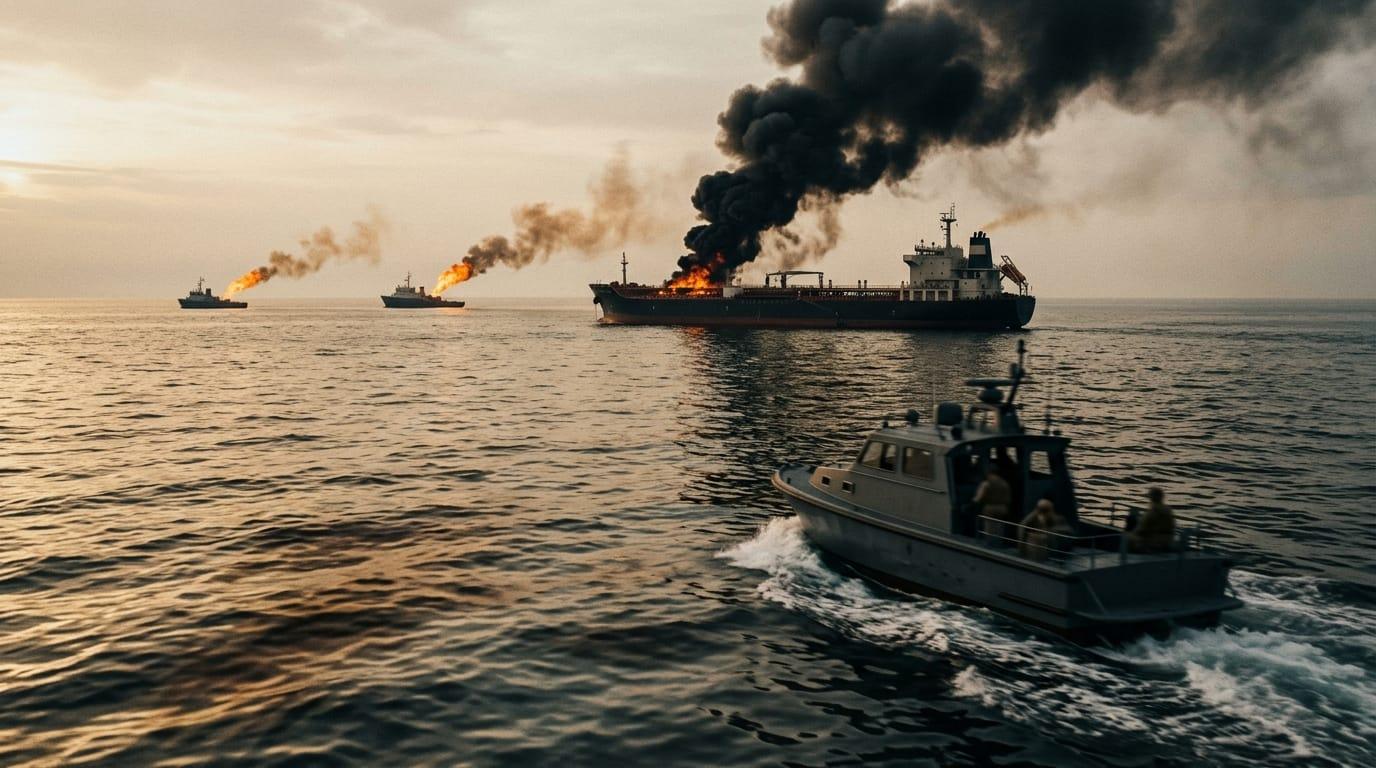
- Iran's IRGC simultaneously reported three oil tankers exploded and ablaze in the Strait of Hormuz, a waterway that handles roughly one-fifth of global oil consumption, per the U.S. Energy Information Administration.
- Brent crude sits near $98 after falling roughly 16% in the prior week as traders unwound a war-risk premium on bets that a Democratic midterm sweep forces the Trump administration toward a peace deal with Iran. Sunday's events challenge that bet directly.
Houthi forces struck a Saudi Aramco administrative building in Riyadh's King Abdullah Financial District on the morning of November 8, 2026. Iran's Islamic Revolutionary Guard Corps reported three oil tankers on fire in the Strait of Hormuz the same morning. Combined, these events are a live stress test for a market that just repriced a large de-escalation discount into Brent crude.
Saudi Arabia's Energy Ministry confirmed the attack via the Saudi Press Agency, stating that "an administrative building belonging to Saudi Aramco in Riyadh was subjected to an attempted attack" and that "falling shrapnel caused minor damage to the building, with no injuries or fatalities reported." Video circulated on X shows blown-out windows across multiple floors of the tower. Saudi-led coalition spokesman Turki al-Maliki confirmed that air defenses "intercepted and destroyed two ballistic missiles launched by the terrorist Houthi militia towards Riyadh," in addition to two cruise missiles over the southern region.
The IRGC statement on the tankers, relayed by Al Arabiya English, said that "three tankers that violated regulations by using a route through the Strait of Hormuz not authorized [by Iran] have exploded and have been engulfed in a fierce fire since early this morning." Iran did not name the vessels or confirm whether it actively targeted them. Separately, US Central Command reported that US forces disabled the St. Kitts-flagged M/V Huda in the Gulf of Oman after it allegedly attempted to breach the blockade of Iran.
The Gap Between the Market's Bet and the Ground Truth
Oil markets spent last week doing something specific: pricing in peace. Brent fell roughly 16% as traders unwound war-risk premium following the Democratic Party's midterm sweep, betting the result forces the Trump administration toward diplomacy with Tehran. At roughly $98, analysts have flagged that some residual risk premium may still be embedded in the price.
Sunday's events stress-test that logic directly. A missile reached the financial district of the world's largest oil oil exporter. Three tankers are on fire in the chokepoint that moves approximately one-fifth of global oil consumption. Houthi and IRGC operations did not pause to honor the market's de-escalation narrative.
The Hormuz flows context here matters. This is not the first probe of Riyadh's air defenses this cycle, and prior Houthi strikes on the capital have demonstrated consistent intent to push past the interception layer. The question Sunday answers partially: interception does not equal immunity. Shrapnel reached Aramco's tower in KAFD regardless.
The petrodollar structural risk compounds the picture. Saudi Arabia's ability to defend its financial infrastructure and its upstream energy assets simultaneously is under real pressure, and every missile that lands inside KAFD narrows the credibility of the deterrence argument.
What Oil as a Geopolitical Hostage Means for Hard Money
The monetary story running underneath the kinetic one is straightforward. Oil infrastructure is state-controlled, blockade-vulnerable, and missile-targetable. The energy economy underwriting the petrodollar system is a geopolitical hostage in ways that a fixed-supply, permissionless monetary asset is not.
When tankers burn in the Strait and shrapnel lands on the administrative tower of the world's largest oil exporter, the inflation transmission channel that fiat savings cannot hedge just went live again. Supply-shock inflation historically follows the kind of gap between political narrative and physical threat environment that markets are currently navigating. Fiat monetary systems are least equipped to absorb that shock. Bitcoin, with no exposure to pipeline politics or IRGC enforcement of "authorized channels," sits outside the blast radius entirely.
The falsifiable thesis: if Brent holds at or below $98 through end of week with no supply disruption and the tanker fires prove to be minor incidents with no effect on throughput volume, the market is correctly discounting the noise, and the geopolitical-to-hard-money transmission is overfit to this headline. That would mean Sunday's events were loud but not load-bearing for energy markets. Watch throughput data and the tanker fire resolution timeline closely.
What to Watch
Three things resolve the open questions quickly: whether Brent holds its level or breaks back toward $100-plus as the tanker fire details emerge; whether CENTCOM publishes a formal statement on the M/V Huda interdiction confirming the vessel name and blockade-breach language; and whether Saudi Aramco's bypass strategy for Hormuz faces new pressure if IRGC enforcement of "authorized channels" extends to additional vessels. Any further strike on KAFD or on upstream Aramco production infrastructure would confirm the market is materially mispricing the risk embedded at current prices.
Sources
Frequently Asked Questions
Is Saudi Aramco's oil production at risk from the Riyadh missile strikes?
The confirmed damage on November 8 was to an administrative building in the King Abdullah Financial District, not to upstream production infrastructure. The Saudi Energy Ministry characterized it as minor shrapnel damage with no casualties. Aramco's core production assets are located primarily in the Eastern Province, well away from Riyadh. The concern is trajectory: Houthi targeting has consistently crept toward higher-value assets across this escalation cycle.
How does Houthi escalation in the Gulf connect to bitcoin?
The direct link is inflation transmission. Oil is a state-controlled, geopolitically exposed commodity. When conflict disrupts its flow, the inflation that follows hits fiat savings and fixed-income assets hardest. Bitcoin has a fixed supply of 21 million coins, no counterparty exposure to Middle East energy infrastructure, and no central authority that can be coerced or blockaded. It does not make bitcoin immune to price volatility in the short run, but it does mean the monetary case for holding a genuinely scarce, permissionless asset gets stress-tested in real time every time a tanker burns in the Strait.