Saudi Arabia's Fiscal Collapse Threatens the Petrodollar's Structural Foundation
Saudi Arabia's real GDP is projected to contract 3.6% in 2026, public debt has surged 17% in a single year, and MBS has systematically dismantled the three pillars that held the kingdom together. If the rentier model cracks, so does the petrodollar loop that has backstopped U.S. deficit spending
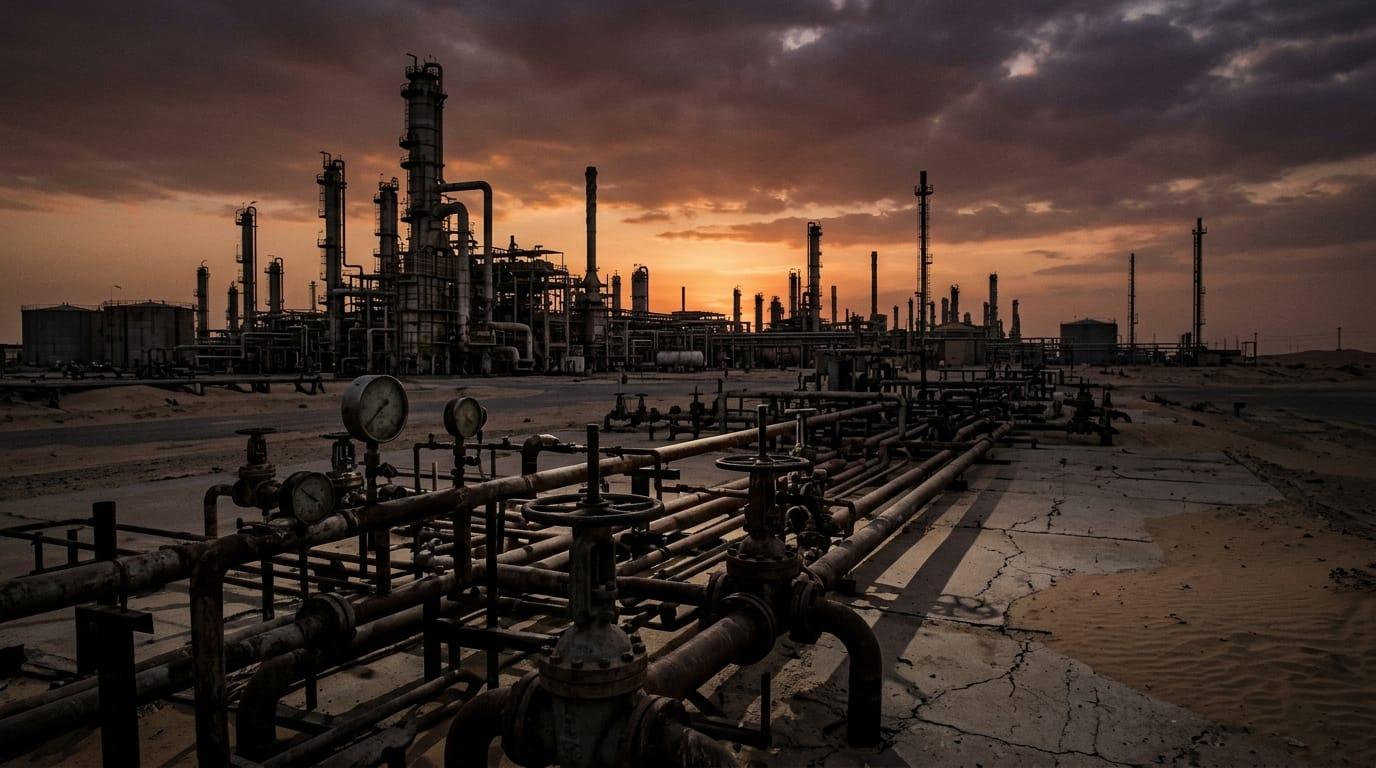
Saudi Arabia's rentier model is breaking under simultaneous pressure from war, demographics, and self-inflicted political fractures, and the monetary consequences extend far beyond Riyadh.
Key takeaways
- Saudi Arabia's real GDP is projected to contract 3.6% in 2026, driven by a 21.8% decline in the petroleum sector, per the Saudi Ministry of Finance's own pre-budget statement.
- Public debt surged nearly 17% in a single year to SAR 1,773 billion (~$473 billion) through Q3 2026, while the actual budget deficit has already blown past the full-year target by roughly 48%.
- A destabilized Saudi Arabia doesn't just mean Middle East geopolitical chaos; it means the petrodollar recycling mechanism that has backstopped U.S. deficit spending for 50 years loses its key participant.
Saudi Arabia's finances are deteriorating faster than its government projected, and the structural reasons why trace back decades. The Saudi Ministry of Finance's pre-budget statement for 2027, covering Q3 2026 fiscal data, shows public debt rising nearly 17% since January to SAR 1,773 billion ($473 billion), a year-to-date deficit of SAR 244 billion ($65 billion) already at the full-year revised estimate, and crude production at reported lows not seen in decades. The original 2026 deficit target was SAR 165 billion. The kingdom is on pace to blow past it by 48%.
The analytical synthesis drawing these threads together was first published at Stark Realities by Brian McGlinchey.
The Three Pillars MBS Knocked Down
To understand why the financial pressure is so dangerous now, the starting point is what held Saudi Arabia together since Ibn Saud unified the kingdom in 1932: distributed power-sharing across the royal family, the Wahhabi religious establishment's institutional legitimacy in exchange for political support, and tribal loyalty purchased through patronage, government jobs, and subsidies.
Crown Prince Mohammed bin Salman dismantled all three after consolidating power in 2017. He imprisoned hundreds of Saudi royals and business leaders at the Riyadh Ritz-Carlton, reportedly extracting $107 billion in settlements (per Saudi government claims). He stripped the religious police of enforcement powers, opened cinemas, allowed women to drive, and pushed a Westernization agenda that alienated the ulema without fully winning over the youth it was designed to pacify.
Chas Freeman, former U.S. Ambassador to Saudi Arabia, said on the Judging Freedom podcast, per McGlinchey's reporting: "He has offended virtually every constituency of the royal family. He's also offended the reactionary religious establishment, so he's made a hell of a lot of enemies."
The result is a kingdom with no distributed system to absorb a shock, at precisely the moment a shock has arrived.
The Math the Market Isn't Pricing
Saudi Arabia is a rentier state. The government doesn't tax its citizens into funding the state; it distributes oil revenue to keep them content. That model works when oil revenue is growing or stable. It fails when revenue falls while the population claiming a share of it keeps expanding.
63% of Saudi nationals are under the age of 30, according to Saudi Arabia's General Authority for Statistics (GASTAT), from the Saudi Census 2022. As of 2016, roughly two-thirds of employed Saudi nationals held government sector jobs, per GASTAT labor force survey data, a structural dependency that has weighed on the kingdom's budget for years.
The Houthi conflict has compounded the fiscal math in both directions. A March 2026 drone attack on the Ras Tanura refinery caused damage Bloomberg estimates in the tens of billions of dollars. The Houthis have imposed a declared naval blockade on Saudi shipping. Saudi FDI fell 17% year-on-year in Q2 2026 to $5.95 billion.
The petroleum sector, which drives the state, is down 21.8% for the year.
The Saudi Aramco response, pre-positioning crude in Singapore as a Hormuz bypass hedge, signals that the kingdom's own planners see the supply disruption risk as structural, not temporary.
The IMF projects Saudi GDP contraction at 3.3% for 2026; the Saudi MoF's own figure is 3.6%. Either way, the kingdom is running simultaneous debt expansion and output contraction. That combination is the classic precondition for a sovereign fiscal spiral.
The falsifiable thesis here: if Saudi Arabia stabilizes oil revenues above its fiscal breakeven (IMF estimated roughly $96/bbl for 2024; the 2026 figure needs confirmation against the IMF's October 2026 World Economic Outlook), successfully lifts non-oil GDP above 60% of total output, and MBS rebuilds internal coalition support among the royal family and ulema without triggering a succession crisis, the petrodollar backstop remains functional. Watch the Public Investment Fund's drawdown rate and the Houthi ceasefire status as the clearest real-time proxies.
What Breaks If the Kingdom Breaks
The petrodollar arrangement, forged after the 1973 oil crisis, made Saudi Arabia the demand-side anchor for U.S. Treasury debt. Riyadh recycled petrodollar surpluses into USTs; the U.S. got cheap borrowing; dollar dominance followed. That loop now faces pressure from three directions simultaneously: falling Saudi oil revenues reduce the surplus available for recycling; China's yuan-for-oil push finds a more receptive audience in a cash-strapped Riyadh; and the Public Investment Fund is burning reserves rather than accumulating them.
The Hormuz disruption is already compressing global oil flows. A Saudi regime crisis layered on top accelerates the timeline on all three paths. If the petrodollar recycling mechanism weakens materially, the U.S. either faces Fed monetization of deficits, higher Treasury yields crushing already-strained fiscal math, or faster de-dollarization as BRICS alternatives gain traction. Any of the three is inflationary for dollar holders.
Bitcoin's fixed supply of 21 million coins is indifferent to which path the dollar takes.
What to Watch
The PIF drawdown rate and any ceasefire development (or escalation) in the Houthi conflict are the two data points that determine whether this thesis accelerates or stalls. A Saudi sovereign wealth fund burning cash rather than accumulating it is the clearest signal the buffer is shrinking. A Houthi ceasefire that reopens shipping lanes and stabilizes oil export revenue buys MBS time. Absent both, the fiscal math tightens further into 2027.
Sources
Frequently Asked Questions
What is the petrodollar, and why does Saudi Arabia matter to it?
The petrodollar arrangement, formalized after the 1973 oil crisis, has Saudi Arabia selling oil exclusively in U.S. dollars and recycling the resulting surpluses into U.S. Treasury debt. This creates structural demand for both dollars and Treasuries, keeping U.S. borrowing costs lower than they would otherwise be. Saudi Arabia is the arrangement's largest and most visible participant. If Saudi oil revenue collapses and the surplus available for recycling shrinks, one of the primary structural buyers of U.S. debt weakens, putting upward pressure on yields and downward pressure on dollar demand globally.
What oil price does Saudi Arabia need to balance its budget?
The IMF estimated Saudi Arabia's fiscal breakeven oil price at roughly $96 per barrel for 2024. The 2026 figure, which would reflect the additional cost of war-related infrastructure damage and the deficit overshoot, has not been independently confirmed at time of publication; check the IMF's October 2026 World Economic Outlook or the Article IV consultation for the updated number. Brent crude trading materially below that breakeven is what converts a fiscal deficit into a debt spiral.
Could Saudi Arabia actually abandon the petrodollar and sell oil in Chinese yuan?
The structural incentive is growing. A kingdom facing a dollar-denominated debt surge and falling oil revenues has reason to diversify its buyer base and settle in whatever currency reduces its external financing burden. China is already the world's largest oil importer. The barrier has been political, not economic: the U.S. security guarantee underpins the arrangement. If MBS's internal political position weakens and the U.S. relationship becomes less reliable, the calculus shifts. No formal yuan-for-oil deal has been announced, but the conditions making one more probable are all moving in the same direction at the same time.