DP World's Fujairah Port Chips Away at Iran's Hormuz Leverage
DP World is negotiating a new multipurpose port in Fujairah on the UAE's Gulf of Oman coast, a direct capital response to the ~95% collapse in Jebel Ali container traffic after Iran closed the Strait of Hormuz earlier this year.
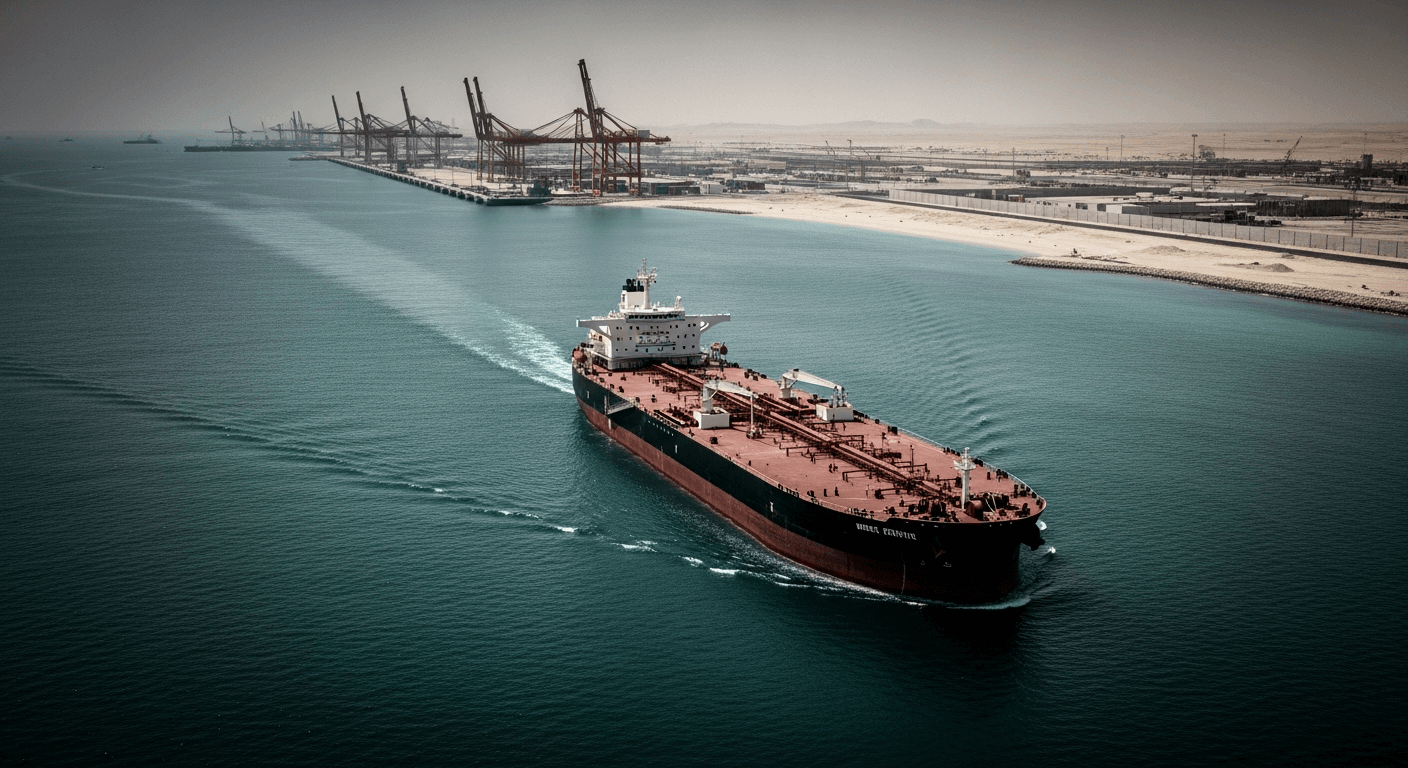
Dubai's state-owned ports giant is moving from contingency planning to capital deployment on a Hormuz bypass, and the math behind that decision is stark.
Key takeaways
- DP World is negotiating a term sheet with UAE government officials to build a new multipurpose port and container terminal in Fujairah, on the UAE's Gulf of Oman coast, outside the Strait of Hormuz.
- The move is a direct response to a reported collapse in container traffic at Jebel Ali after Iran closed the Strait of Hormuz; UAE Minister of Foreign Trade Thani Al Zeyoudi has publicly committed to "zero Hormuz dependency."
- For the Bitcoin macro picture, this is the structural defusing of the Hormuz-to-oil-spike-to-inflation-chaos chain that represented one of the more credible geopolitical tail risks to risk assets.
DP World, operator of Jebel Ali, the UAE's flagship port on the Persian Gulf, is in active talks to develop a new port and container terminal in Fujairah on the country's east coast, first reported by the Financial Times on July 14, 2026. The trigger is unambiguous: Iran's closure of the Strait of Hormuz earlier this year sent container volumes at Jebel Ali down sharply, a shock severe enough to push executives toward permanent structural alternatives rather than waiting out the disruption.
A senior DP World official told the Financial Times the project is "defensive in case things go wrong." A term sheet is under discussion with UAE government officials; structure and financing have not been finalized. The same official indicated the new port could be completed "as soon as within a year and a half," though that timeline is contingent on approvals and financing closing.
From Policy Promise to Hard Capital
The Fujairah move fits inside a broader UAE posture that is now backed by specific infrastructure commitments. UAE Minister of Foreign Trade Thani Al Zeyoudi told Bloomberg on June 17, 2026:
"We're moving toward having zero Hormuz dependency and that's regardless of whether it's open or not. It's going to open and we hope that will happen quickly, but we will not stop the new plan."
That plan includes new pipelines, rail, and road links connecting Gulf-side ports to Dibba, Fujairah, Khor Fakkan, and at least one additional new harbor on the Gulf of Oman coast. On the crude side, the Abu Dhabi Crude Oil Pipeline (ADCOP), running from Habshan to Fujairah, already carries roughly 1.5 million barrels per day and has been operational since 2012. ADNOC is fast-tracking a second crude pipeline to Fujairah, targeted for 2027, that would meaningfully expand that bypass capacity.
The Strait of Hormuz carries approximately one-fifth of global crude oil and LNG flows. The UAE's investment program is an explicit bet that this chokepoint's leverage will be engineered away, not negotiated away.
This isn't the first signal. The UAE's exit from OPEC and the broader energy repricing underway since the Hormuz closure have been pointing in this direction. DP World breaking ground (or even committing to a term sheet) converts those signals into concrete infrastructure.
What This Actually Means for the Macro Tail Risk
The Hormuz scenario had a specific path to Bitcoin-relevant macro chaos: credible closure threat leads to sudden energy supply shock, oil spikes, second-wave inflation arrives, central banks face the impossible choice of tightening into recession or capitulating and re-inflating, risk assets including BTC get caught in forced liquidation or in the whiplash of emergency fiat expansion. That chain required the chokepoint to remain a reliable, asymmetric weapon for Iran.
The more bypass capacity the UAE and Saudi Arabia build, the smaller the supply shock from any future closure. A smaller shock means a smaller inflation impulse, which means less policy chaos, which removes one of the more credible geopolitical macro headwinds for Bitcoin. This is the war premium slowly being priced out of the energy complex through physical infrastructure rather than diplomacy.
The nuance worth holding: Al Zeyoudi's "zero dependency" target applies most cleanly to crude oil. Pipelines move barrels. They do not move LNG, aluminum, or containerized manufactured goods. The reported collapse in Jebel Ali's container traffic is not solved by ADCOP or a second crude pipeline. The Fujairah port addresses the container routing problem directly, but it is an 18-month buildout at minimum, not an operational fix today. The tail risk does not go to zero. It goes structurally lower for energy inflation specifically, while remaining elevated for manufactured goods and specialty commodity flows until the new port is actually operational.
Iran has also demonstrated it can layer bitcoin-settled instruments on top of the Hormuz threat. A non-Hormuz leverage mechanism, whether in the Red Sea, the Bab-el-Mandeb, or the Gulf of Oman directly, would reassert an equivalent chokepoint threat and break the bypass thesis.
What to Watch
The thesis rests on capital commitment becoming physical infrastructure. The specific triggers to monitor: whether DP World and UAE officials move from term sheet to signed financing within the next 12 to 24 months; whether ADNOC's second crude pipeline reaches completion on its 2027 target; and whether Iran develops a new coercion mechanism outside Hormuz that replicates the leverage this buildout is designed to eliminate. A term sheet is intent. Breaking ground is commitment.
Update, September 23, 2026
The LNG side of the Hormuz story is now moving from price shock into permanent supply-chain restructuring. At last week's Gastech conference in Bangkok, energy executives, government officials, buyers, traders, and investors discussed the urgency of securing new supplies from conflict-free areas, largely because the Hormuz chokepoint has become a major liability. The numbers behind the pivot are concrete: roughly a fifth of all global LNG flowed through Hormuz before the war, and the disruption of transit via the Strait has reduced LNG supplies from Qatar and the UAE by over 300 million cubic metres per day since March 1.
Buyers are not waiting for diplomacy to reopen the lane. Inpex Corp., the Japanese energy producer, is considering investing in a US LNG export project, with its CEO stating that LNG flows through the strait "will not return to the previous status quo" and that "portfolio resiliency is important." Japan's top gas importer Jera has been ahead of this trade: Jera spent the last decade diversifying its sources and now depends on the Middle East for only about 5% of its LNG. The structural shift to US supply is already showing in the data: EIA figures show US LNG exports averaged 17.4 billion cubic feet per day in the first half of 2026, up 23% from a year earlier, with US exporters helping replace disrupted Gulf supplies as commercial maritime traffic in the Gulf of America remains stable.
The medium-term supply math is also deteriorating independently of the shipping question. Damage to LNG liquefaction infrastructure in Qatar is set to reduce projected supply growth, and short-term supply losses combined with slower capacity growth could result in a cumulative loss of around 140 billion cubic metres of LNG supply between 2026 and 2030.
Asia faces the most immediate exposure, as nearly 90% of the LNG transiting Hormuz in 2025 was destined for Asian buyers, but Europe is not insulated either, with Hormuz-linked LNG representing about 7% of Europe's imports, meaning competition for replacement spot cargoes spreads scarcity globally. The DP World Fujairah port build addresses container trade; the LNG rewiring is a separate, parallel structural shift that removes a different layer of Hormuz leverage simultaneously.
Sources
- Bloomberg interview, Thani Al Zeyoudi, June 17, 2026
- First reported by the Financial Times, July 14, 2026
Frequently Asked Questions
What is DP World and why does it matter who builds the Fujairah port?
DP World is Dubai's state-owned ports and logistics operator and one of the largest port operators in the world. Its involvement signals a government-backed strategic commitment. When the sovereign is effectively the client and the developer, the probability of financing closing and construction completing is materially higher than a purely private speculative project.
Does this eliminate the Strait of Hormuz as an oil price risk?
Not fully. Crude bypass capacity is scaling on multiple tracks, with the existing ADCOP pipeline already operational and a second UAE pipeline targeting 2027. But LNG, containerized goods, and manufactured imports moving through Gulf-side ports remain exposed until the Fujairah terminal is operational. The "zero dependency" goal is directional. It is not an operational reality yet.
Is the Fujairah port actually confirmed, or is this still speculation?
A term sheet is under negotiation between DP World and UAE government officials. Structure and financing are not finalized. No ground has been broken. The 18-month completion estimate comes from a senior company official quoted by the Financial Times, not a signed contract. The thesis rests on stated capital commitment intent. That is the key variable to track.