Commodities Hit 50-Year Low vs. Stocks, and Hard Assets Are Waking Up
The S&P GSCI/S&P 500 ratio is near its lowest reading in more than five decades. Jefferies, UBS, and Azoria Capital are calling a commodity upcycle driven by physical scarcity and structural dollar weakness. Bitcoin is the only hard asset the market can't supply its way out of.
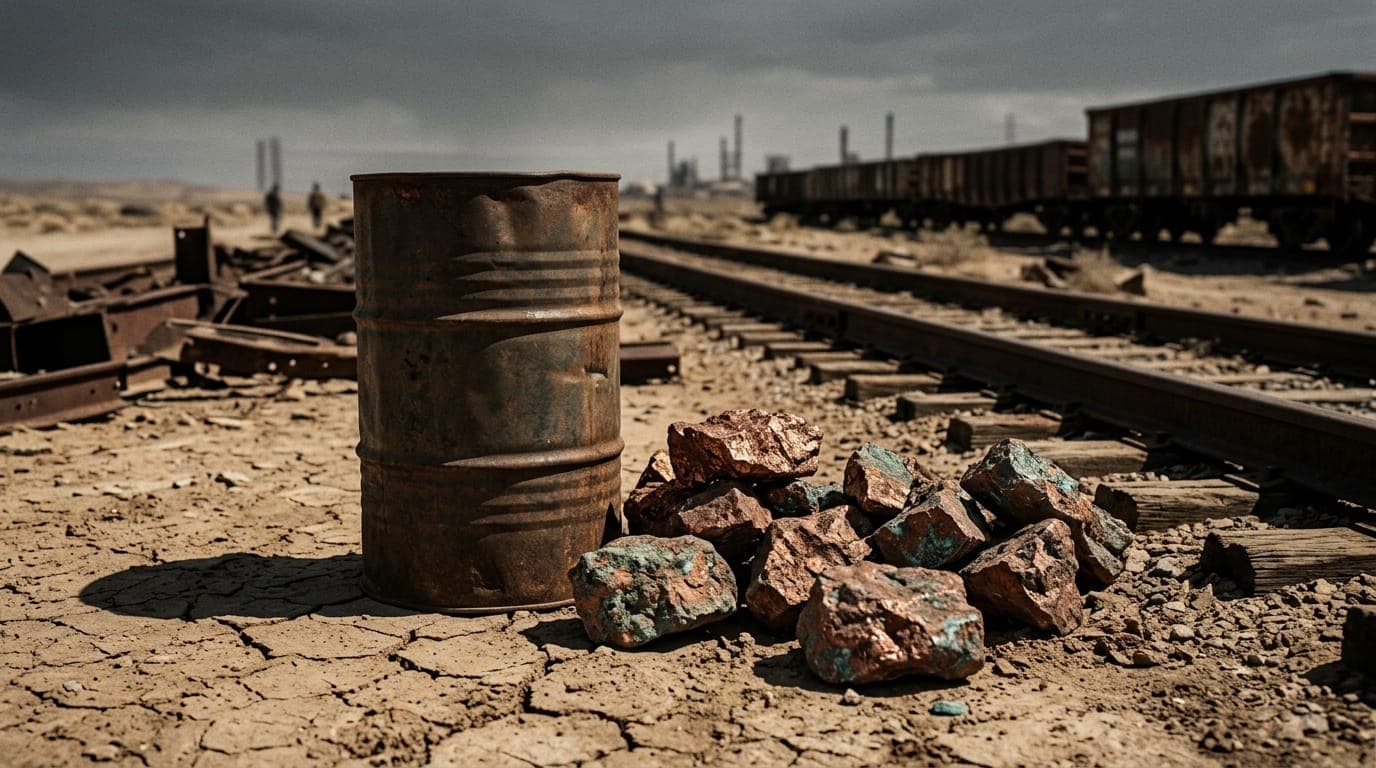
The S&P GSCI/S&P 500 ratio is near its lowest reading in more than five decades. Wall Street says the reversion is coming.
Key takeaways
- Jefferies' Christopher LaFemina told clients Saturday that the S&P GSCI/S&P 500 ratio is hovering near its lowest level in over 50 years, a trough that preceded sharp commodity outperformance during the Nifty Fifty and dot-com eras.
- UBS strategist Sagar Khandelwal published a note on August 21 urging clients to "position for a commodity upcycle," citing physical scarcity across energy, metals, and agriculture driven by underinvestment, electrification demand, and geopolitical fragmentation.
- Bitcoin is the only hard asset with a supply schedule that cannot respond to price signals, making it the terminal expression of the debasement trade that a commodity upcycle signals, not a commodity-cycle position that reverses when producers drill more holes.
The S&P GSCI/S&P 500 ratio is sitting near its lowest level in more than 50 years, per a client note from Jefferies' Christopher LaFemina, first reported by ZeroHedge on August 30. Similar troughs preceded commodity outperformance following the Nifty Fifty bubble and the dot-com collapse. The setup is different this time: instead of a single exogenous shock, structural underinvestment across energy, metals, and agriculture is colliding simultaneously with electrification demand, AI buildout, and China's weaponization of critical mineral exports.
UBS strategist Sagar Khandelwal reached the same conclusion ten days earlier. In a publicly available note dated August 21, 2026, Khandelwal told clients to "position for a commodity upcycle," pointing to physical scarcity emerging across multiple commodity classes.
What the Ratio Is Saying
The S&P GSCI is a production-weighted index of physical commodities: energy, metals, agriculture. The S&P 500 is a market-cap-weighted index of U.S. equities. When the ratio is low, stocks are expensive relative to the stuff the real economy runs on. When it reverses, commodity producers capture a larger share of economic output.
Previous upcycles in the ratio coincided with the 1970s oil embargo, the Gulf War, and the 2008 oil surge. Each was triggered by a supply shock. What LaFemina and Khandelwal are flagging now is not one shock but several compounding simultaneously: years of underinvestment in mining and energy, accelerating demand from AI infrastructure buildout, and geopolitical fragmentation closing off supply routes. London copper has crossed $14,000 per ton. Azoria Capital's Tavi Costa has documented agricultural commodities breaking out from nearly 20 years of resistance, a call he has made publicly across his Substack and X posts since March 2026. Critical materials tied to the AI supply chain are repricing sharply.
Azoria Capital's Tavi Costa put the monetary dimension plainly in posts on X dated August 29 and August 30, 2026. "The 10-year rolling change in the US dollar remains one of the most important macro developments in the world today," Costa wrote. "We are likely witnessing the beginning of a secular decline in the dollar, a necessary adjustment to the significant trade deficit the US economy faces today." A structurally weakening dollar amplifies every commodity price move by shrinking the purchasing power of the unit in which those commodities are priced.
This dynamic connects directly to the debasement trade that has driven institutional interest in hard assets across the board, and it reinforces the structural energy squeeze already radiating through global power markets.
Bitcoin at the Apex of the Debasement Trade
Commodity bulls are right about the diagnosis: fiat credibility is deteriorating, real assets are underpriced relative to financial assets, and the correction will be violent. The part they're leaving on the table is the asymmetry.
Physical commodities carry storage costs, counterparty risk, geopolitical seizure risk, and, critically, a supply response. When copper prices stay high long enough, miners sink more capital and produce more copper. The price signal eventually clears. That's how markets work. Bitcoin's supply schedule does not work that way. Miners can add hashrate; they cannot add coins. The 21 million cap is the only hard ceiling in this trade.
Governments running structural deficits face a specific squeeze in a commodity upcycle: rising input costs feed consumer prices, which creates political pressure, which makes fiscal consolidation politically impossible, which requires more debt issuance, which accelerates debasement, which pushes commodity prices higher. It's a feedback loop that erodes real bond yields and makes the hard-asset thesis self-reinforcing. Bitcoin sits at the apex of that dynamic in a way no commodity ETF does. The same institutions now accepting Bitcoin as loan collateral are reading the same LaFemina charts.
The falsifiable version of this thesis: it breaks if AI-driven productivity genuinely destroys commodity demand faster than supply is constrained, collapsing the copper and energy bids before the ratio reverts. It also breaks if a sustained dollar strengthening on credible fiscal consolidation keeps the GSCI/SPX ratio depressed. Neither outcome looks likely given current deficit trajectories, but those are the triggers worth watching.
What to Watch
The ratio itself is the signal. If the GSCI/S&P 500 begins a sustained reversal from these 50-year lows, the timeline on the hard-asset revaluation compresses fast. Watch copper, agricultural spot prices, and the dollar's 10-year rolling change. Watch whether capital concentrated in hyperscaler and AI equities begins rotating toward producers. And watch Bitcoin's behavior during that rotation: if it tracks with commodities, it's being treated as a risk asset; if it diverges and outperforms, the monetary premium thesis is being priced in separately from the commodity cycle. The latter is the outcome the sound-money case predicts.
Sources
- UBS "Position for a Commodity Upcycle", Sagar Khandelwal, August 21, 2026
- Jefferies, Christopher LaFemina bio
- First reported by ZeroHedge, Jefferies LaFemina client note, August 30, 2026 (no public primary URL exists for the paywalled institutional research document)
- Posts by @TaviCosta on X, August 29, 2026 and August 30, 2026
Frequently Asked Questions
What is the S&P GSCI and why does its ratio to the S&P 500 matter?
The S&P GSCI (Goldman Sachs Commodity Index) is a production-weighted benchmark tracking physical commodities across energy, industrial metals, precious metals, agriculture, and livestock. Dividing it by the S&P 500 shows how cheap or expensive real assets are relative to financial assets. A ratio at a 50-year low means stocks have almost never been more expensive relative to the physical stuff the economy actually consumes. Historically, extreme lows in this ratio have preceded multi-year periods of commodity outperformance.
Why are commodities so cheap relative to stocks right now?
A decade of cheap money made financial engineering more profitable than building mines or drilling wells. Passive capital flows concentrated in mega-cap equities, particularly AI and technology names. Underinvestment in energy, metals, and agriculture compounded quietly while stock multiples expanded. The result is a historically wide gap between financial asset valuations and the cost of physical production, just as demand from electrification and AI infrastructure is accelerating and geopolitical fragmentation is constraining supply routes.
Does a commodity upcycle automatically mean Bitcoin goes up?
Not automatically, and not for the same reason. Commodities rise because physical scarcity meets inelastic demand. Bitcoin rises because the monetary system loses credibility. Both can happen simultaneously, and both are consistent with fiat debasement, but they are not the same trade. Commodity prices will eventually respond to supply investment; Bitcoin's supply schedule won't. If the commodity upcycle thesis is correct, the debasement backdrop it implies is bullish for Bitcoin, but Bitcoin should be held for the monetary premium, not as a proxy for copper.