CleanSpark's $6.6B Georgia Lease Proves Bitcoin Miners Own the Power Grid
CleanSpark signed a 20-year, $6.6B triple-net data center lease with an unnamed investment-grade tech company. The same tenant holds an LOI on 885 MW of CleanSpark's Texas portfolio. The Georgia headline is just the opening move.
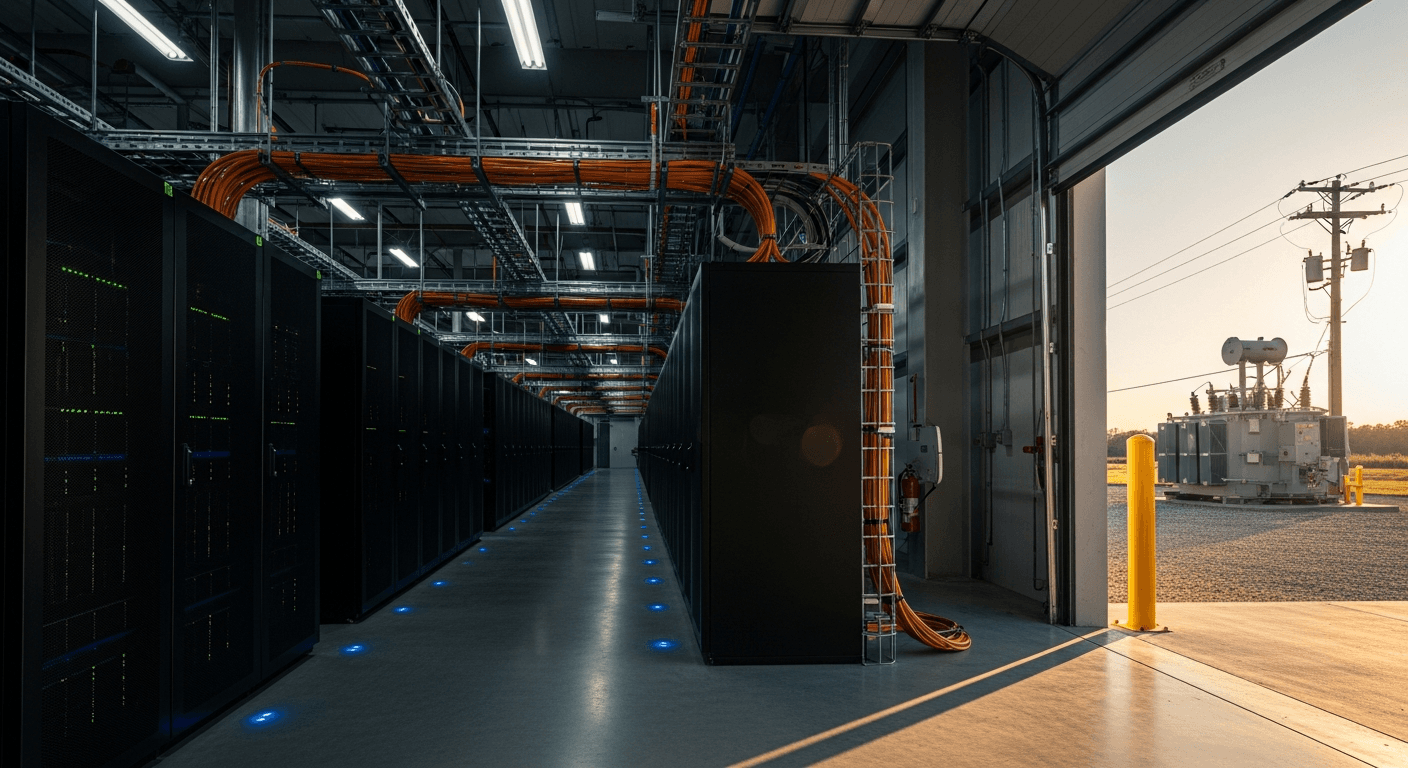
Bitcoin miners built low-cost power capacity to survive the halving. AI hyperscalers are now paying institutional rates to use it.
Key takeaways
- CleanSpark signed a 20-year triple-net lease for 175 MW of critical IT load at its Sandersville, Georgia campus, generating $6.6 billion in contracted revenue (rising to $11.6 billion if both 5-year extension options are exercised), per the company's SEC Form 8-K filed July 14, 2026.
- The same unnamed tenant executed a letter of intent covering CleanSpark's entire Texas portfolio, up to 885 MW across its Sealy and Brazoria campuses, making Georgia the first chapter of a potentially far larger deal.
- The lease projects roughly $330 million in average annual net operating income at near-100% margin. CleanSpark shares surged as much as 22% intraday on July 14.
CleanSpark (Nasdaq: CLSK) announced on July 14 that it signed a 20-year triple-net data center lease at its Sandersville, Georgia campus with an unnamed "high-investment-grade global technology company," contracting $6.6 billion in revenue over the initial term. The deal, executed July 10 and disclosed via SEC 8-K, covers 175 MW of critical IT load with phased deliveries beginning Q4 2027. Total value hits $11.6 billion if both five-year extension options are exercised.
CEO Matt Schultz called it "a transformational moment for CleanSpark as we complete our evolution into a diversified digital infrastructure platform and begin monetizing our power portfolio at institutional scale."
The Math the Headline Understates
The NOI projection is where this gets interesting. CFO Gary Vecchiarelli said on the investor call that direct costs will be minimal and NOI margins should be close to 100%, a structural consequence of the triple-net format where the tenant bears operating costs. That implies roughly $330 million in average annual NOI from a single lease.
The company's trailing twelve-month revenue was approximately $739 million across its entire mining operation. This one lease, if it delivers, adds a revenue stream equivalent to nearly 45% of that, at near-zero marginal cost.
CleanSpark's landlord build cost is pegged at $10 to $12 million per MW of critical IT load in the 8-K. At 175 MW, that puts required capital expenditure in the range of $1.75 billion to $2.1 billion for Sandersville alone. The company will need substantial debt financing to execute, and the 8-K is explicit: failure to meet financing, construction, and delivery milestones exposes CleanSpark to rent abatements or lease termination. The deal is transformational on paper. The execution risk is real.
The Texas Optionality Is the Sleeper
The Georgia announcement is the headline. The Texas disclosure is the story underneath it.
The same unnamed tenant executed a letter of intent and exclusivity arrangement covering CleanSpark's entire Texas portfolio: 271 acres with approximately 300 MW at Sealy and 447 acres with 300 MW (expandable to 600 MW) at Brazoria, totaling up to 885 MW. If that exclusivity converts into signed leases, the aggregate contracted value dwarfs the $6.6 billion Georgia figure and potentially the $11.6 billion figure with extensions.
One unnamed hyperscaler may be quietly consolidating CleanSpark's entire power portfolio across two states. That is a nationwide infrastructure consolidation story, not merely a data center story.
This pattern is not isolated to CleanSpark. TeraWulf's Anthropic lease and the Stargate buildout repricing power beneath miners all point to the same dynamic: AI hyperscalers need dense, reliable, geographically distributed power capacity on a timeline that precludes building from scratch. Bitcoin miners built exactly that, under halving pressure and at disciplined cost.
What CleanSpark Is Still Running
CleanSpark is not walking away from Bitcoin. Schultz confirmed on the investor call that the company will continue mining at Sandersville until power is formally transferred to the new data center. The company still holds and accumulates Bitcoin. The pivot is additive.
The Sandersville campus has been operational since 2022. The company controls more than 1.8 GW of power, land, and data center capacity across the United States. Financial advisor Morgan Stanley and legal counsel Davis Polk and Wardwell LLP advised on the transaction, per the 8-K exhibit.
Q3 results are expected this summer. Watch whether the company provides updated guidance on Texas LOI conversion and the debt financing structure for the Georgia build. Those two data points will determine whether this deal re-rates the stock durably or just produced a single-day pop.
The falsifiable thesis here: Bitcoin miners who built geographically distributed, low-cost power stacks are becoming the most defensible AI infrastructure landlords in America, and the market is only beginning to price that in. What disproves it: CleanSpark misses its financing or construction milestones and the unnamed tenant walks before Q4 2027 delivery. Or Bitcoin's mining economics recover faster than AI capex demand grows, flipping the opportunity cost of MW conversion negative and stopping the pivot in its tracks.
Sources
Frequently Asked Questions
Who is the unnamed tenant in CleanSpark's Georgia data center lease?
CleanSpark has not disclosed the tenant's identity, describing them only as "a high-investment-grade global technology company." The company has offered no further detail in the 8-K or the press release. No confirmed identification is available.
Does CleanSpark still mine Bitcoin, or is it pivoting away entirely?
CleanSpark will continue mining Bitcoin at Sandersville until power is formally transferred to the new data center, per CEO Matt Schultz on the investor call. The company still identifies as a Bitcoin accumulator. The infrastructure lease is an addition to the business, not a replacement of its mining operation.
What could kill this deal?
The 8-K explicitly flags the risk. CleanSpark must hit financing, construction, and delivery milestones or face rent abatements or outright lease termination. With an estimated $1.75 billion to $2.1 billion in required landlord build costs for the 175 MW Sandersville facility, the company needs substantial debt financing. Execution risk is the honest read that the stock-pop coverage tends to skip.