China's Record 244-Ship Swarm Around Taiwan Signals Blockade Rehearsal
China deployed a record 244 government vessels around Taiwan in July 2026, a fourfold increase over July 2025, per Taiwan's Coast Guard Administration. The activity looks less like routine maritime operations and more like a rehearsal for economic strangulation.
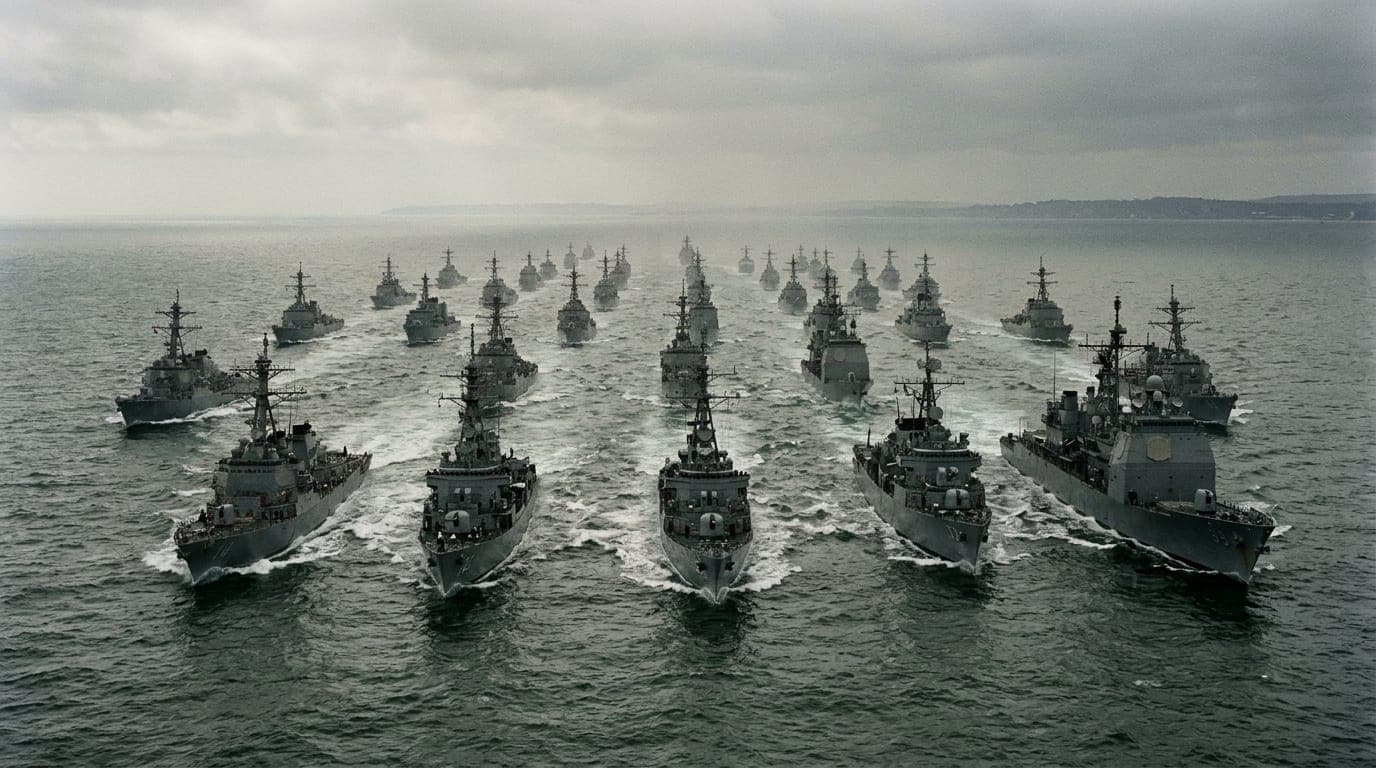
China's coast guard and government vessel deployments around Taiwan hit a record high in July, with the data pointing toward infrastructure-building for a future quarantine rather than routine maritime activity.
Key takeaways
- China deployed 244 government vessels around Taiwan in July 2026, more than four times the 58 logged in July 2025, per Taiwan's Coast Guard Administration data reported to AFP.
- Another 152 vessels were detected in the first 21 days of August, bringing the total since May 2026 to 1,247 ships, excluding PLA Navy warships that operate in the area near-daily.
- The vessel activity includes seabed mapping and oceanographic sampling consistent with anti-submarine warfare database construction, with a US Naval War College expert describing the scale as "unprecedented."
Taiwan's Coast Guard Administration told AFP that 244 Chinese coast guard, research, and other government vessels were detected in waters surrounding Taiwan in July 2026, compared with 58 in July 2025, 55 in June 2026, and 30 in May 2026. The surge averages roughly eight ships per day. A senior CGA official said plainly: "When we say the situation is becoming increasingly severe, we mean that the number of their government vessels in the waters surrounding Taiwan has increased, and there was a marked increase in July."
The figures exclude PLA Navy warships, which operate near Taiwan almost daily. Approximately 60% of the July vessels were Chinese coast guard ships; research and other government vessels made up the rest.
What the Ships Are Actually Doing
The activity is not flag-planting. Per Taipei Times reporting citing CGA analysis, the Chinese vessels are engaged in oceanographic sampling and seabed survey operations that feed into China's anti-submarine warfare capabilities.
Ryan Martinson, an expert on China's maritime strategy at the US Naval War College's China Maritime Studies Institute, told the Taipei Times that the data collected is useful for Chinese naval forces that will operate in these waters in the event of a conflict. He noted a significant increase in Chinese research ships operating around Taiwan, especially to the island's east, in recent months. His assessment, per the Taipei Times: "This is not a new 'play' in its 'playbook.' Rather, the novel aspect is that the scale of these operations around Taiwan is unprecedented."
The Institute for the Study of War has assessed that China is escalating its campaign to bring Taiwan's surrounding waters under its jurisdiction and may be testing the willingness of foreign vessels to comply with Chinese authorities in disputed waters, per CNN's August 2026 reporting citing ISW analysis. Chinese coast guard vessels have already been broadcasting jurisdictional radio challenges to commercial ships transiting the area. None have changed course yet. That is a present-tense condition, not a future scenario.
China also conducted its first law enforcement patrol east of Taiwan in June 2026, an area where PLA Navy operations have historically been absent, and announced "traffic control measures" for the Taiwan Strait during a late-summer typhoon. Both moves assert jurisdictional authority Beijing does not legally hold.
The Supply Chain Exposure Is Already Partially Activated
A blockade scenario gets framed as a future risk. The underlying supply-chain exposure is current.
China imposed export licensing controls on tungsten in February 2025. It holds export control authority over germanium and gallium through at least November 2026, following a partial suspension of an outright ban. China controls roughly 70% of global germanium production and approximately 80% of gallium. Tungsten runs through chip interconnects. Germanium sits inside fiber optic infrastructure and infrared sensors.
The maritime pressure campaign is being erected on top of a supply chain China has already begun to weaponize. The AI supply chain fragility exposed by optical transceiver policy moves is one dimension of the same problem.
For Bitcoin specifically, the hardware exposure is acute. ASIC miners (Bitmain, MicroBT) are manufactured almost entirely in mainland China and depend on Taiwan-proximate semiconductor supply chains. Bitcoin's hashrate is globally distributed. Its hardware pipeline is not.
A credible blockade threat, even a gray-zone soft version, introduces a durable capital risk premium into every mining operation planning its next machine purchase cycle. The server smuggling indictments already show how fragile and gameable that supply chain is under present conditions, before any blockade.
The falsifiable thesis: China does not need to fire a shot to fracture the supply chains that Bitcoin miners, chip fabs, and energy infrastructure depend on. The 244-vessel deployment is a live rehearsal for maritime jurisdiction seizure and, eventually, an economic quarantine.
The trigger that deflates it: a verifiable bilateral agreement, emerging from the scheduled September 24 Trump-Xi White House meeting, that produces a documented halt to vessel deployments and a rollback of critical mineral export controls. Watch for that. It has not happened.
What to Watch
The acceleration is the signal. May logged 30 vessels. June logged 55. July logged 244. The first 21 days of August logged 152.
If September continues at August's pace, the annual trajectory makes the 2024 and 2025 baselines look like baseline noise. Any diplomatic framework that bends that curve will be visible in the monthly CGA data. Until it does, the trajectory is up and to the right, and the premium on assets that clear without counterparty exposure to any particular strait grows with it.
Sources
Frequently Asked Questions
Could China impose a blockade on Taiwan without a military invasion?
Yes, and that appears to be the scenario being rehearsed. A gray-zone quarantine or "soft blockade" uses coast guard and government vessels to assert jurisdictional control, intercept shipping, and compel compliance from commercial traffic without a formal military strike. The jurisdictional radio challenges already being broadcast to commercial ships transiting Taiwan's waters are the early infrastructure of exactly that scenario. A soft blockade does not require favorable invasion weather windows and can be initiated at any point.
How would a Taiwan Strait blockade affect Bitcoin mining hardware?
Bitcoin ASIC hardware is manufactured predominantly in mainland China by Bitmain and MicroBT. A blockade or credible quarantine threat would disrupt the entire pipeline of new mining machines reaching global operators. Hashrate itself is globally distributed and would not disappear, but the capital planning cycle for any operation expanding or replacing hardware would face severe uncertainty and likely a significant cost premium. The constraint is on new machine supply, not on the existing network.
What critical minerals does China control that matter for semiconductors and Bitcoin infrastructure?
China controls roughly 70% of global germanium production and approximately 80% of gallium, both critical to semiconductor fabrication and fiber optic infrastructure. Tungsten, subject to Chinese export licensing controls since February 2025, runs through chip interconnects including those used in advanced TSMC processes. These are the same materials that feed ASIC production. China's export control regime over these inputs is active now, not a contingency.