DOE's $581M TVA Grid Award Proves Transmission Is the Binding Constraint
The DOE's $581M TVA grid investment formalizes what everyone already knew: you can build all the generation you want, and none of it moves without wire. Ratepayers are now explicitly subsidizing the infrastructure AI hyperscalers need.
The federal government just socialized the cost of wiring up AI's next decade. Bitcoin miners already in the queue have a structural advantage that is hardening by the month.
Key takeaways
- The DOE formalized a $581 million investment on October 13 to fund 84 TVA transmission and distribution projects across eight states, expecting to add 2.5 GW of capacity, though the award was first selected in October 2024 and final agreements remain unsigned.
- Transmission scarcity, not generation shortfalls, is the explicit binding constraint on the AI buildout in the TVA region, with Goldman Sachs Research flagging Tennessee as "critically tight" and multi-year U.S. grid interconnection waits compounding the problem.
- Federal taxpayers and TVA ratepayers are absorbing the transmission upgrade costs that AI hyperscalers require, while Bitcoin miners operating with flexible or behind-the-meter load arrangements hold a structural position those hyperscalers cannot replicate quickly.
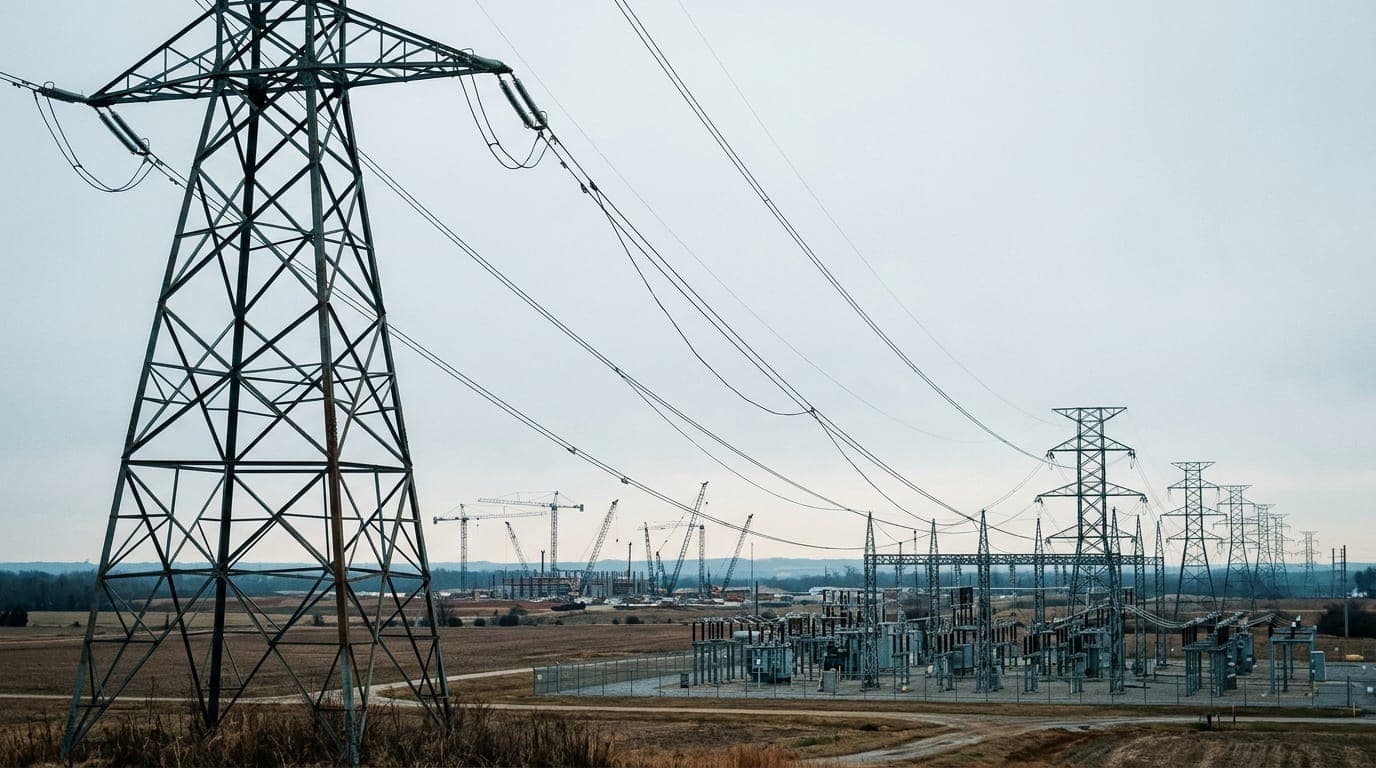
On October 13, the U.S. Department of Energy announced plans to help the Tennessee Valley Authority fund 84 transmission and distribution projects across eight states, adding approximately 2.5 gigawatts of grid capacity through a $581 million award split between $250 million in federal funds and roughly $331 million in TVA cost-share. The award was first selected in October 2024. Two years later, it is being formalized at a press event in Knoxville, and final project agreements are still unsigned.
Deputy Secretary of Energy James P. Danly made the announcement in person at TVA headquarters: "America is blessed with an abundance of natural resources and some of the most advanced technology in the world, but we must have the generation and transmission infrastructure necessary to support our rapidly growing economy and its electricity needs." Senator Bill Hagerty posted his own reaction on X citing the projected jobs and power for families and businesses served by the award.
What the Award Actually Covers
This GRIP award sits alongside a separate but stacked TVA commitment under the DOE's SPARK program: roughly $80 million federal to reconductor approximately 125 miles of existing lines in Tennessee, Alabama, and North Carolina using advanced conductors, adding about 1,900 MW. SPARK itself is a $5.25 billion nationwide program ($1.9 billion federal, $3.35 billion cost-share) covering 31 projects in 26 states and more than 1,500 miles of lines for over 23 GW of freed capacity.
Combined, TVA has nearly $741 million in planned grid investment for more than 4,300 MW of added capacity. Both awards draw from GRIP, the $10.5 billion Grid Resilience and Innovation Partnerships program created by the 2021 Infrastructure Investment and Jobs Act.
TVA's own long-term planning makes the urgency clear. Its 2026 Integrated Resource Plan projects the region will need significant additional generation by 2040. TVA already has substantial new capacity under construction and secured a $400 million DOE award for a GE Vernova Hitachi BWRX-300 small modular reactor at the Clinch River site. Every one of those megawatts still needs wire.
The Queue No One Wants to Solve
The wires matter more than the watts right now. Goldman Sachs Research flagged Tennessee as one of the markets "likely to see constrained data center additions since the market is already critically tight" and separately warned clients that power scarcity is the primary risk that could slow the U.S. in the AI race with China. Goldman also documented multi-year waits, ranging from two to seven years depending on region, just to get permission to connect to the grid. That queue applies to every new load, AI data center and Bitcoin miner alike.
The hyperscalers have noticed. Goldman projects behind-the-meter generation will power roughly a quarter of all global data center power demand by 2030. A quarter of the industry is effectively giving up on the grid and building its own. That is not a confidence indicator in the transmission buildout, and it means a significant portion of announced AI capex lands outside the grid entirely, leaving the ratepayer-funded wire upgrade serving a smaller addressable load than the price tag implies.
The cost structure here matters. The $581 million is split between federal taxpayers and TVA ratepayers, not the Meta or Amazon capex budgets that will ultimately use the capacity. Hyperscalers have argued in policy conversations that shared grid upgrades provide a system benefit that ratepayers should absorb broadly.
Tuesday's announcement is that argument winning. The public eats the infrastructure cost; the hyperscaler captures the upside. Projections of tens of trillions in AI data center capex through mid-century are built on the assumption that someone else strings the wire.
What to Watch
The falsifiable version of this thesis: if DOE and TVA execute all 84 project agreements within 12 months and interconnection wait times in the TVA footprint fall materially below 18 months for new load connections, transmission stops being the binding constraint and the story pivots to generation scarcity. Until that happens, announced megawatts are not deliverable megawatts, and every high-power load operator in the Southeast should be tracking the interconnection queue as closely as the energy price. Bitcoin miners with secured grid access or flexible behind-the-meter arrangements are not disadvantaged in this environment. They are ahead.
Sources
Frequently Asked Questions
What is the GRIP program and where does the money come from?
GRIP stands for Grid Resilience and Innovation Partnerships. Congress created it through the 2021 Infrastructure Investment and Jobs Act (Bipartisan Infrastructure Law) and funded it with $10.5 billion total. SPARK, TVA's second award, is the third and final GRIP funding round, covering 31 projects nationally. The TVA awards combine $250 million federal (GRIP) plus approximately $80 million federal (SPARK), with TVA and local power companies providing cost-share on top.
How long does it actually take to connect a new load to the U.S. power grid?
Per Goldman Sachs Research, interconnection queue times in the U.S. range from two to seven years depending on which regional grid a project is connecting to, before a single cable is laid or transformer purchased. That queue applies to data centers and Bitcoin mining operations equally. Loads that have already cleared interconnection, or that operate behind the meter, bypass this bottleneck entirely.
What does the TVA grid expansion mean for Bitcoin mining in the Southeast?
Every megawatt of firm transmission capacity allocated to an AI data center in the TVA footprint is a megawatt unavailable to competing loads at grid rates. Miners who secured grid access before the queue deepened, or who operate in flexible demand-response arrangements, hold a position that is structurally harder to replicate as the interconnection backlog grows. The ratepayer-funded upgrade benefits all loads on the wire, but only loads that can actually reach the wire in time to use it.