Brookfield and NextEra Plan $100B AI Campus at DOE's Paducah Site With 4.6 GW
Brookfield and NextEra announced July 29 a $100B AI data center campus at the DOE's former Paducah uranium enrichment site, targeting 1.8 GW of utility capacity backed by up to 4.6 GW of dedicated private generation. The grid couldn't supply it, so they're building their own.
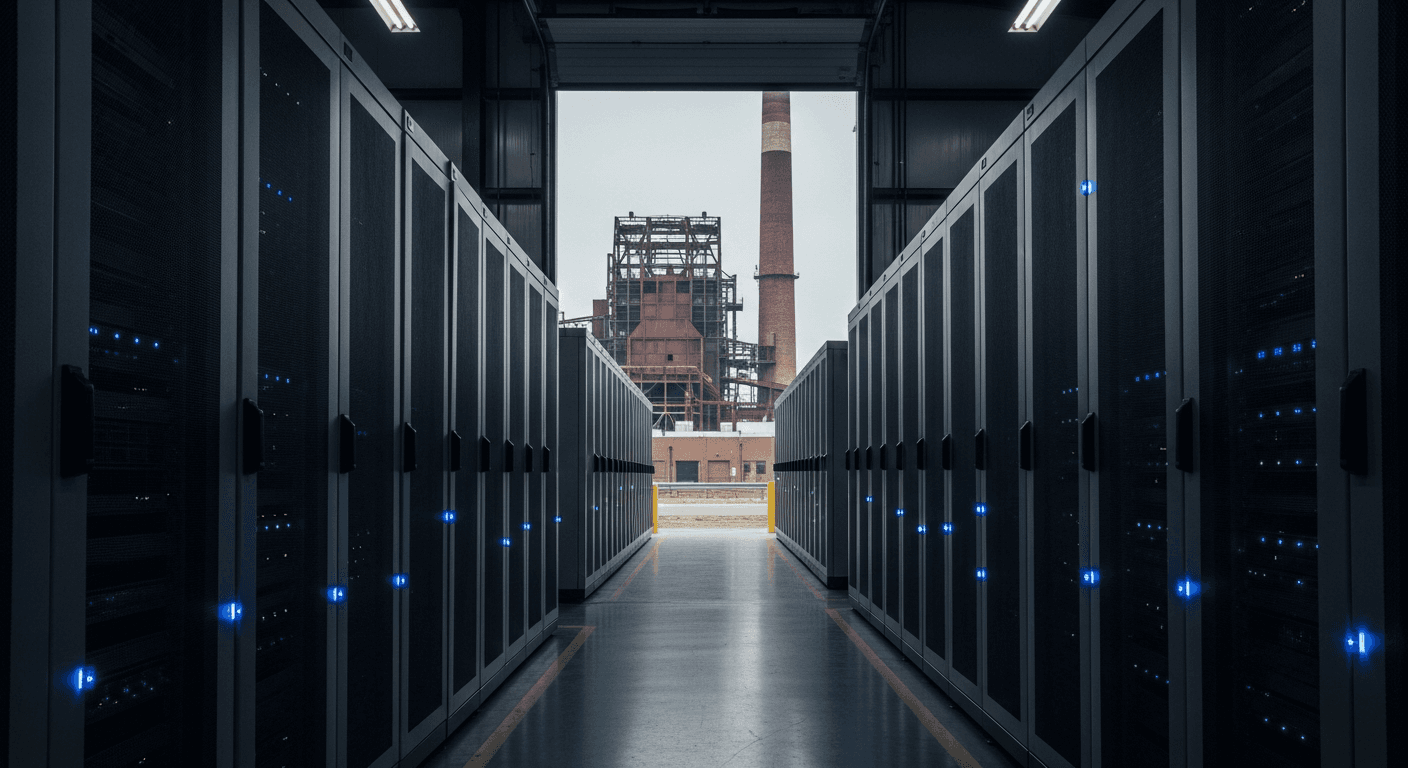
The existing grid couldn't feed it, so they're building the power plant too.
Key takeaways
- Brookfield and NextEra announced July 29 a $100B AI data center campus at the DOE's former Paducah Gaseous Diffusion Plant, targeting 1.8 GW of utility capacity and over 1.2 GW of compute capacity.
- NextEra will construct up to 2 GW of natural gas-fired generation and up to 2.6 GW of battery energy storage, a dedicated power stack of up to 4.6 GW, entirely privately funded with no costs passed to existing ratepayers.
- The deal sets the new baseline for frontier AI infrastructure: campuses now require dedicated off-grid-scale generation, intensifying the competition for firm, dispatchable electricity that Bitcoin miners depend on.
Brookfield and NextEra Energy announced on July 29, 2026, a plan to develop a $100 billion AI data center campus on the DOE's Paducah Site in western Kentucky, a former Cold War uranium enrichment facility that has sat in cleanup status for decades. The project will target up to 1.8 GW of utility capacity and over 1.2 GW of compute capacity, expected to be complete by 2031 per the DOE's official release, and is described by the DOE as one of the largest private investments in Kentucky's history.
The coalition also includes Big Rivers Electric Power Corporation, Jackson Purchase Energy Cooperative, and Paducah Power System. Per the coalition's announcement and the DOE's official release, Brookfield will lease the land from the DOE, develop and operate the campus, while NextEra builds and owns up to 2 GW of natural gas-fired generation and up to 2.6 GW of battery energy storage. The project is subject to negotiation and execution of definitive agreements, meaning the $100B commitment is a plan, not closed financing.
The campus is expected to create roughly 8,000 construction jobs and 600 permanent positions, and is structured to comply with Trump's Ratepayer Protection Pledge, meaning zero cost passed to existing residential or small-business customers. The deal flows from a series of Trump administration executive orders on AI leadership, energy, and federal permitting, and from a DOE Request for Offers issued November 4, 2025, which explicitly invited proposals integrating small modular reactors and nuclear capacity. The selected plan uses natural gas and battery storage.
The Power Math Is the Story
NextEra Chairman, President and CEO John Ketchum stated it plainly: "This project is a proof point for how AI infrastructure should be built in America. The data center will bring its own power, pay for its own power infrastructure and create good-paying jobs for local workers."
That sentence contains the tell. The campus needs 1.8 GW of utility capacity. To deliver firm, reliable power for AI training and inference at that scale, the developers are building up to 4.6 GW of dedicated generation from scratch. That is a ratio of roughly 2.6x generation capacity to campus load, and it is not a rounding error. It reflects how completely the existing grid has failed to keep pace with frontier AI capex demand.
DOE Secretary Chris Wright said: "It's difficult to overestimate the importance of this project." The Paducah Site, operational since 1952 as a gaseous diffusion plant, is being repositioned as the seed of a $100B private infrastructure stack. DOE Assistant Secretary Tim Walsh: "We are intently focused on finding ways to put federal land back to productive use for the American people." Brookfield Corporation CEO Bruce Flatt described the site as "the seed of our plan to invest $100 billion in AI infrastructure."
The DOE named Paducah as one of four federal sites targeted for AI data center development in July 2025, alongside Idaho National Lab, Oak Ridge, and Savannah River. The Savannah River award followed a similar template of pairing a federal site with dedicated generation. Paducah scales that model further with 1.8 GW of utility capacity backed by up to 4.6 GW of dedicated generation.
What This Means for Bitcoin Miners
AI hyperscalers can now outbid nearly every other industrial load for firm grid access. The Paducah model, federal land plus dedicated generation plus no ratepayer subsidy, is explicitly the template the Trump administration intends to replicate at the remaining federal sites. Each replication pulls on the same finite pool of engineers, grid interconnection queue slots, transformers, switchgear, battery storage equipment, and power purchase agreements that Bitcoin mining operations need.
The AMD-Anthropic 2 GW deal and the DOE's $3.26B Texas grid loan pointed the same direction. Paducah confirms the pattern is no longer episodic. When AI campuses must build their own generation because the grid cannot accommodate them, the scarcity of firm dispatchable power becomes structural, not cyclical.
There is a bull case embedded in the squeeze. Bitcoin miners who already hold pre-permitted, grid-connected sites with operating interconnections become increasingly valuable as brownfield alternatives, real estate that AI firms can acquire or lease to skip years in the permitting queue. The miners who survive the power competition will hold the most valuable digital infrastructure real estate in the country. That is a meaningful long-term asymmetry even as the near-term cost pressure is real.
One more asymmetry worth noting: the Trump administration has issued executive orders specifically accelerating AI infrastructure on federal land. No equivalent order exists for Bitcoin mining infrastructure. The political gap matters for long-term regulatory posture.
What to Watch
The thesis holds as long as large AI campus announcements continue to require dedicated generation buildout rather than interconnecting to existing utility grids. If the next wave of projects at Idaho National Lab, Oak Ridge, or elsewhere successfully absorbs into existing grid capacity without dedicated buildout, and industrial power prices remain stable, the scarcity signal weakens. If Kentucky's Public Service Commission modifies the power service structure in ways that reduce the campus's dedicated generation component, that would also challenge the model. Watch the DOE's remaining federal site awards and whether the generation-to-load ratio holds at 2x or above. If it does, the Paducah model is the new floor.
Update, July 30, 2026
The Paducah site is not just flipping from uranium plant to AI campus. It is becoming a crowded federal energy hub with multiple capital stacks competing for the same land and infrastructure. General Matter, a company with ties to Peter Thiel, announced plans last year to build a privately funded $1.5 billion uranium enrichment facility on the grounds of the Paducah DOE site.
Across the fenceline, Global Laser Enrichment is developing a $1.76 billion project: what would be the world's first laser uranium enrichment facility on a commercial scale. The Brookfield/NextEra campus sits on top of all of that.
In March, DOE said it would revitalize its Portsmouth, Ohio, uranium enrichment site into a 10-gigawatt power generation facility. Earlier this year, state officials announced plans for General Matter to invest $1.5 billion in a new uranium enrichment facility at the Paducah site to produce fuel for commercial and next-generation nuclear reactors, while Global Laser Enrichment proposed its own advanced enrichment project. Together, the developments signal a dramatic transformation of the reservation from a legacy nuclear site into a hub for advanced energy production, nuclear fuel manufacturing, and artificial intelligence infrastructure.
DOE officials say the Paducah site's existing transmission capacity, water infrastructure, fiber connectivity, and available land make it "uniquely positioned to support large-scale AI infrastructure." That same bundle of stranded Cold War assets is now being bid on by AI hyperscalers, nuclear fuel startups, and laser enrichment ventures simultaneously. The federal government is not converting a uranium plant into a data center. It is layering an AI campus on top of an already-active nuclear fuel redevelopment play, with billions in competing private capital chasing the same DOE acreage. Energy allocation questions follow directly from that structure.
Sources
Frequently Asked Questions
The short answer is that the existing grid cannot deliver power at the scale and reliability that frontier AI workloads require. The Paducah campus needs 1.8 GW of firm capacity. No utility in western Kentucky has that available in the interconnection queue on a timeline that works for a near-term build. Building dedicated generation, up to 4.6 GW in this case, is the only way to guarantee the power stack the campus requires. The DOE's emergency order forcing AI data centers onto backup generators during a PJM demand spike is a preview of what happens when large AI loads try to share grid capacity they don't own.
No, not in the selected plan. The DOE's original Request for Offers explicitly invited proposals integrating small modular reactors and nuclear capacity, consistent with the site's history as a uranium enrichment facility. The Brookfield-NextEra coalition selected natural gas-fired generation (up to 2 GW) plus battery energy storage (up to 2.6 GW). Nuclear integration remains possible in future phases or at other federal sites, but it is not part of the announced plan.
AI hyperscalers are now competing directly with Bitcoin miners for firm, dispatchable power, interconnection queue slots, and the equipment supply chain (transformers, switchgear, large-scale battery storage). The Paducah model, replicated across four federal sites, amplifies that competition significantly. The near-term pressure is upward on power costs and downward on grid access for miners without locked-in agreements. The longer-term opportunity: miners holding pre-permitted, grid-connected brownfield sites become acquisition or lease targets for AI developers who want to avoid the permitting queue entirely.


