Bitcoin Stocks Decouple From Wall Street as Hormuz Talks Collapse
Bitcoin held above $64,000 and treasury stocks surged Monday while equities sold off, as Trump threatened to bomb Oman and the 60-day U.S.-Iran negotiating window closed without a deal.
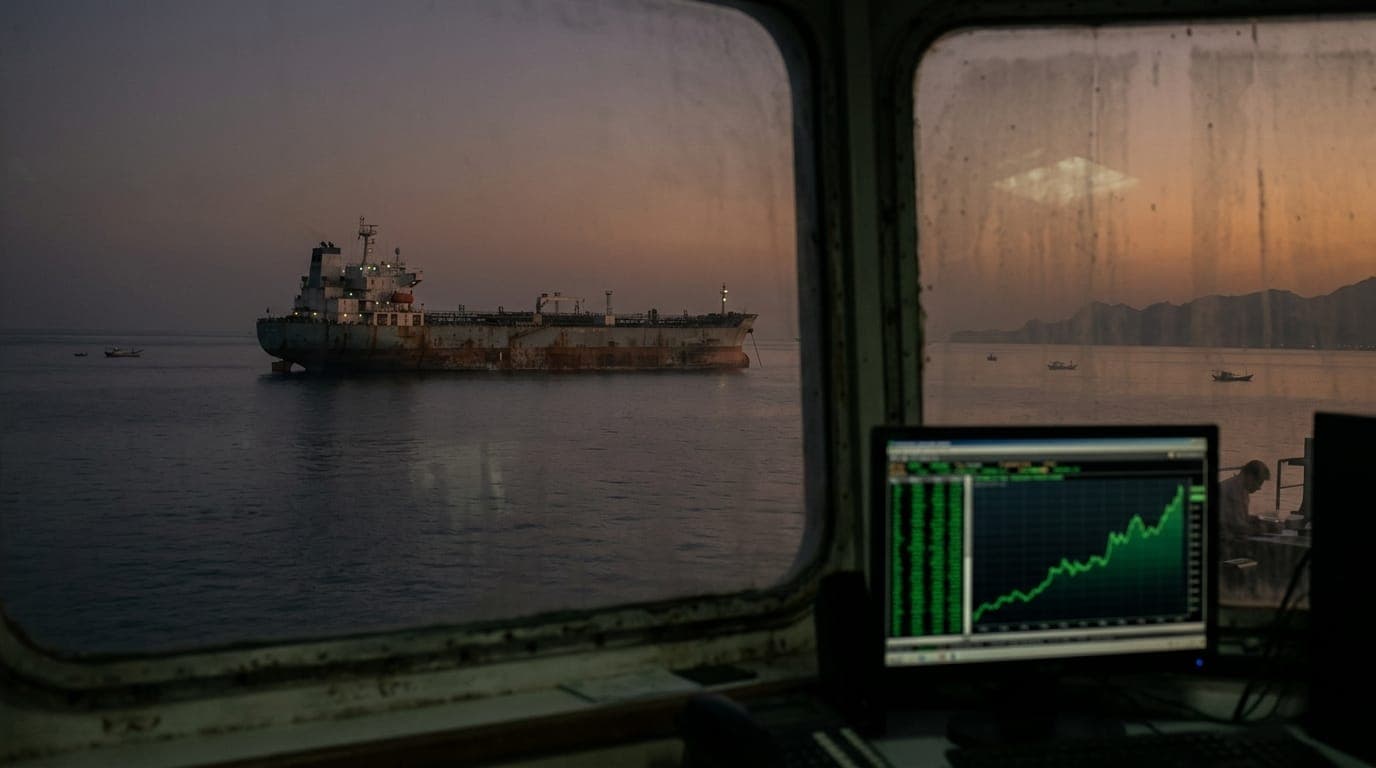
Bitcoin and bitcoin-treasury equities diverged sharply from broad markets Monday as Trump threatened military action against Oman and the 60-day U.S.-Iran negotiating window expired without a deal.
Key takeaways
- Bitcoin traded in the low-$63,000s on Monday and treasury-heavy stocks (Strategy, Strive, MARA) rose while the Dow dropped roughly 0.5% and the S&P 500 fell roughly 0.4%, as the 60-day U.S.-Iran MOU expired and Trump threatened to bomb Oman.
- The decoupling was not uniform: pure BTC treasury plays outperformed while operationally energy-exposed names (Canaan, Bitgo) lagged, a split that reflects Hormuz-era energy costs hitting mining economics directly.
- Brent crude is trading around $88/bbl per TradingEconomics, and the EIA's August 11 Short-Term Energy Outlook forecasts ~0.6 mb/d of ongoing disruption through end of 2027, making the inflation pressure structural.
Bitcoin traded in the low-$63,000s as of Monday morning, per Yahoo Finance, while the Dow shed roughly 0.5%, the S&P 500 fell roughly 0.4%, and the Nasdaq dropped roughly 0.3%, per Yahoo Finance. The catalyst: Trump told Fox News correspondent Trey Yingst that the U.S. would bomb Oman if the country interfered with Washington's efforts to reach an agreement with Iran over Strait of Hormuz shipping access. "If Oman gets in the way, we'll bomb the shit out of them," Trump said, according to CNN, CBS News, and The Hill.
The threat landed on the same day the 60-day negotiating window tied to the June 17 memorandum of understanding between Washington and Tehran expired Monday without a broader settlement -- CNN and CBS News report the window closed Monday, August 17, though the calendar math from a June 17 signing puts 60 days at August 16. Iran and Oman remain in separate bilateral shipping talks. Maritime traffic through Hormuz fell last week, per two maritime monitors cited by CBS News, and the strait carried a significant share of global crude oil before the conflict began choking traffic in late February 2026.
Treasury Plays Led; Miners Felt the Energy Squeeze
Strategy rose on the session, reflecting its function as a publicly traded vehicle for leveraged BTC exposure. Strive and MARA Holdings also gained. Coinbase added modestly. Verify exact percentage moves and price levels against TradingView or Yahoo Finance at publication time, as intraday figures were still in flux at the time of writing.
Not everything with a crypto label caught the bid. Canaan and Bitgo slipped, and Cleanspark and Hut 8 posted modest gains. The distinction matters. Strategy and Strive are treasury plays, pure BTC exposure on a balance sheet. Canaan and other miners are operationally torqued to energy prices: their costs run higher precisely when Hormuz-driven energy shocks are worst. When Brent crude climbs, treasury holds outperform; miners get squeezed from both ends. Circle Internet Group also advanced on the session, though Circle is a stablecoin and payments company, not a Bitcoin treasury play, and its move should not be read through the same lens.
The EIA's August 11 Short-Term Energy Outlook forecasts Brent averaging approximately $85/bbl in Q3 2026, with Hormuz-related disruptions of ~0.6 mb/d persisting through end of 2027. Brent traded around $88.31 on Monday per TradingEconomics. That is not a transient spike; that is a structural inflation input embedded into every energy-intensive business on earth, including Bitcoin miners, for at least another 18 months. The EIA's extended disruption forecast has been in place since the conflict began.
The Thesis and What Would Break It
Monday's session is the most concrete real-world test of a thesis Bitcoiners have held for years: in a world of energy-constrained, geopolitically fragmented shocks, permissionless bearer-settled money with no counterparty and no geographic address catches a bid that dollar-denominated assets and traditional defensives do not.
The falsifiable version: if Bitcoin and bitcoin-treasury stocks sell off in lockstep with equities on the next Hormuz escalation, whether a confirmed strike on Oman or a full strait closure, the safe-haven repricing thesis fails. One session of decoupling proves correlation-breaking behavior; it does not prove a permanent regime change. A sustained 3-5 session pattern with volume confirmation would upgrade the read to durable.
It is also worth separating the signal from the noise on the geopolitical side. Trump threatening a U.S. diplomatic partner (Oman has been a key intermediary throughout the Hormuz crisis) while the negotiating framework has already collapsed sets a new baseline for what "diplomacy" looks like in this conflict. The tanker crew double-pay premiums for Hormuz transits and the Somali piracy surge that followed the strait's effective closure are already priced into shipping costs. An escalation to kinetic action against Oman would be a different order of magnitude.
What to Watch
The immediate question is whether Oman and Iran respond to Trump's threat with escalation or renewed talks, and whether bitcoin can hold the $63,000 range through the reaction. Beyond this week: the EIA's ~0.6 mb/d disruption forecast through 2027 means energy cost pressure on miners is not resolving soon. Treasury plays and pure BTC-exposure equities are positioned differently than energy-dependent operations in that environment. Watch the pattern across multiple sessions, not just Monday's close.
Sources
- Trump/Oman threat, CNN live blog, August 17, 2026
- U.S.-Iran MOU collapse and Hormuz developments, CBS News live blog, August 17, 2026
- Trump Oman threat and IEA Hormuz data, The Hill, August 17, 2026
- June 17 MOU and Hormuz background, CNBC, August 10, 2026
- EIA Short-Term Energy Outlook, August 11, 2026
- Brent crude real-time data, August 17, 2026, TradingEconomics
- First reported (market synthesis/decoupling angle): Bitcoin.com News (Jamie Redman), August 17, 2026
Frequently Asked Questions
Is Bitcoin actually acting as a safe-haven asset, or was Monday a coincidence?
One session of decoupling during a geopolitical shock is a data point, not confirmation. The thesis holds if Bitcoin continues to hold or rise on subsequent Hormuz escalations while equities sell off. If it sells off in lockstep with the S&P 500 on the next escalation, the safe-haven read was premature. The honest answer after Monday: the data point is interesting; the thesis needs more sessions to confirm.
What happens to Bitcoin and oil prices if the Strait of Hormuz fully closes?
The EIA's current baseline models ~0.6 mb/d of disruption with the strait partially constrained. A full closure would remove what The Hill, citing the IEA, estimates as roughly 34% of globally traded crude (a 2025 IEA figure for crude oil specifically, cited secondarily via The Hill) from normal routing, sending Brent well above current levels and compressing mining margins sharply. In that scenario, treasury plays would likely outperform miners further, while BTC spot's safe-haven behavior would face its most serious real-world test yet.