Anthropic's $45B West Virginia Deal Runs on the Bitcoin Miner Playbook
Anthropic committed $45 billion over six years to rent 460 megawatts from Nscale's Monarch Compute Campus in West Virginia, a fully off-grid, natural-gas-powered microgrid that runs on the same energy-monetization architecture Bitcoin miners built.
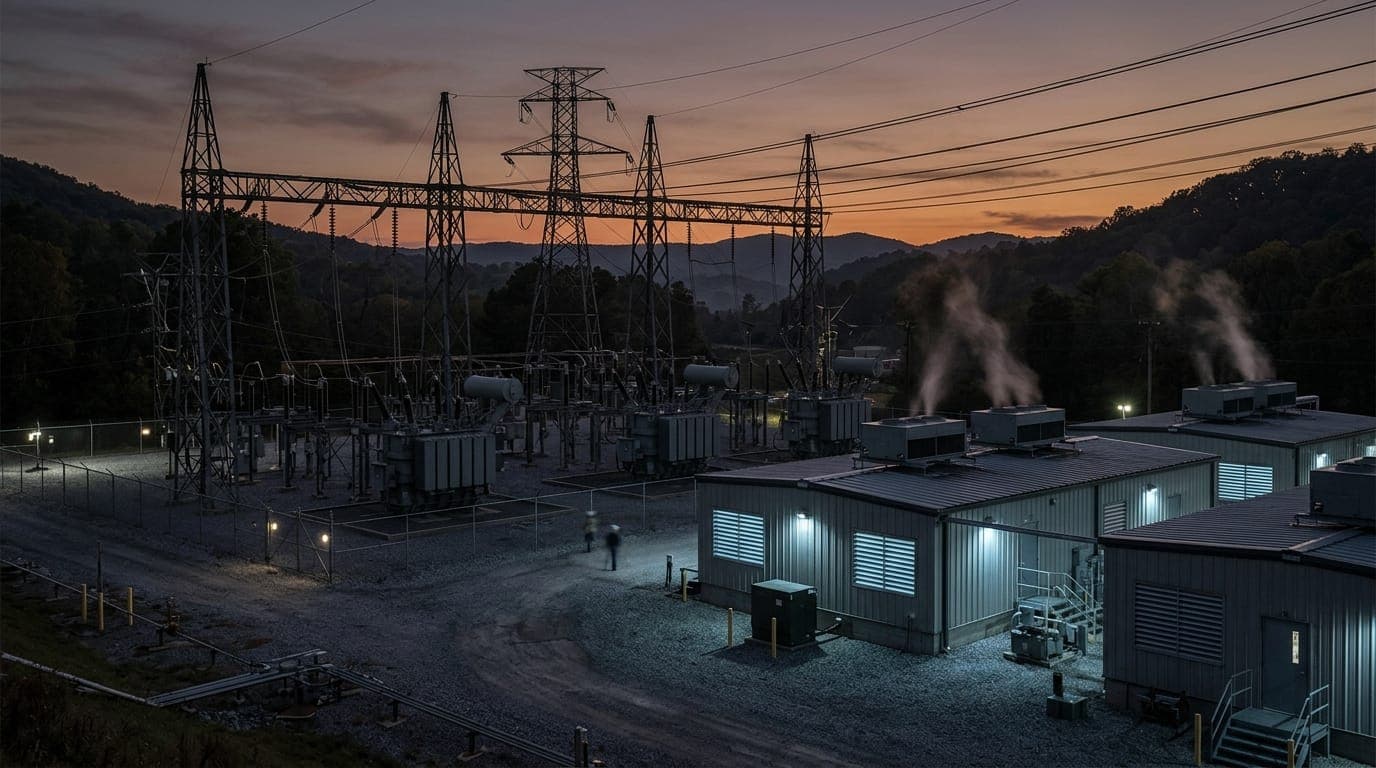
Anthropic is paying $45 billion to rent compute from a company spun out of a Bitcoin miner, on a campus that runs entirely off-grid on Appalachian natural gas. Sound familiar?
Key takeaways
- Anthropic committed $45 billion over six years to rent 460 megawatts from Nscale's Monarch Compute Campus in Mason County, West Virginia, first reported by Bloomberg on August 26.
- The campus is fully off-grid, powered by Marcellus Shale natural gas through on-site Caterpillar gen-sets, and holds certification as the U.S.'s first state-certified AI microgrid under West Virginia HB 2014.
- Nscale was spun out of Arkon Energy, a Bitcoin mining operator, making this a direct descendant of the energy-to-compute model Bitcoin miners pioneered.
Anthropic agreed to spend roughly $45 billion over six years to rent 460 megawatts of GPU capacity from Nscale's Monarch Compute Campus, a 2,250-acre site in Mason County, West Virginia, first reported by Bloomberg on August 26. At $7.5 billion per year, it is one of the largest compute lease commitments ever signed, and it runs on infrastructure that Bitcoin miners built first.
The chips are Nvidia Vera Rubin (NVL72). The first 460-megawatt tranche is expected online in late 2027, per Blockspace. Neither Anthropic nor Nscale commented publicly on the deal.
Off the Grid, on Appalachian Gas
The Monarch campus does not draw from the public grid. It runs on a behind-the-meter microgrid fed by Marcellus Shale natural gas, using Caterpillar G3500 series fast-response gen-sets delivered on a schedule running from September 2026 through August 2027, according to the Nscale press release from March 2026. The campus is the U.S.'s first state-certified AI microgrid under West Virginia HB 2014.
That certification matters for ratepayers: Monarch's power costs fall entirely on the tenant, not the public grid. This is the rare AI data center story where residential electricity bills are not part of the equation.
"Projects like Monarch demonstrate how Caterpillar's natural gas generation platforms are being deployed as core infrastructure for data centers," said Melissa Busen, SVP Electric Power at Caterpillar, in the Nscale press release.
Governor Patrick Morrisey called the project "another major vote of confidence in West Virginia's future" when Nscale acquired the campus in March 2026. West Virginia's Appalachian gas reserves made it a logical landing spot; the question was always which tenant would fill the gigawatts.
That tenant almost wasn't Anthropic. Microsoft signed a letter of intent for 1.35 gigawatts at Monarch during GTC 2026, then walked away during the summer, per VKTR. Anthropic stepped into the slot as the anchor tenant.
The Bitcoin Mining Through-Line
Here is the detail that most coverage will miss: Nscale was spun out of Arkon Energy, a Bitcoin mining operator, according to The Energy Mag. That is not a footnote. The energy-to-compute monetization model, source cheap stranded power, convert it to compute, capture the margin between raw energy cost and compute rental price, is the exact architecture Bitcoin miners have been running for years.
Bitcoiners built this. AI is scaling it to $45 billion contracts.
The convergence shows up in the power economics too. Marcellus Shale gas is cheap. Nscale captures the spread between that raw energy cost and what Anthropic pays per megawatt-hour of compute rental. Bitcoin miners live in the same margin, and as the Bitdeer Norway lease shows, miners who own their power are now in a structurally stronger position than those who don't.
The off-grid model also has a specific implication for phantom load concerns: Monarch's 460 megawatts are real, contracted, and backed by gen-sets on a delivery schedule, not a grid interconnection request sitting in a queue for a decade.
The downside for miners: this deal competes for the same Appalachian gas supply, Caterpillar gen-sets, Nvidia chips, and construction labor that mining operators source. The off-grid structure reduces grid-side competition with miners, but tightens the broader energy infrastructure market.
What to Watch
Anthropic has now committed to more than $169 billion in compute deals in 2026 alone -- a rough sum of individually reported agreements including Fluidstack, Volta Infrastructure, SpaceX, and TeraWulf's Kentucky campus. The company confidentially filed for an IPO with the SEC in June 2026 and carries a $965 billion valuation from its May 2026 Series H, with investors targeting a $2 trillion-plus IPO price per the Financial Times. That means these compute deals, structured as multi-year operating leases, will land in Anthropic's S-1 and face public market scrutiny on their energy cost assumptions. If Marcellus Shale gas prices spike, the margin that makes Monarch attractive compresses fast.
The falsifiable test here is straightforward: if Monarch draws primarily from the public grid rather than its dedicated off-grid infrastructure, or if power costs prove uncompetitive and the campus is delayed past 2029, the AI-as-energy-monetizer convergence thesis weakens. Given that gen-sets are already on delivery schedule and the microgrid is state-certified, cancellation looks unlikely. But Nscale is also reportedly targeting a roughly $3 billion IPO as soon as September 2026, according to Bloomberg, with deliberations ongoing and details subject to change, adding its own capital markets pressure to a deal that has barely been announced.
Nscale founder Josh Payne has called this "the largest infrastructure buildout in human history," per PYMNTS citing Bloomberg. On the numbers so far, it's hard to argue.
Update, September 1, 2026
The municipal pushback against AI data center sprawl just got a concrete legal form. Savannah City Council voted unanimously to approve a 155-day moratorium on large-scale data center developments in the city.
The ordinance blocks data center developments with an electrical capacity of 10 megawatts or greater, as well as industrial buildings of 200,000 square feet or more being built or converted for data center use. The vote was triggered directly by the chaos next door: the move was fueled by backlash to OpenAI's Project Camellia deal in neighboring Effingham County , a $20 billion, 3.2-gigawatt campus that was announced to residents as a done deal before any public input.
Savannah is not alone. Savannah joined about 40 other municipalities imposing moratoriums on data centers in Georgia.
City officials in Richmond Hill say their local development ordinance already prohibits data centers. Senator Raphael Warnock has gone further, calling for a statewide moratorium on data centers after visiting the Effingham County site.
The parallel to the Monarch/Nscale story is direct. Anthropic's West Virginia deal works precisely because Nscale went off-grid, behind-the-meter, and out of reach of public utility commissions and local zoning fights. The Savannah situation shows why that structure matters: Mayor Van Johnson framed the pause around needing to "fully understand what this means for our electrical grid, for our water sources, for our infrastructure capacity, our land use." Grid-tied AI campuses are now walking into a wall of municipal resistance that off-grid, self-powered compute infrastructure sidesteps entirely. The 155-day window will give the Savannah city council until just after the new year to study the issue and draft a formal regulatory policy.
Update, September 2, 2026
The Nscale deal is no longer a standalone headline. Anthropic has agreed to a second massive compute commitment, this time a $35 billion deal with Lambda, a cloud provider backed by Nvidia.
Lambda will fill a single Texas data center campus with chips bought from Nvidia, the campus is owned and built by Hut 8, a Bitcoin miner turned data center landlord, and Nvidia itself signed the 15-year leases underneath the arrangement.
Combined with the West Virginia Nscale contract signed the previous week, the two commitments stack to roughly $80 billion of planned cloud spending.
The funding math does not close. Anthropic just signed a $35 billion computing obligation against money it has not yet raised.
A compute commitment is a multi-year contract to purchase capacity from a cloud operator, usually with take-or-pay terms, and once signed it behaves like a fixed obligation, closer to a lease than a variable utility bill.
Analyst Neil Campling said Anthropic will likely need an IPO to fund the promise, and the revenue Lambda books against this contract carries the credit quality of Anthropic, whose credit quality depends on rounds and an IPO that has not been announced.
The Hut 8 thread is worth noting for the Wall Street Journal's readers who missed it: Lambda will secure access to a data center being built by Hut 8, which mines Bitcoin and builds data centers.
The Beacon Point campus in Nueces County, Texas carries two identical 15-year leases of 352 megawatts each, with a base-term value of $9.8 billion per lease and a 3 percent annual escalator on triple-net terms, meaning whoever signed those leases owes Hut 8 close to $20 billion regardless of what happens to the AI market. The Bitcoin miner-to-AI-infrastructure pipeline just got a second data point inside the same week.
Update, September 29, 2026
Anthropic's leaked IPO prospectus, first reported by Reuters and confirmed by the Financial Times, puts hard numbers on the AI capex story this article has been tracking. Anthropic reported a net loss of $42 billion in 2025 and plans to spend $518 billion on cloud, computing, and infrastructure obligations in coming years. That $518 billion figure is the total committed-spend stack, and the two deals covered above, West Virginia and Texas, are a part of it.
The headline loss requires unpacking. Revenue grew 12-fold in 2025 to nearly $4.6 billion, even as the company lost more than $8 billion on an operating basis excluding writedowns, with the near-$42 billion net loss including a roughly $34 billion accounting charge tied to an increase in the estimated value of financing instruments that could convert into Anthropic shares. So the operating reality is an $8 billion hole on $4.6 billion in revenue, not a $42 billion cash bonfire, but the compute cost line underneath that is the number worth watching. Operating losses widened to $8.06 billion from $2.98 billion a year earlier, and Anthropic spent $7.33 billion on computing and infrastructure last year, up threefold from 2024.
The forward obligation is what connects directly to this story. Anthropic's infrastructure obligations offer considerably less flexibility, with the company having committed roughly $518 billion to cloud capacity, chips, and related infrastructure over the coming decade. The $45 billion Nscale contract and the $35 billion Lambda deal are both baked into that number. The company had $20.28 billion in cash, cash equivalents, and short-term investments at the end of December 2025 , which means the compute obligations dwarf the cash on hand by a factor of 25. The lab is reportedly aiming for a valuation of more than $2 trillion in an IPO that, after several delays, could occur after the U.S. midterm elections in November. The IPO is no longer a rumor. It is the only plausible mechanism for closing the gap between what Anthropic has promised to spend and what it currently holds.
Update, October 1, 2026
The financing stack just added a layer nobody had modeled. Anthropic's IPO prospectus, first reported by Reuters, discloses that Broadcom has agreed to lend Anthropic up to $42 billion to finance infrastructure spending. This is not equity, not a cloud-provider credit line, and not a lease-backed SPV. It is a chipmaker directly financing demand for its own product through convertible notes that could later be swapped for Anthropic equity. The convertible note Anthropic would issue could finance about a third of the $125.2 billion commitment the AI lab has made for a five-year lease of tensor processing unit computing capacity. Anthropic has already put cash into a restricted account for Broadcom's benefit and may be required to contribute additional amounts under certain circumstances. Anthropic said in its filing it doesn't expect any notes to be sold before it completes its IPO.
Anthropic stands to become the largest customer in Broadcom's bread-and-butter chip design business next year, making their relationship a prime example of the reciprocal spending that has animated AI skeptics on Wall Street.
For Broadcom, the financing arrangement follows what rival Nvidia has done in recent years: use its strong financial position to help boost chip sales. The competitive dynamic is now explicit. Chipmakers are not waiting for AI labs to source their own capital. They are becoming the creditors. As Seaport Research analyst Jay Goldberg put it: "Nvidia is putting in place a massive amount of its balance sheet, and Broadcom is having to follow suit."
The conflict-of-interest problem writes itself. Anthropic disclosed that Broadcom's role as both hardware supplier and financing partner creates potential conflicts of interest that could affect Anthropic's ability to access the computing power needed for its work. The company warned that certain payment or performance defaults could make a substantial portion of its lease obligations immediately due while limiting its ability to use the $42 billion financing facility to cover those payments. The same entity that sets chip prices and controls hardware allocation is also the lender who accelerates debt on default. There is no clean exit from that structure.
This lands on top of the $518 billion in total compute obligations Anthropic disclosed in September, against $20.28 billion in cash on hand at year-end 2025. The $45 billion Nscale contract in West Virginia and the $35 billion Lambda deal in Texas are both inside that number. The IPO remains the only plausible mechanism for closing the gap, and Anthropic does not anticipate completing it before any Broadcom convertible notes are sold. On the revenue side, Anthropic has confirmed annualized revenue now exceeds $30 billion, up from approximately $9 billion at the end of 2025, with over 1,000 enterprise customers each contributing more than $1 million annually, representing 100 percent growth in just eight weeks. The revenue trajectory is real. So is the debt.
Update, October 6, 2026
The full supplier breakdown inside Anthropic's IPO prospectus is now public, and the numbers are worth laying out explicitly. Anthropic's commitments include $111.1 billion with Google, $110 billion with Amazon, and $31.4 billion with Microsoft, alongside $161.2 billion in largely non-cancelable equipment leases tied to Broadcom. On top of those four, the company has up to $84.5 billion in Nvidia-based computing capacity under an arrangement with xAI through 2029.
The $518 billion in planned spending over the next decade is largely locked in, with roughly 80 percent of those commitments non-cancelable or requiring payment regardless of how much computing capacity Anthropic actually uses.
The Broadcom piece deserves its own paragraph because it is structurally unlike the cloud deals. The $42 billion Broadcom facility, disclosed in Anthropic's IPO prospectus, is sized to cover approximately one-third of the $125.2 billion Anthropic has pledged under a five-year agreement for tensor processing unit computing capacity.
Broadcom has linked its financial upside directly to the success of Anthropic's eventual IPO: if Anthropic succeeds, Broadcom converts its position into equity; if the company falters, Broadcom retains its status as a senior creditor with significant leverage over the infrastructure assets it provides.
Anthropic's own prospectus flags that Broadcom's simultaneous role as a hardware supplier and a financing partner raises "potential conflicts of interest" that could compromise Anthropic's capacity to secure the computing power it requires.
The energy implication running underneath all of this is straightforward. The money is committed, but the copper and concrete are not, and turning that demand into energized data center capacity remains a multiyear process. Every gigawatt Anthropic has contractually obligated across Google, Amazon, Microsoft, Broadcom, xAI, Lambda, and Nscale has to be powered from somewhere. The West Virginia off-grid Marcellus Shale build Nscale is running is one answer to that problem. The rest of the $518 billion stack is still hunting for electrons.
Sources
- Nscale Monarch Compute Campus press release (March 16, 2026)
- VKTR: Anthropic Took Microsoft's Spot at Nscale's West Virginia Campus (August 26, 2026)
- First reported by Bloomberg (August 26, 2026)
Frequently Asked Questions
Does the Monarch Compute Campus draw power from the West Virginia public grid?
No. Monarch is the U.S.'s first state-certified AI microgrid under West Virginia HB 2014. It runs entirely on dedicated on-site Caterpillar natural gas gen-sets fed by Marcellus Shale, with no draw on the public grid. Ratepayers are legally insulated from its operating costs.
What happened to Microsoft's deal at the same West Virginia site?
Microsoft signed a letter of intent in March 2026 at GTC for 1.35 gigawatts at Monarch, then walked away during the summer, per VKTR. Anthropic stepped in as the anchor tenant for the initial 460-megawatt tranche.
How does this deal affect Bitcoin miners competing for energy?
Miners and AI data centers now compete for the same natural gas supply, Caterpillar gen-sets, Nvidia chips, and permitting pipelines. Monarch's off-grid design reduces direct grid-side competition with miners, but tightens the broader infrastructure market. The more significant fact: Nscale was spun out of Bitcoin miner Arkon Energy. The line between mining infrastructure and AI infrastructure is gone.