Put America Back on the Henry Adams Curve
America broke from two centuries of rising energy use per person. Bitcoin miners and AI datacenters are exposing the scarcity we chose to build.


TFTC - Truth for the Commoner Bitcoin Brief | |||||||||||||||||||||||
Sup, freaks. If America wants to reindustrialize, win the AI race, strengthen the grid, and raise living standards, it needs to stop treating energy demand like a disease. The demand is the signal. The shortage is the problem. | |||||||||||||||||||||||
LEAD STORY | |||||||||||||||||||||||
Put America Back on the Henry Adams CurveIf I could pick one metric to rally around as a nation, it would be energy availability per capita. We need to get back to basics. We need to generate more energy. If we focus on expanding reliable generation and the infrastructure required to deliver it, many of the problems we worry about become easier to solve. It is not that simple, but it is the clearest low-hanging fruit available to the United States. A chart I posted yesterday should hang in every utility boardroom, governor's office, and committee room in Washington. It plots actual energy use per person against the Henry Adams Curve. 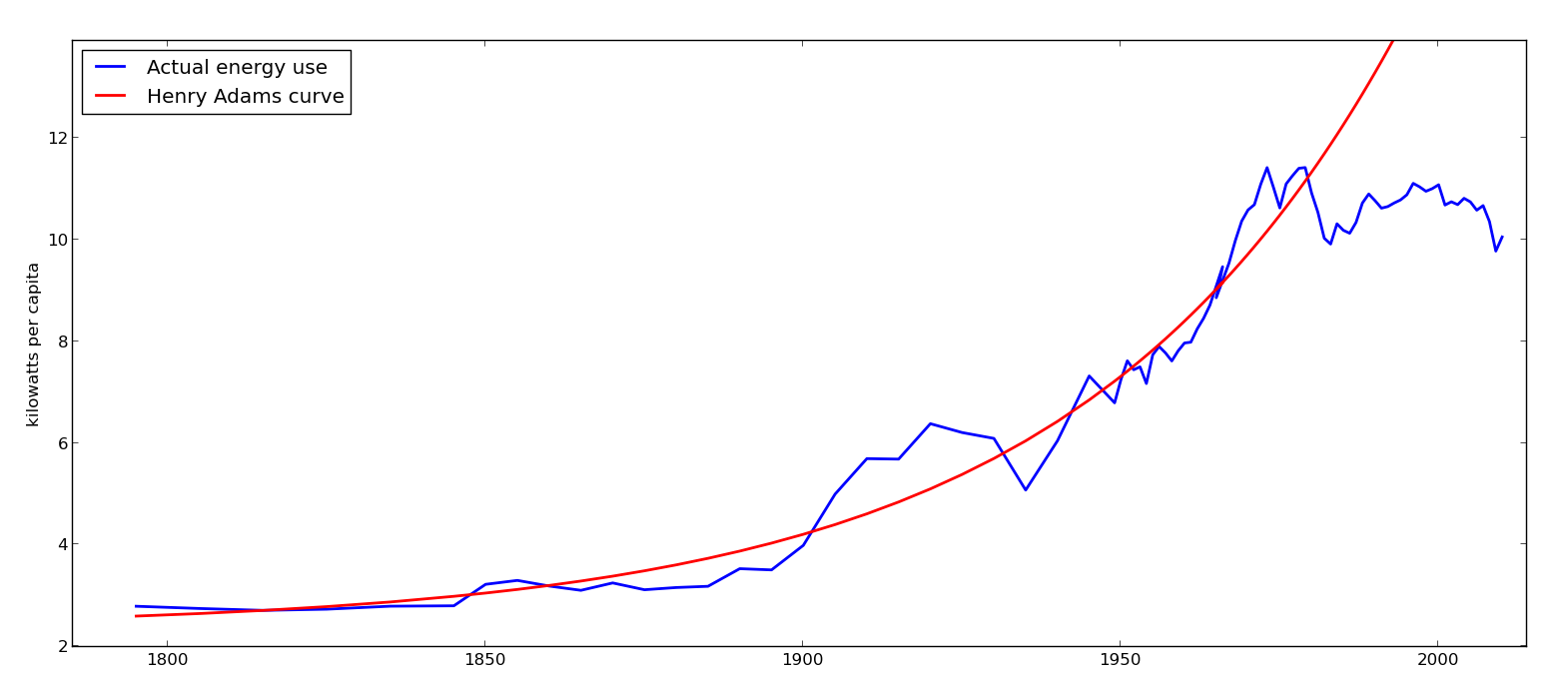 J. Storrs Hall named the curve after Henry Adams, who observed that humanity's command of physical force seemed to accelerate over time. Hall calculated that useful energy available per person had grown at roughly 2% per year for centuries. More energy meant more machines, more transportation, more manufacturing, more heat, more cooling, more food, more medicine, more computing, and more physical capability for ordinary people. Then America broke from the curve. The exact year is less important than the structural shift. During the 1970s, the country stopped assuming that future generations would command dramatically more energy than the generation before them. We moved from building abundance to managing scarcity. The EIA's annual data make the break visible. U.S. primary-energy consumption reached 348 million Btu per person in 1973. In 2025 it was 282 million Btu, approximately 19% lower. Total U.S. energy consumption reached 96 quadrillion Btu last year, still below the 99-quad record set in 2007. The Henry Adams Curve is not a physical law. It does not prove that civilization must increase raw fuel consumption forever. Efficiency matters. A heat pump can provide more useful heat with less primary energy. A modern datacenter can produce more intelligence per watt. Burning fuel without producing something valuable is not progress. So I would sharpen the national objective this way: maximize abundant, reliable, affordable energy availability per person. Primary-energy consumption is one observable proxy. The real target is useful physical capability. America is producing more energy in aggregate than ever. Record production matters. The United States produced more than 103 quads in 2024, an all-time record. But national production does not guarantee that power is available where and when it is needed. Energy can be exported. Gas can sit behind pipeline constraints. Generation can sit behind transmission congestion. A datacenter can own land beside a grid that cannot deliver the requested load for years. The bottlenecks are generation, firm capacity, transmission, substations, interconnection, cooling, equipment, permitting, and the willingness to build. The mismatch helps explain why AI datacenters and bitcoin miners trigger so much political hostility. They arrive with visible demand. They ask for hundreds of megawatts. They expose the gap between the amount of power politicians assume exists and the amount utilities can actually deliver. The standard response is to attack the customer. New York wants to slow datacenters. Communities fight substations. Regulators push expensive projects into decade-long queues. Politicians describe energy-intensive industry as wasteful before asking why supply has not kept pace. Attacking the customer gets cause and effect backward. America does not have too much energy demand. America has refused to build enough generation and infrastructure to satisfy the demand created by new industries. Bitcoin has been ahead of this realization for years. Miners can locate beside remote hydro, stranded natural gas, curtailed renewables, underused nuclear capacity, and grids that need flexible buyers. They can shut down when power becomes scarce and restart when it is abundant. They turn electricity that cannot easily reach another customer into a globally saleable digital commodity. Mining is an energy-discovery mechanism. A miner showing up in a county is not proof that the county has too much demand. It is often proof that somebody found energy the existing economy was failing to monetize. The miner gives that energy a buyer, creates a revenue stream for the producer, and can help finance the next increment of generation. AI demand is now forcing the rest of the country to confront the same reality. Hyperscalers need power, fiber, cooling, transformers, and reliable delivery. Their demand can finance gas plants, nuclear restarts, geothermal development, transmission, and behind-the-meter systems. The answer is not choosing between AI and bitcoin. The answer is building enough capacity that both can grow while households and industrial users receive cheaper, more reliable power. Build nuclear. Build natural gas. Build geothermal. Build hydro where geography allows it. Build transmission. Build substations. Expand interconnection capacity. Let storage compete where it makes sense. Stop pretending one technology will satisfy every region and every load profile. Environmental constraints are real. So are local land-use concerns, fuel security, grid reliability, and capital costs. Energy systems are physical systems. They cannot be rebuilt through slogans or executive orders. Major infrastructure takes years, sometimes decades. Long lead times argue for beginning immediately, not another excuse for delay. Energy abundance does not automatically produce good institutions, strong families, sound money, or wise leaders. It can be wasted. It can be weaponized. It can enrich incumbents who capture the permitting system. But scarcity makes almost every social problem harder. It raises housing and transportation costs. It limits industrial investment. It weakens defense production. It turns new technology into a fight over who gets the remaining capacity. It pushes politics toward rationing. A civilization that expects progress should expect each generation to command more useful energy than the one before it. Put the blue line back on the curve. | |||||||||||||||||||||||
SIGNAL | |||||||||||||||||||||||
BITCOIN / MARKET STRUCTURE Bitcoin's Bottom Is Starting to Look More ConstructiveJames Check argues that bitcoin's roughly $63,000 200-week moving average has held for four consecutive weeks. His model estimates that approximately $100 billion of capital changed hands between $58,000 and $65,000, while more than 80% of realized cap is now held by long-term holders. The market is improving without proving that the bottom is in. Bitcoin Lab puts the short-term-holder cost basis at $68,005, above spot. MVRV is 1.23 and STH-MVRV remains below one. Ownership is becoming more bottom-heavy and downside momentum is weakening. Reclaiming and holding $68,000 is the next test. | |||||||||||||||||||||||
BITCOIN / CORPORATE STRATEGY Twenty One Is No Longer Trying to Buy StrikeTwenty One's July 21 filing confirms that Jack Mallers resigned as CEO and director to focus on Strike. Raphael Zagury is the new CEO, and XXI is no longer pursuing a Strike acquisition. A potential Elektron transaction remains preliminary and under evaluation. The original treasury, payments, and mining consolidation has broken apart. Strike stays independent. XXI now wants cash-flow-generating operating businesses, disciplined capital allocation, capital-markets capabilities, and bitcoin-native lending. Management describes a Berkshire-style model benchmarked against bitcoin rather than a passive treasury wrapper. | |||||||||||||||||||||||
BITCOIN / PROTOCOL Bitcoin's Data Debate Moves From Philosophy to OperationsKevin McKernan compares Bitcoin to biology: preserving information consumes energy, but evolution requires mutation and experimentation. He argues that centrally defining valid “monetary” data resembles intelligent design and that BIP-110 may redirect data toward the UTXO set rather than eliminate it. AMBOSS finds that BIP-110's byte limits do not break Lightning as it operates today. The risk is its forced-activation design near block 961,632. A minority split could interfere with Lightning's breach-remedy assumptions because every Lightning node inherits its chain view from the Bitcoin backend beneath it. Biology is an analogy, not protocol proof. The operational risk is concrete. | |||||||||||||||||||||||
BANKING DESK Wall Street Sees Scarcity Under EverythingThirty-seven fresh bank reports point toward the same constraint. Goldman expects Kevin Warsh's five Fed task forces to produce modest changes, including more attention to M2 and AI, without overturning the ample-reserves framework. Goldman also delayed expected Persian Gulf LNG normalization to October and raised its third- and fourth-quarter European gas forecasts to €60 and €53 per MWh. JPMorgan, Deutsche Bank, and Citi see Kimi K3 compressing model-company valuation premiums while cheaper open models accelerate adoption. The common thread is scarcity: firm energy and compute sit beneath inflation risk, European gas vulnerability, AI valuations, and monetary policy. | |||||||||||||||||||||||
CULTURE / FERTILITY Motherhood Lost Status. Georgia Showed Status Can Be Restored.Johann Kurtz argues that modern status games reward credentials and careers while treating motherhood as leaving the field. Georgia offers a remarkable counterexample. In 2007, Patriarch Ilia II promised to personally baptize and become godfather to every third-or-higher child born to married Georgian Orthodox parents. A peer-reviewed study estimates that the intervention raised Georgia's national fertility rate 17%, increased married Orthodox women's birth rate 42%, and doubled their third-or-higher birth rate. The intervention combined faith, authority, marriage norms, baptism, and social honor, so it does not prove status acted alone. It does show that culture can move fertility at national scale. | |||||||||||||||||||||||
PODCAST SPOTLIGHT | |||||||||||||||||||||||
| |||||||||||||||||||||||
| |||||||||||||||||||||||
| |||||||||||||||||||||||
⚡ FREEDOM TECH CORNER | |||||||||||||||||||||||
Bitcoin Is Starting to Prove Its Own Consensus RulesWhy it matters: Consensus disputes should move from rhetoric toward machine-checkable claims wherever possible. Keagan McClelland's early btc-verified project is translating parts of Bitcoin into Lean 4. Its first demonstration formally proves that Bitcoin Core's mutation check prevents distinct transaction lists from passing the check and producing the same Merkle root, assuming SHA-256 remains collision-resistant. The project is immature, uses AI heavily, and does not formally verify Bitcoin end to end. The direction is still important. Mathematical proofs can help developers settle factual questions before they become political arguments. | |||||||||||||||||||||||
DATA SNAPSHOT | |||||||||||||||||||||||
As of July 21, 2026, approximately 9:04 a.m. ET | |||||||||||||||||||||||
| |||||||||||||||||||||||
| |||||||||||||||||||||||
| |||||||||||||||||||||||
See you tomorrow. | |||||||||||||||||||||||
Marty Bent on X: https://x.com/MartyBent?ref=tftc.io TFTC on YouTube: https://www.youtube.com/@TFTC TFTC Podcasts: https://www.tftc.io/tag/podcasts/ |