Former Bitcoin Mine to Become 50MW AI Data Center Under Nebius Deal
AIB Data Centers is converting a former Spartanburg County Bitcoin mine into a 50MW AI colocation facility for Nebius under a 12-year deal. Nebius's own infrastructure chief said the deciding factor was secured power. That's the thesis in three words.
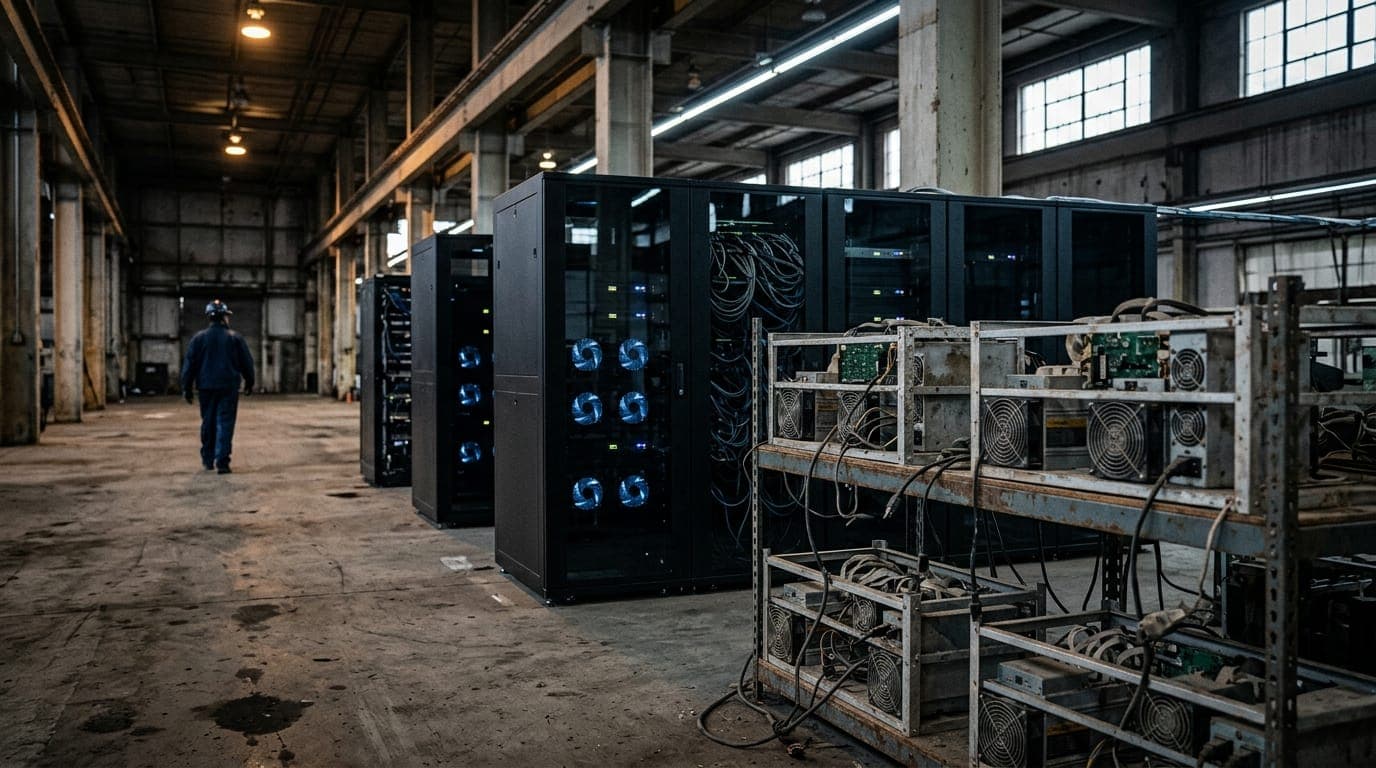
A Spartanburg County, SC cryptomine is being converted into AI colocation infrastructure. The reason it was chosen reveals the widening gap between miners who hold secured power and those who don't.
Key takeaways
- AIB Data Centers signed a 12-year Master Colocation Services Agreement with Nebius (NASDAQ: NBIS) to deliver 50MW of AI data center capacity at a former Bitcoin mining site in Spartanburg County, SC, with two 25MW data halls targeting Q4 2027.
- Nebius's Chief Product and Infrastructure Officer said "time-to-power is the binding constraint on AI infrastructure today." The site was chosen because AIB already held a 15-year, 65MW utility power agreement, eliminating the interconnection queue that kills greenfield timelines.
- Spartanburg County passed a 1-year data center moratorium in September 2026 but wrote an exemption for former industrial/mining sites at or under 65MW. AIB's development agreement was postponed at the October 19 council meeting pending noise, lighting, and landscaping review.
AIB Data Centers (NYSE American: AIB) announced on September 30, 2026 that it had signed a Master Colocation Services Agreement with Nebius, an Amsterdam-based AI cloud provider trading on the Nasdaq, to build out 50MW of critical IT capacity at its CLT1 campus in Spartanburg County. The deal term is 12 years with two five-year renewal options. The site, located at 389 Tyger River Industrial Drive in Moore, SC, was established as a Bitcoin mining data center in 2022 and was still operating mining rigs earlier this year before they were shut down.
The financing structure, per the SEC 8-K, relies on customer prepayments from Nebius combined with project-level debt and preferred equity. No corporate common equity raise is expected, and no dollar figures were disclosed.
Power Was the Product
The existing infrastructure is the deal. AIB already held a 15-year electric service agreement for 65MW of utility supply. No major grid upgrades. No multi-year interconnection queue.
The containers used for mining operations are being replaced with a standalone data center building across approximately 16 acres. Two 25MW data halls are the build plan, with the first targeted at roughly 10 months from signing and the second at roughly 14 months, per AIB's October investor presentation.
Andrey Korolenko, Nebius's Chief Product and Infrastructure Officer, put it plainly in the company's press release: "Time-to-power is the binding constraint on AI infrastructure today." That is a precise description of why a former cryptomine in Spartanburg County beat out greenfield alternatives: the power was already there.
Morgan Stanley flagged a 32 GW power shortfall for U.S. data centers through 2028. That structural gap is what makes a pre-permitted, utility-connected mining site worth a 12-year contract.
AIB CEO Jerry Tang framed the company's thesis directly: "Signing Nebius represents a transformational milestone for AIB. Our strategy is straightforward: secure power in attractive markets and convert that power into long-term contracted revenue with leading AI infrastructure companies."
The Option Value of a Megawatt
The event-only read is a corporate pivot story. The more important read is about option value.
Any mining operator sitting on permitted, grid-connected capacity now holds a call option that did not exist three years ago. That option is a 12-year contracted colocation lease with an AI tenant. The spread between "secured power" and "unsecured power" is widening fast.
Miners without locked capacity aren't just competing against other miners for new grid connections. They're competing against hyperscaler capex. Those are different auctions at very different price levels.
The hashrate data already shows the AI pivot hasn't eased mining competition. What it has done is change the ceiling on what secured power is worth as an asset class.
The falsifiable version of this thesis: if Bitcoin mining economics recover enough that hashprice and BTC price make mining more profitable per MW than AI colocation lease rates, miners start outbidding AI tenants for power agreements and the displacement dynamic reverses. Alternatively, if significant new generation comes online specifically for mining in remote or stranded-gas locations unsuitable for AI, the competition weakens. Neither condition is present today.
The Local Political Economy Is Reshaping
Spartanburg County voted 5-1 on September 21, 2026 to pass a 1-year data center moratorium, per WSPA. The moratorium includes an exemption for facilities at or under 65MW located in designated industrial parks or on former industrial sites that do not self-generate power beyond emergency backup. That language fits the AIB site precisely.
The county had previously denied AIB tax incentives for a separate, larger project in the same industrial park, which AIB abandoned in February 2026. The county also accepted the surrender of FILOT incentives that had originally been awarded for the mining facility.
As of October 29, 2026, the AIB development agreement has not yet received county approval. The October 19 council meeting postponed the vote pending noise, lighting, and landscaping plan review. Councilmember Grant DeShields noted the connection directly, per the Post and Courier: "The changing of the moratorium language tonight had a lot to do with postponing the AIB and the Valara." The project is proceeding toward approval, not away from it, but final county sign-off is still outstanding.
The counterintuitive dynamic worth tracking: localities writing moratorium exemptions that specifically advantage former mining sites, on industrial-footprint language, are paradoxically encoding a permitting advantage for past Bitcoin mining activity. The mine that got built first may get the AI build-out.
What to Watch
County approval is the immediate gate. If Spartanburg County clears the development agreement, AIB moves to construction and the Q4 2027 delivery timeline becomes the operational test. If that timeline holds across both 25MW halls, it becomes a replicable playbook for other mining-site-to-AI conversions. The companies that secured power capacity ahead of the AI capex surge are the ones now setting the terms.
Sources
- AIB Data Centers SEC 8-K / EX-99.1, September 30, 2026
- Nasdaq press release, AIB Data Centers / Nebius, September 30, 2026
- WSPA: Spartanburg County data center moratorium, September 21, 2026
- First reported by Data Center Dynamics: AIB CLT1 site identification and October 19 county council details, October 29, 2026
Frequently Asked Questions
What happens to Bitcoin miners when AI companies convert former mining sites?
Miners who already hold permitted, energized capacity gain option value. They can lease to AI tenants at long-term contracted rates or continue mining, depending on which is more profitable per MW. Miners without locked power face rising competition from AI capex for new grid connections and site permits. The Spartanburg deal is a concrete example of that dynamic playing out.
Why did Nebius choose a former Bitcoin mine over a greenfield site?
Per Nebius's own public statement, "time-to-power" was the deciding factor. The former mine had a pre-existing 15-year, 65MW utility power agreement that required no major grid upgrades, bypassing the multi-year interconnection queue that delays new construction.
Does the Spartanburg County moratorium block this project?
No. The September 2026 moratorium includes an explicit exemption for facilities at or under 65MW on former industrial sites that don't self-generate power. The AIB development agreement was postponed at the October 19 county council meeting pending review of noise, lighting, and landscaping plans. County approval is pending but has not been denied.