AI Capex Is Weaponizing Eminent Domain Against Private Landowners
Power companies in five states are using or threatening eminent domain to seize private land for high-voltage transmission lines that primarily serve AI data centers. The constitutional 'public use' floor is the only thing standing between landowners and condemnation.
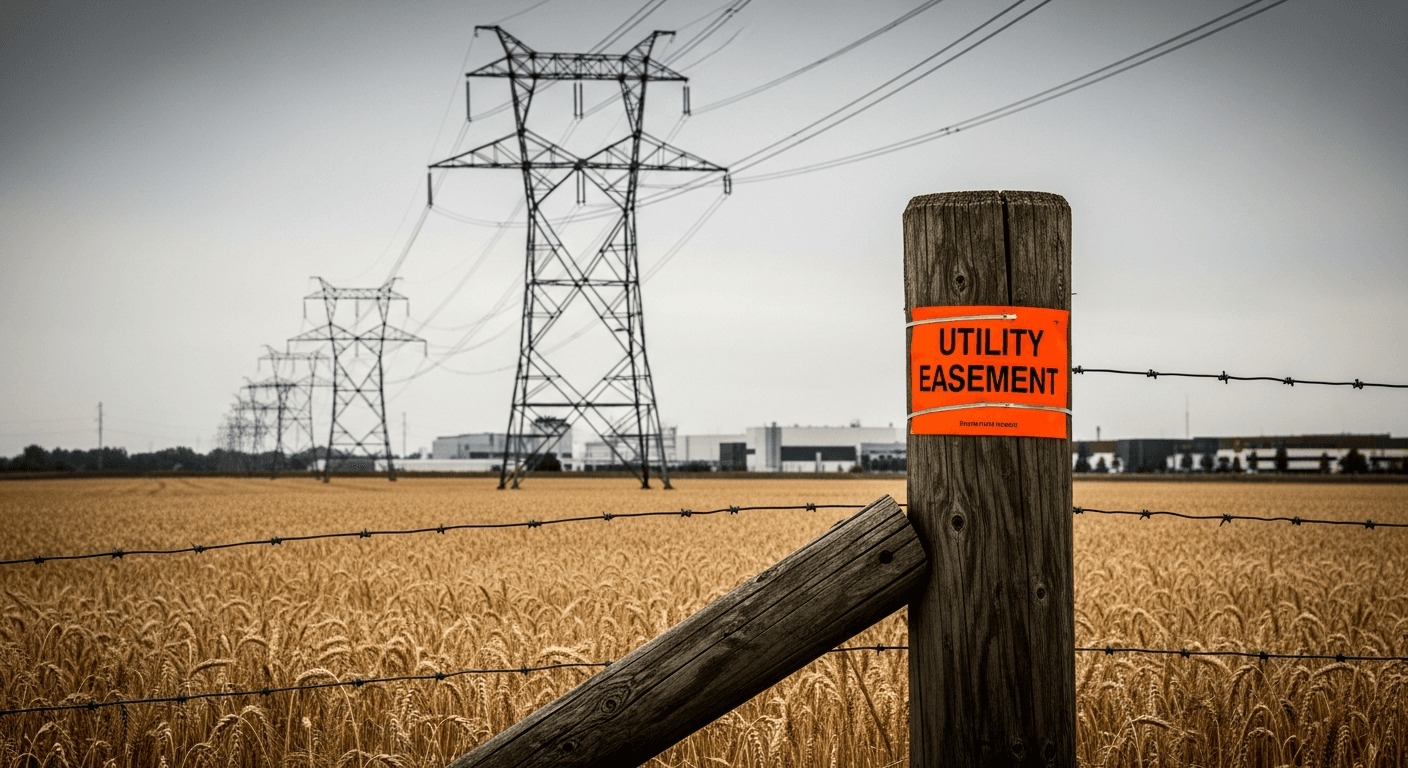
Power companies are condemning private property across five states to run transmission lines that serve AI data centers first and the general public second.
Key takeaways
- Utilities in Georgia, Maryland, Virginia, Indiana, and Pennsylvania are using or threatening eminent domain to acquire private land for transmission lines, with the utilities' own figures showing 70-80% of new capacity will serve data centers.
- The constitutional "public use" doctrine is the landowner's only legal lever. The U.S. Supreme Court's 2005 Kelo v. City of New London ruling broadly interpreted "public use" to include economic development, though 45 states subsequently passed reform laws that may provide stronger protection.
- Data centers already account for more than 4% of U.S. electricity consumption, per The Conversation, with over 3,000 facilities operating and 1,500 more in development.
Georgia Power is building a 35-mile transmission line through Coweta County, requiring acquisition of more than 300 parcels including residential properties. The company acknowledged that 70-80% of the new capacity will serve data centers, with only 20-30% going to homes and businesses. Georgia Power declined to name the data center customers, citing safety and security concerns.
Coweta County resident Ansley Brown's family home is directly in the path. After being told Georgia Power could seek the property through eminent domain, her mother reached an agreement to sell. "To us it's theft," Brown told CBS News. "It's literally a billion-dollar company stealing land from smaller people, people who can't fight back. We don't have the money to fight Georgia Power." Georgia Power spokesperson Holly Lovett said eminent domain is "always a last resort for us and it's something we never want to do."
The Legal Frame Is Thin
The mechanism is straightforward: state governments delegate eminent domain authority to regulated utilities, classifying them as "common carriers." That delegation lets Georgia Power, PSEG, Dominion Energy, AES Indiana, and PPL Electric Utilities threaten condemnation against private landowners who won't voluntarily sell easements.
The constitutional constraint, per Aaron Walayat, Assistant Professor of Law at the University of Dayton, writing in The Conversation, is that the seizure must satisfy the Fifth Amendment's "public use" requirement. The problem: when a utility admits the majority of a line's capacity serves a single unnamed private customer, the "public use" argument gets hard to sustain.
Precedent cuts both ways. South Dakota and Vermont supreme courts have affirmed utility seizures. The Mississippi Supreme Court rejected one in 1984 because the line served no in-state customers. Texas courts have held that a project must "serve the public" and cannot be built exclusively for the builder's private use. Kelo broadly blessed economic development as public use at the federal level, but 45 states responded with reform laws that impose stricter standards in state court, which is where most of these fights will be decided.
The same pressure is playing out across multiple states simultaneously. PSEG is proposing a 67-mile Maryland Piedmont Reliability Project across Baltimore, Frederick, and Carroll counties, with eminent domain on the table for holdouts. AES Indiana is planning an approximately 10-mile, 345-kilovolt line in Morgan County tied to Google's planned data center near Monrovia. PPL Electric is pushing a line through Union and Lycoming counties, Pennsylvania, over opposition from farmers. Dominion Energy has a 185-foot power pole slated for an Ashburn, Virginia homeowner's yard after state regulators approved the route, part of its buildout serving Northern Virginia's "Data Center Alley."
The Property Rights Problem Runs Deeper
The "just compensation" guarantee sounds like a protection. It isn't, not fully. Fair market value for farmland assessed by a state regulator does not capture generational attachment, location value, or what it means to have a 185-foot steel tower installed in your yard. Sound money thinking applies here: value is subjective, and a fiat-denominated appraisal handed down by the same government authorizing the seizure is not a neutral transaction.
The political economy runs toward buildout. The Trump administration has framed AI data center expansion as a national security priority, giving utilities and state commissions political cover to keep moving. The AI data center backlash has already triggered 142 protests across 42 states, and the resistance is scaling. Voters have ousted officials over secret data center deals. New York signed a statewide moratorium on new hyperscale data center construction. The resistance is real, but so is the infrastructure pressure.
Bitcoin miners understand the grid war from the demand side. The Stargate buildout is already repricing power beneath them. This story shows the supply side of the same machine: the state deploying condemnation authority to get electrons to whoever the current favored industry is. That precedent does not stay contained. The legal scaffolding being built for AI data centers is available for any energy-intensive industry the government decides is a national security priority, and it is equally available to strangle industries it disfavors by controlling grid access.
The sharpest contrast: Bitcoin's network has no physical choke point subject to condemnation. No state can seize a routing table or condemn a node's propagation path. Grid-dependent AI requires land acquisition, utility dependency, and regulatory approval at every layer of its buildout. The property rights exposure is structural, not incidental.
What to Watch
The thesis breaks if state courts, armed with post-Kelo reform statutes, consistently rule that transmission lines serving predominantly private data center loads fail the "public use" test. That precedent, if it develops, creates a hard legal ceiling on utility delegation of eminent domain for commercial AI infrastructure. The Georgia Power and PSEG cases are likely the first tests. Watch the state court filings in Georgia and Maryland, and watch whether any legislature moves to explicitly restrict eminent domain delegation for projects where private commercial loads exceed a defined threshold of capacity.
Sources
- The Conversation, Aaron Walayat, University of Dayton, "When can a power company take your land for data center infrastructure?" (July 16, 2026)
- CBS News, Georgia Power / Coweta County / Ansley Brown
- Newsweek, multi-state roundup: PSEG, Dominion, AES Indiana, PPL Electric, Georgia Power
- PBS NewsHour, full legal analysis including Kelo and state reform laws
Frequently Asked Questions
Can a private utility actually use eminent domain to take land?
Not directly. Eminent domain is a government power. States delegate it to regulated utilities classified as "common carriers," which is the mechanism Georgia Power and PSEG are using. The utility can initiate condemnation proceedings, but the authority flows from the state.
What is the strongest legal argument for landowners?
The "public use" requirement. Post-Kelo, 45 states passed eminent domain reform laws that read their own constitutions more restrictively than the federal floor. When a utility acknowledges, on the record, that 70-80% of a line's capacity serves an unnamed private data center, the public use argument is structurally weak in a state with strong reform law. That is the argument to make in state court.
Why can't data centers build their own on-site power and avoid this entirely?
Some are moving that direction, including nuclear and on-site gas generation. Most still require grid interconnection for reliability and redundancy. The Federal Energy Regulatory Commission has flagged that data centers should bring their own generation or curtail during peak demand, but that policy is not yet enforced. Until it is, utilities remain under pressure to expand transmission capacity, condemnation or not.