Dutch Central Bank Moves 86 Tonnes of Gold Out of US Citing Geopolitical Risk
De Nederlandsche Bank transferred 86 metric tonnes of gold from New York and Ottawa to London between March and August 2026, citing geopolitical unrest and crisis preparedness, a quiet signal that US custody of foreign assets is no longer treated as unconditional.
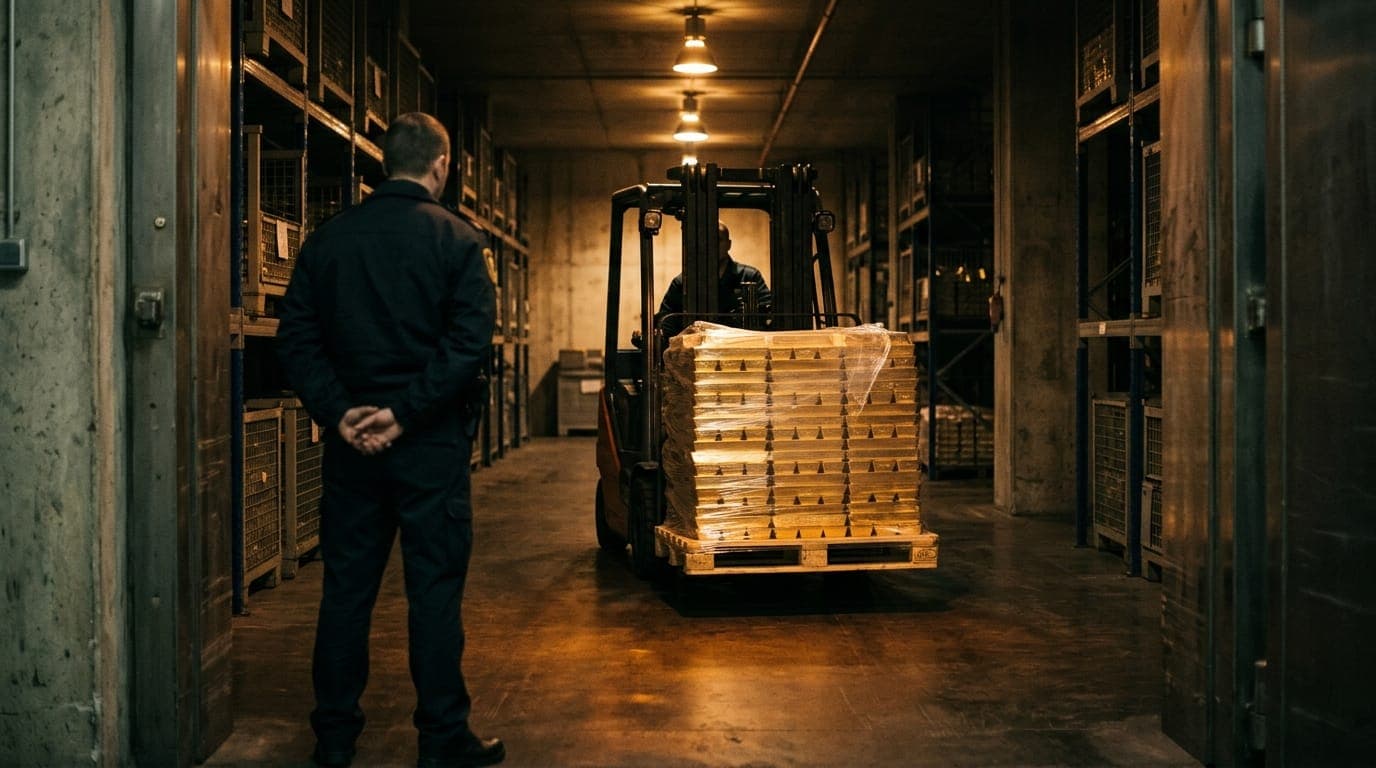
De Nederlandsche Bank quietly repositioned a quarter of its North American gold to London. The reasoning points somewhere uncomfortable.
Key takeaways
- De Nederlandsche Bank transferred 86 metric tonnes of gold from the Federal Reserve in New York and the Bank of Canada in Ottawa to the Bank of England between March and August 2026, citing "increasing geopolitical unrest" and the need for assets deployable in a crisis.
- Goldman Sachs analysts Lina Thomas and Daan Struyven flagged in a recent research note that "the location of central bank's gold holdings appears increasingly top of mind for reserve managers," framing political access risk as an explicit variable in gold storage decisions.
- Central bank gold buying has accelerated from roughly 17 tonnes per month pre-2022 to approximately 100 tonnes per month on a three-month seasonally adjusted basis, per Goldman's NowCast estimate, with the move away from single-jurisdiction concentration driving part of the demand signal.
De Nederlandsche Bank announced September 3, 2026 that it completed the transfer of 86 metric tonnes of gold from its holdings at the Federal Reserve Bank of New York and the Bank of Canada in Ottawa to the Bank of England in London. The operation ran from March through August 2026 and was kept secret until completion. Dutch Finance Minister Eelco Heinen described it as a matter of "vital public interest."
The mechanics: roughly 27 tonnes moved physically from North America to DNB's vault in Zeist, Netherlands; an equivalent 27 tonnes then moved from Zeist to London; and approximately 59 tonnes were sold in New York with proceeds used to buy gold in London. Post-move, London now accounts for 32.1% of DNB's reserves, up from 18.1%. The US and Canada combined account for 18.5%.
DNB holds 612.4 metric tonnes in total, valued at approximately €72.2 billion at end-2025. Gold is currently trading near $4,429 per ounce.
What DNB Actually Said
DNB Governor Olaf Sleijpen stated: "With this relocation, we have improved the tradability of our gold reserves. We expect that we will never need to use them, but we do need to strengthen our resilience and preparedness."
The bank's stated logic is operational. Gold stored at the Bank of England must meet international trade standards and sits inside the primary physical gold settlement network, enabling swaps, leasing, and immediate market access. Gold held in New York and Ottawa, DNB said, "could not be utilized as quickly and directly in a crisis situation." London gold is, in DNB's own framing, "the world's most easily tradable gold."
DNB's institutional statement: "Keeping a larger share of the gold reserves in London strengthens the function of gold as an anchor of trust."
The operational framing is plausible. It is also incomplete. A purely operational decision does not need to be hidden until finished.
A Pattern, Not an Anomaly
DNB is not moving in isolation. France's Banque de France sold 129 metric tonnes of gold held at the Federal Reserve Bank of New York in 26 transactions between July 2025 and January 2026, replacing it with modern-standard bars now held in Paris. The realized capital gain was approximately €11 billion. France's 2,437 tonnes are now entirely on domestic soil. BdF Governor François Villeroy de Galhau said the decision was "not politically motivated."
Goldman Sachs, in a research note authored by Lina Thomas and Daan Struyven (available to Goldman clients), named what is actually happening: "The location of central bank's gold holdings appears increasingly top of mind for reserve managers." The note frames political access risk as an explicit variable in gold storage decisions, with Venezuela's gold frozen at the Bank of England in 2018 cited in secondary reporting as a precedent the note invokes. The full text is paywalled and the specific language in the note is not independently verifiable from public sources.
Per Goldman's NowCast, central bank gold buying ran at approximately 57 tonnes in June and roughly 100 tonnes per month on a three-month seasonally adjusted basis, versus a pre-2022 average of approximately 17 tonnes per month, per Goldman research. These figures are Goldman estimates drawn from a paywalled note and should be treated as such. The 2022 Russian asset freeze did not just punish Russia. It permanently changed how every sovereign holding assets in New York calculates the risk of doing so.
The World Gold Council's 2026 Central Bank Gold Reserves Survey found 9% of respondents increased domestic storage in the past year and 10% diversified overseas storage, up from 5% and 2% respectively in the prior survey. Both figures are moving in one direction.
The Variable to Watch
The critical holdout is Germany. The Bundesbank holds approximately 3,352 metric tonnes of gold at end-2024, with a substantial portion held at the Federal Reserve in New York. Bundesbank President Joachim Nagel has publicly dismissed seizure risk. "I have no doubt that our gold is safely stored at the Federal Reserve in New York," he told Frankfurter Allgemeine Zeitung.
If the Bundesbank holds and other major European central banks do not follow DNB and France, this reads as a tail-country idiosyncrasy. If Germany moves, the thesis becomes a systemic defection from dollar-denominated custody as a default assumption.
The falsifiable read: if DNB's own subsequent communications clarify this was purely a quality-standard upgrade (the argument France partly used) and Goldman's full note reveals no political-risk framing beyond routine diversification advice, then the geopolitical signal is overstated. Watch the Bundesbank.
What This Signals for Hard-Money Assets
The hard asset upcycle thesis has a new data point. Gold's value as a reserve asset rests on neutral, accessible storage. The moment reserve managers start treating US custody as a political variable rather than a fixed assumption, they are pricing in the same financial weaponization that the offshore dollar dismantling thesis has been tracking since 2022.
DNB spent a summer moving the equivalent of roughly $12 billion in metal (an editorial estimate at approximately $4,429/oz) across the Atlantic to reduce exactly the kind of seizure risk that a bearer asset with no custodial counterparty eliminates by design. The 6x acceleration in central bank gold buying shows the demand for that property is real.
Sources
- DNB official press release, September 3, 2026
- CNBC, September 3, 2026
- Goldman Sachs research note by Lina Thomas and Daan Struyven (paywalled; available to Goldman clients)
- World Gold Council 2026 Central Bank Gold Reserves Survey
Frequently Asked Questions
Why did DNB move gold to London instead of back to the Netherlands?
The Bank of England sits at the center of the global physical gold settlement network. Gold held there can be deployed immediately through swaps, leasing, and spot market transactions. Domestic vaults in the Netherlands are secure but lack that market infrastructure, and concentrating holdings domestically creates a different kind of single-jurisdiction risk. London gives DNB liquid access without full repatriation.
Is Germany's gold in New York at legal risk of seizure?
Legally, almost certainly not under current US law and treaty frameworks. Practically, the 2022 freeze of Russian sovereign assets demonstrated that access to legally owned foreign reserves can be constrained by political decision without formal seizure. The Bundesbank's public position is that no such risk exists. The question is no longer purely theoretical, which is exactly why Goldman is publishing research on it.
What does central bank gold repatriation have to do with Bitcoin?
The same jurisdictional access risk driving central banks to relocate gold is the problem Bitcoin resolves at the bearer-asset level. There is no vault to repatriate from, no custodian to petition, and no political decision that can freeze a properly self-custodied position. Central banks are spending significant resources managing a risk that the asset's architecture eliminates entirely.