US Crude Inventories Hit Precariously Low Levels as SPR Falls to 1983 Low
US commercial crude inventories fell 7.2 million barrels for the week ending July 24, nearly six times what analysts expected, while the Strategic Petroleum Reserve dropped to 307.7 million barrels, its lowest level since 1983. Two administrations have burned the buffer; no replenishment plan
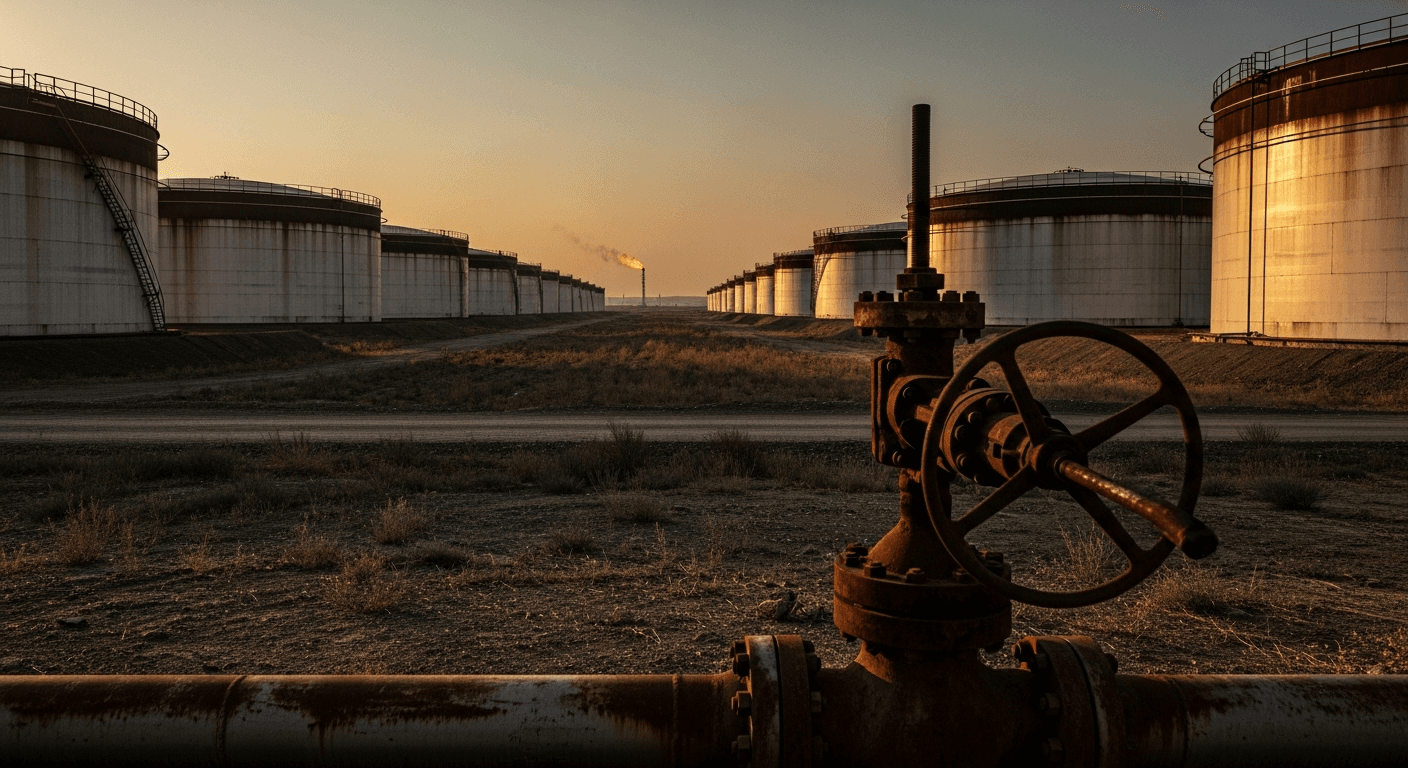
Two administrations burned the strategic buffer as a price-suppression tool. Now the bill is coming due.
Key takeaways
- US commercial crude inventories fell 7.2 million barrels for the week ending July 24, nearly six times the ~1.3 million barrel consensus forecast, leaving stockpiles 7% below their five-year seasonal average, per EIA data released July 29.
- The Strategic Petroleum Reserve dropped to 307.7 million barrels, its lowest level since 1983, after a combined 350-plus million barrels were released across the Biden and Trump administrations as emergency price-suppression measures.
- With refineries running at 97.2% capacity and the US absorbing roughly 70% of global onshore inventory draws over four months, the energy cost repricing ahead is structural, not cyclical.
US commercial crude oil inventories fell 7.2 million barrels for the week ending July 24, 2026, according to the EIA Weekly Petroleum Status Report released July 29. The draw was nearly six times the roughly 1.3 million barrels analysts had penciled in, and left commercial stockpiles at 404.5 million barrels, 7% below the five-year average for this time of year. Simultaneously, the Strategic Petroleum Reserve fell to 307.7 million barrels, its lowest level since 1983.
The geopolitical driver is straightforward: renewed US-Iran conflict has disrupted oil shipments through the Strait of Hormuz, pushing US refineries to elevated throughput levels. Refineries operated at 97.2% of operable capacity that week, averaging 17.3 million barrels per day of crude inputs. The Financial Times, which first reported the analyst commentary, noted that the US has stepped in to offset reduced Middle Eastern supply.
The Buffer Is Being Consumed in Real Time
The numbers from Kpler director of commodity research Matt Smith frame the scale of the problem plainly, as first reported by the Financial Times:
"US crude inventories, both commercial and the SPR, have drawn down by nearly 20 per cent since early April. The US accounts for about 70 per cent of global onshore crude inventory draws over the past four months. It has carried the burden of trying to keep oil prices in check over this period via SPR releases and higher exports, but stockpiles are rapidly depleting and this pace of draws cannot persist ad infinitum."
Rory Johnston of Commodity Context described current crude and gasoline inventories as "precariously low."
That 70% figure is the one that matters. The US is the single largest absorber of global geopolitical risk premium, drawing down a finite reserve with no credible replenishment plan announced.
The SPR mechanics compound the problem in a way the headline number obscures. The Bipartisan Policy Center notes the theoretical maximum extraction rate of the SPR is 4.4 million barrels per day, but that rate falls to roughly 1 to 1.4 million barrels per day as reserve levels drop, due to reduced reservoir pressure. So as the SPR shrinks, not only does the cushion get thinner, the rate at which that cushion can be deployed in a future crisis falls too. The US is burning the buffer and degrading the fire hose at the same time.
At 307.7 million barrels, the SPR sits roughly 100 to 130 million barrels above its estimated operational minimum of 180 to 200 million barrels. That sounds like headroom until you account for the current draw pace and the fact that the Trump administration authorized a 172-million-barrel IEA-coordinated emergency release in mid-March 2026, on top of the 180 million barrels Biden released in 2022. Two administrations have now used the reserve as a recurring price-suppression tool rather than a genuine emergency backstop, and what remains is not a cushion, it is the shock absorber being consumed in real time.
What the Energy Repricing Means for the Monetary Policy Trap
This feeds directly into the inflation picture the Fed is already navigating. Tight crude and gasoline inventories mean less pricing flexibility when demand spikes or supply is disrupted further. Sustained higher energy costs flow through to manufacturing, food, transport, and heating, the full CPI basket.
The Fed cannot raise rates aggressively into a war economy without compounding a deficit that is already running in the multi-trillions. It cannot cut aggressively into a supply-driven inflation spike without destroying dollar credibility further. That is the monetary policy trap. Watch for hot July and August CPI prints as the leading indicator of how fast that corner tightens.
Bitcoin is a fixed-supply asset with no strategic reserve the government can release on demand to manage its price. Every barrel the SPR depletes without a funded replenishment program is another data point confirming that fiat price management has a hard ceiling, and that the ceiling is getting closer.
The thesis here is falsifiable. If the Strait of Hormuz reopens to normal commercial traffic within 30 to 60 days and the Trump administration launches a congressionally funded SPR replenishment program buying oil back at scale, the supply pressure lifts. A sustained WTI retreat back below $75 per barrel would be the price confirmation. Until then, the structural energy repricing is the base case, and the monetary policy paralysis it creates is the environment Bitcoin was designed for.
What to Watch
The EIA will release the next Weekly Petroleum Status Report in approximately one week. The numbers to watch: whether the commercial draw rate moderates, whether SPR releases continue at the current pace, and whether refinery utilization pulls back from the 97.2% ceiling. Any congressional action on SPR replenishment funding would shift the calculus materially. There is none currently on the table.
Update, September 11, 2026
Piper Sandler global energy strategist Jan Stuart put institutional weight behind the inventory alarm this week. Stuart's note flags the physical oil market flashing major warning signs, with disrupted exports, depleted inventories, and an ongoing diesel shortage crisis all converging ahead of stronger fourth-quarter demand.
Middle Eastern crude loadings averaged 13.3 million barrels a day in the week through September 9, with Stuart warning the shortfall is roughly 5 to 6 million barrels a day.
The diesel picture is the sharpest near-term pressure point. The national average diesel price hit $5.90 a gallon as of Monday, up from $3.70 a year ago, while US distillate stocks including diesel and heating oil sat 14% below their five-year average for the week ending August 28, with refineries already running at 98% of capacity.
There is no spare refining capacity sitting idle to rescue a cold December. The supply hole has two distinct sources: Russia has banned diesel exports while repairing refinery damage from Ukrainian drone strikes, and Middle Eastern refiners cannot move fuels through the Strait of Hormuz while also absorbing refinery damage of their own.
Surging crude values are barely compressing diesel margins, and the oil market has begun pricing several deep problems with no easy or quick resolution to conflicts in either the Middle East or Ukraine.
Households will feel this less at the gasoline pump than in the price of everything trucks move: groceries, building materials, parcels, and heating oil in the Northeast. That transmission mechanism is the inflation vector the Fed cannot cut its way out of.
Sources
- EIA Weekly Petroleum Status Report, week ending July 24, 2026
- DOE Strategic Petroleum Reserve
- Bipartisan Policy Center, How the US Strategic Petroleum Reserve Works
- Analyst commentary first reported by the Financial Times
Frequently Asked Questions
The estimated physical and mechanical floor for SPR operation is 180 to 200 million barrels, per the Bipartisan Policy Center. At 307.7 million barrels, roughly 100 to 130 million barrels of usable reserve remain above that floor. Critically, draw rates slow significantly as levels fall, reducing the SPR's utility in a future crisis even before it hits the technical minimum.
Middle Eastern supply disruptions caused by the Strait of Hormuz conflict have forced the US to act as the market's de facto buffer, through SPR releases and ramped-up domestic refining and exports. No other country has the reserve scale or refinery capacity to absorb the shortfall at this magnitude. That role is not sustainable at the current draw pace.
Tight inventories remove the pricing buffer that absorbs demand spikes or further supply disruptions. Higher sustained energy costs feed directly into broader CPI. The Fed cannot raise rates into a war-economy deficit without compounding the fiscal crisis, and cannot cut into a supply inflation spike without stoking further dollar weakness. That policy paralysis, the inflate-or-die corner, is the environment where Bitcoin's fixed supply and government-proof scarcity is most directly valuable.