Ukraine Hits Russia's Largest Refinery Again and Yandex's Biggest Data Center
Ukrainian drones struck Russia's largest oil refinery in Omsk for the second time on October 8 and hit Yandex's largest data center in a war first, accelerating an economic-attrition campaign that carries real consequences for global energy supply and centralized digital infrastructure.
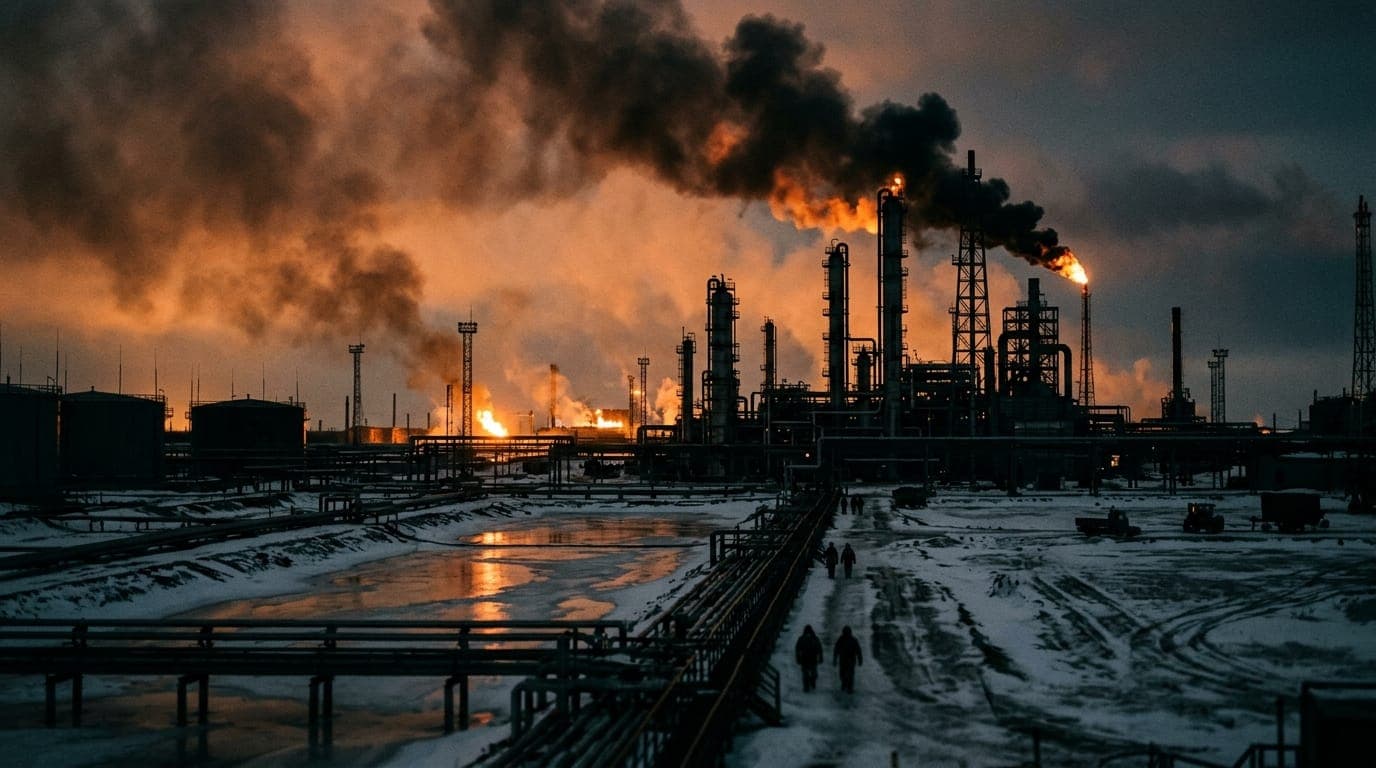
Ukrainian FP-1 drones traveled more than 2,500 km to strike Gazprom Neft's Omsk refinery a second time, while a separate drone destroyed Yandex's largest data center in the first confirmed attack on Russian digital infrastructure since 2022.
Key takeaways
- Ukraine's Special Operations Forces struck the Omsk Oil Refinery (roughly 440,000 barrels per day, approximately 1/15th of Russia's total refining capacity) with upgraded FP-1 long-range drones on October 8, 2026, the second hit on the facility after a July 6 strike.
- A Ukrainian drone also destroyed Yandex's largest data center in Sasovo, Ryazan Oblast, knocking out operations and threatening two of the company's three Nvidia A100-based supercomputers used to train YandexGPT.
- Both strikes extend an economic-attrition campaign targeting Russia's energy and digital backbone, tightening global refined-product supply and introducing a new category of correlated risk for centralized infrastructure.
Ukraine's Special Operations Forces confirmed on October 8, 2026, that "Deep Strike" units struck the Omsk Oil Refinery in Western Siberia, using upgraded FP-1 drones manufactured by Fire Point and flying a path the SSO cited as roughly 3,000 km. The same facility was forced offline by a prior drone strike on July 6. Omsk is Russia's largest refinery and, per Ukraine's General Staff, the last of Russia's eleven biggest gasoline producers to have been targeted.
Russia's Defense Ministry confirmed its air-defense systems intercepted 399 Ukrainian drones across 18 regions in the same overnight operation, but Omsk's regional governor Vitaly Khotsenko acknowledged on Telegram that at least one drone penetrated defenses and impacted the facility. Residents were already lining up at Omsk gas stations before dawn, against the backdrop of an existing national fuel shortage.
The Refinery Math
The Omsk facility processed roughly 22 million tonnes of crude in 2024, equivalent to approximately 440,000 barrels per day, producing five million tonnes of gasoline and eight million tonnes of diesel annually. That output represents approximately 1/15th of Russia's total refining capacity. Ukraine's General Staff framed the operation in terms the Kyiv Post relayed directly from the SSO statement:
"On Oct. 8, 'Deep Strike' units of the Special Operations Forces struck the refinery."
The General Staff added that the campaign constitutes "the exercise by Ukraine of its inalienable right to self-defence in accordance with Article 51 of the UN Charter and is aimed at reducing the military and economic potential of the Russian Federation."
The FP-1 drone reaching Omsk matters beyond the headline. The refinery sits beyond the Ural Mountains in Western Siberia, more than 2,500 km from Ukraine's border. No Russian refinery is now geographically safe, and Ukraine has confirmed this is the completion of a deliberate targeting list: every one of Russia's eleven largest gasoline producers has now been struck at least once.
Ukraine's General Staff claimed as of July 2026 that over 42% of Russian refining capacity had been disabled since August 2025. The October 8 Omsk strike is additive to that figure, though the current damage assessment remains open.
Digital Infrastructure Enters the Target Set
The overnight campaign also hit Yandex's largest data center in Sasovo, Ryazan Oblast, starting a fire confirmed independently by NASA's FIRMS satellite service. Yandex released a statement that the attack forced a complete suspension of operations and left the company unable to confirm whether equipment can be restored:
"The scale of the damage to the infrastructure is still being assessed. For the moment, we cannot confirm whether it is possible to restore the data centre equipment in Sasovo."
Per reporting from Meduza, the Sasovo facility houses two of Yandex's three Nvidia A100-based supercomputers, the hardware underpinning YandexGPT development. Outage tracker Downdetector logged more than 1,300 user reports of disruptions to Yandex Cloud, Yandex Documents, and Yandex Tables, though core consumer services including search and the taxi platform stayed online. Yandex shares fell more than 3.4% on the Moscow Exchange Thursday morning, per Moscow Times reporting.
The Moscow Times confirmed this is the first strike against Russian data infrastructure since the February 2022 invasion. Russia had itself struck at least eight major Ukrainian data centers in the weeks prior, arguing those facilities supported military operations. Ukraine is now returning that logic.
What Tighter Refined-Product Supply Actually Means
Energy supply disruptions are inflation injections. Diesel and gasoline from Omsk flow into global refined-product markets. A second hit on 440,000 b/d of capacity, layered on top of a campaign Ukraine's General Staff claims has disabled more than 40% of Russian refining since August 2025, tightens supply. Tighter supply lifts prices.
The diesel crack spread was already flashing structural inflation signals before October 8. The Fed's own framework cannot resolve supply-shock inflation without pain. October 8 is supply-shock inflation in action.
The data center strike adds a second transmission mechanism. State actors can now credibly threaten cloud uptime, AI compute, and the payment rails that run on centralized digital infrastructure at ranges exceeding 2,500 km. Bitcoin's distributed consensus and self-custody architecture is the only monetary network structurally hardened against that class of attack. Capital that cannot be seized, and a network that has no data center to target, look different after Sasovo.
The falsifiable version of this thesis: if Russia demonstrates full refinery redundancy within 30 to 60 days and global refined-product prices register no sustained supply-risk premium, the economic-attrition case does not hold. Watch Omsk restart timelines and diesel crack spreads.
What to Watch
The damage assessment at Omsk is still open. The immediate signal set to track: whether the facility restarts within weeks or remains offline for months (the July strike forced a halt of undisclosed duration), whether Russia's fuel shortage spreads beyond Omsk, and whether Yandex can recover its A100 compute capacity or faces a sustained gap in its AI development pipeline. Any of those outcomes running longer than the market currently expects widens the gap between how this is being priced and what it actually means.
Sources
- Ukraine General Staff of the Armed Forces, statement via Ukrpravda, October 8, 2026
- SSO Telegram statement via Kyiv Post, October 8, 2026
- Meduza: Yandex data center strike and A100 supercomputer detail
- The Moscow Times: Yandex data center strike confirmation and Downdetector reports
- Kyiv Independent: Omsk refinery second strike and targeting context
Frequently Asked Questions
Why does the Omsk refinery's location beyond the Ural Mountains matter strategically?
The Urals have functioned as a practical boundary for Ukrainian strike range throughout most of the war. FP-1 drones reaching Omsk, more than 2,500 km from Ukraine's border, eliminates any remaining geographic sanctuary for Russian industrial assets. Every major Russian refinery is now within potential range, regardless of how far east it sits.
What happened to Yandex's AI supercomputers in the Sasovo strike?
The Sasovo data center houses two of Yandex's three Nvidia A100-based supercomputer clusters, which are used to train and run YandexGPT. Yandex's official statement said the company cannot yet confirm whether the data center equipment can be restored. The status of those two supercomputers remains unconfirmed as of publication.
How much Russian refining capacity has Ukraine's campaign disabled in total?
Ukraine's General Staff claimed as of July 4, 2026, that strikes since August 2025 had disabled approximately 42% of Russia's refining capacity and caused roughly $13.5 billion in losses. That figure predates the October 8 Omsk strike. It is a Ukrainian government claim and has not been independently verified, but it provides the baseline context for what the latest hit adds to.