Torus Raises $500M to Deploy Modular AI Compute Where Power Already Exists
Torus closed a $500M Series C led by Magnetar to mass-produce Foundry, a 1-20 MW prefab AI inference unit that installs behind existing transformers in 12-16 weeks. The model mirrors what Bitcoin miners have done for a decade. The competition for stranded power just got institutional.
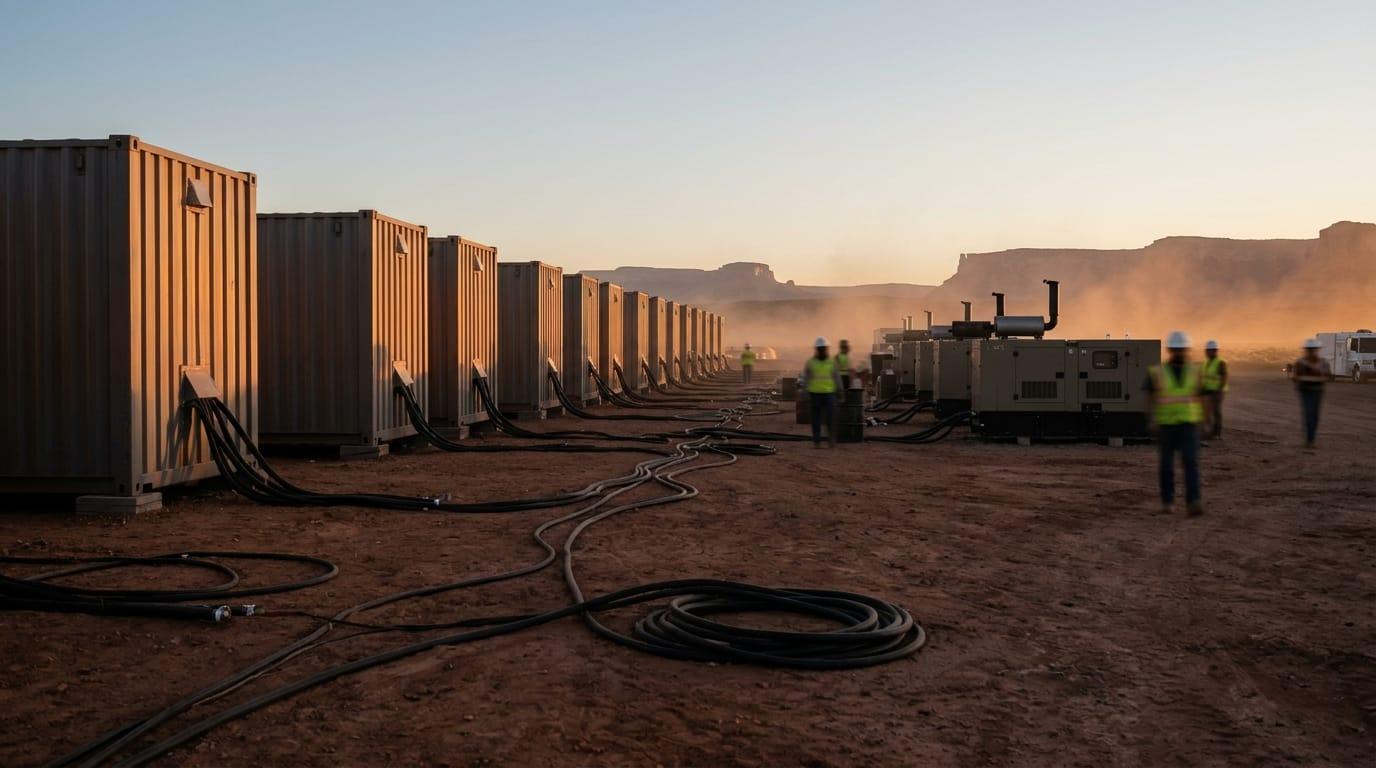
Magnetar leads a landmark Series C for a prefab inference unit that skips the grid queue entirely by going to power that's already there.
Key takeaways
- Torus closed a $500M Series C led by Magnetar on November 11, 2026, to mass-produce Foundry, a prefabricated 1-20 MW AI inference unit that installs behind existing transformers and goes live in 12-16 weeks.
- The model bypasses the interconnection queue outright. Bringing new generation online in PJM averaged over 8 years in 2025, per an RMI analysis.
- The same behind-the-meter, go-to-the-stranded-power playbook Bitcoin miners have run for a decade is now attracting institutional capital at scale, which raises the floor price on the curtailed and underutilized power that underpins mining's cost advantage.
Torus, a Salt Lake City energy-storage startup, closed a $500M Series C led by Magnetar on November 11, 2026, to scale production of Torus Foundry, a containerized AI inference unit that plugs into spare transformer headroom without requiring a new grid connection. The company says Foundry goes from signed contract to live compute in 12 to 16 weeks, a timeline that inverts the decade-long physics problem the AI capex boom has been colliding with.
Per the Torus press release, the round also included ICONIQ Capital, Origin Ventures, Ridgeline Partners, and Trinity Capital. CEO and Founder Nate Walkingshaw framed the product plainly: "Instead of waiting years to bring power to the chips, we bring the chips to the power."
What Foundry Actually Does
Each Foundry unit scales from 1 to 20 MW and is built to fit behind existing distribution infrastructure, using transformer headroom that would otherwise sit idle. Torus pairs it with its Reserve product, a flywheel-and-battery system that smooths the sharp load spikes AI inference creates on the local grid.
Torus manufactures Foundry at GigaOne, a 545,000-square-foot facility in Salt Lake City that opened its first production line in early 2026. Per the Torus press release, the company says that line can support 500 MW of IT load with plans to expand to 1 GW. Named customers include bare-metal GPU infrastructure provider Hydra Host and one unnamed AI cloud provider. Torus says thousands of GPUs are already running in deployed Foundry units and targets 47,000 GPUs live by end of 2027.
The interconnection problem Foundry is designed around is not abstract. Bringing new generation online in PJM averaged over 8 years in 2025, up from under 2 years in 2008, per RMI's analysis. That gap is why power shortfall projections for AI data centers keep landing. Torus routes around the queue entirely rather than trying to fix it.
The Bitcoin Mining Playbook, Institutionalized
Here is what cannot be missed: Bitcoin miners built this exact model. Containerized compute, behind-the-meter installation, go to where power already exists and is cheap, skip the queue. Miners have been doing this since the first ASIC got dropped next to a curtailed hydro dam. For years, that approach was treated as parasitic or at best opportunistic.
Now Magnetar is writing a $500M check to do the same thing for AI inference, and the architecture is being celebrated as visionary infrastructure. That is validation of the Bitcoin mining approach, and it is competition at the same time.
The downstream pressure on miners is real. Every flared gas wellhead, every industrial transformer with spare headroom, every curtailed wind farm that Bitcoin miners have historically accessed at a discount now has a second institutional buyer. AI data center demand is not speculative anymore; it is capitalized and moving fast. That compresses the energy arbitrage that has defined mining's cost structure.
The miners holding long-dated power purchase agreements at defensible sites with demonstrated grid value are structurally protected. The ones relying on cheap power today without a durable contract are increasingly exposed.
The falsifiable thesis: Torus Foundry validates that the go-to-the-power model works at institutional scale. That thesis breaks if FERC or state PUC rulemaking disallows or cost-shifts behind-the-meter co-location arrangements (FERC's December 2025 order already directed PJM to revise behind-the-meter generation rules), or if Torus misses its 47,000-GPU target by end-2027. If either happens, the competitive pressure on miners from this vector eases considerably.
What to Watch
Torus's execution at GigaOne is the near-term tell. If the first production line hits its stated 500 MW IT load capacity and customer deployments scale past the thousands-of-GPUs baseline into five-figure GPU counts by mid-2027, the model is real and the competitive pressure on miners for behind-the-meter power sites accelerates. Watch also for FERC rulemaking on co-location. Any order that meaningfully restricts behind-the-meter AI compute would change the competitive calculus for both Torus and the miners it is now racing against for the same electrons.
Sources
Frequently Asked Questions
What is a behind-the-meter installation and how does it skip the grid queue?
A behind-the-meter installation connects to the customer side of an electricity meter, using capacity that already exists in a local transformer or substation rather than requesting a new grid connection. Because no new interconnection is needed, the project bypasses the formal interconnection queue entirely. That queue now takes over 8 years on average in PJM for new generation, per RMI. Behind-the-meter projects can go live in weeks.
How does Torus Foundry compare to Bitcoin mining containers in power and deployment?
Foundry scales from 1 to 20 MW per site and deploys in 12 to 16 weeks using existing transformer headroom. Bitcoin mining containers operate on a similar behind-the-meter, modular-deployment model, typically in the 1 to 5 MW range per container stack, with comparable fast-deployment timelines. The hardware differs (GPUs for inference versus ASICs for hashing), but the site selection logic and grid interaction are structurally the same.
Will AI data centers compete with Bitcoin miners for curtailed and stranded power?
They already are. Torus Foundry is designed specifically for sites where power exists but grid capacity to export or transmit it does not. That is the same energy profile Bitcoin miners have targeted for years: curtailed renewables, flared gas, underutilized industrial substations.
With $500M in institutional capital now funding modular AI inference at those sites, miners face a structural second buyer in a market that was previously thinly contested. The miners best positioned to absorb this competition are those with locked-in, long-dated power agreements at sites that are difficult to replicate.