US, Japan, and South Korea Sign Trilateral SMR Pact at NATO Summit
Secretary Rubio, Japan's Motegi, and South Korea's Cho signed a trilateral SMR Memorandum of Cooperation on July 8 at the NATO Ankara Summit, committing $10M+ in US funding and an industry deal to push the BWRX-300 into Europe and the Indo-Pacific.
Nuclear is geopolitical infrastructure now. The paperwork just caught up.
Key takeaways
- Secretary of State Marco Rubio, Japan's Foreign Minister Motegi Toshimitsu, and South Korea's Foreign Minister Cho Hyun signed a trilateral SMR Memorandum of Cooperation on July 8, 2026, at the NATO Ankara Summit, with initial focus on Indo-Pacific reactor deployments and $10M+ in new US State Department FIRST Program funding.
- The agreement pairs with an industry deal: GE Vernova, Hitachi, Samsung C&T, and Poland's SGE (Synthos Green Energy) will deploy the BWRX-300 SMR across Europe, signaling a coordinated attempt to displace Russian and Chinese reactor exports globally.
- For Bitcoin miners and AI infrastructure operators, allied SMR buildout in the 300 MWe range directly matches large-scale facility power footprints and rewrites where cheap, dispatchable power concentrates over the next decade.
The United States, Japan, and the Republic of Korea signed a trilateral Memorandum of Cooperation on SMR deployments on July 8, 2026, on the sidelines of the NATO Summit in Ankara, per the US State Department's official release. The MOC, signed by Rubio, Motegi, and Cho, targets Indo-Pacific partner nations first and frames nuclear energy explicitly as a security asset. The State Department's language is blunt: "The MOC advances our mutual security interests and paves the way for partner countries to meet their energy security needs."
This is not a climate communiqué. Rubio said the quiet part at the podium: "One of the most important issues in the world today, as we're reminded of even now with events happening in the Straits of Hormuz and in other places, is energy security." He added that SMRs are "going to be in many ways the future of energy generation in a very safe, efficient way, cost-effective way that will make our economies stronger."
What the MOC Actually Commits
The US is putting $10 million in new funding into the State Department's FIRST Program (Foundational Infrastructure for Responsible Use of Small Modular Reactor Technology), directed at advancing SMR project development and standing up an SMR Regional Training Hub in the Indo-Pacific.
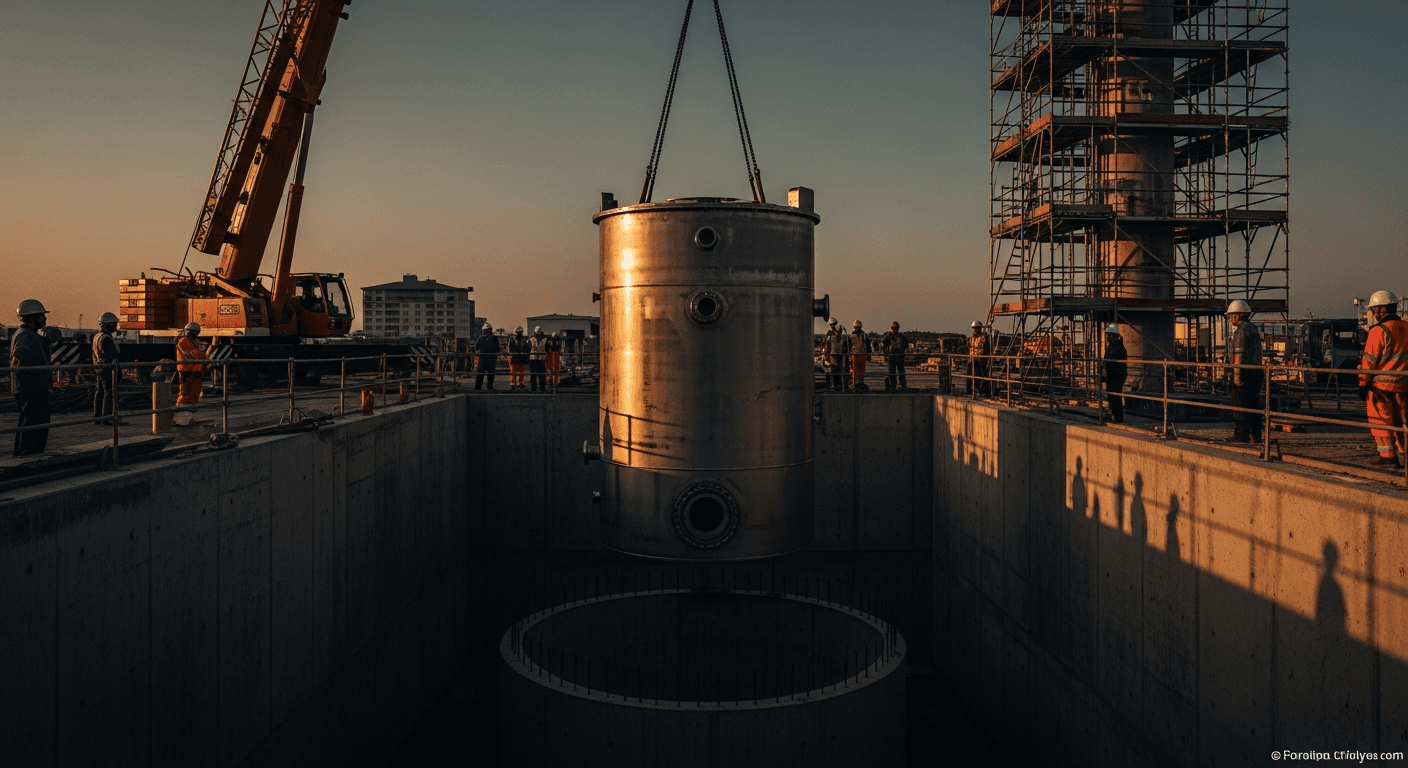
Alongside the government framework, an industry deal was announced: GE Vernova, Hitachi, Samsung C&T, and SGE (Synthos Green Energy, a Warsaw-based SMR development platform) will deploy the BWRX-300 SMR across Europe. The BWRX-300 is a 300 MWe water-cooled, natural circulation reactor built on GE Vernova Hitachi's NRC-certified ESBWR design. The first unit is under construction at Ontario Power Generation's Darlington site in Canada, with completion targeted by end of the decade.
The fuel supply chain is already being assembled. Centrus Energy signed an expanded MOU with Korea Hydro & Nuclear Power (KHNP) and POSCO International in August 2025, increasing low-enriched uranium supply volumes tied to new enrichment capacity at the American Centrifuge Plant in Piketon, Ohio, per Centrus's SEC 8-K filing. That supply commitment is contingent on Centrus receiving federal funding. The company subsequently received a $900 million DOE award to expand the Piketon facility for commercial-scale HALEU and LEU production. Amir Vexler, Centrus President and CEO, said the KHNP deal reflects work "to restore America's ability to enrich uranium at a large scale."
Geopolitical Infrastructure, Not Climate Policy
The dominant reactor exporter the MOC is aimed at displacing is Rosatom. Russia's state nuclear company has spent the better part of two decades locking up reactor contracts across Asia, Africa, and the Middle East, building dependencies that translate directly into political leverage. China's CNNC is running the same playbook. This trilateral framework is the West's explicit counter.
The falsifiable thesis here: if Indo-Pacific partner nations continue awarding reactor contracts to Rosatom or CNNC at scale despite this framework, or if the BWRX-300 deployment pipeline stalls again on cost overruns and licensing delays (a pattern that has repeated since 2010), then this MOC is a press release, not a realignment. Watch the Darlington completion date and any new reactor contracts signed in Southeast Asia through 2027.
The Hormuz pressure Rubio cited at the signing is the live stress test. Energy supply routes that run through geopolitical chokepoints are exactly the vulnerability allied SMR capacity is designed to route around.
What This Means for Miners and Data Center Operators
The mainstream read stops at "energy diplomacy." The second-order effect is more interesting.
AI data centers and industrial-scale Bitcoin miners both need the same thing: firm, dispatchable, around-the-clock power that solar and wind cannot reliably deliver. The grid is already straining under AI capex demand, and AI infrastructure build is repricing power for miners in real time. SMRs in the 300 MWe class sit at exactly the right scale for a large mining campus or hyperscaler pod. They can be sited at the load. They don't require new transmission. The Nvidia-Valar microreactor proof of concept is already showing what behind-the-meter nuclear looks like for compute workloads.
The "go where energy is cheapest" calculus that sent hashrate toward authoritarian-energy-cheap jurisdictions for years starts bending toward allied-SMR-cheap jurisdictions if this buildout succeeds. Hashrate decentralization doesn't require altruism. It follows energy economics. The miner who secures an SMR power purchase agreement in the early 2030s enters the next halving cycles with a structural cost advantage that grid-tied competitors cannot match.
What to Watch
Darlington is the proof of concept. If the first BWRX-300 comes online on schedule by end of decade, the deployment pipeline for every subsequent Indo-Pacific unit this MOC envisions becomes credible. If it slips, every timeline attached to this framework slips with it. Track new reactor contract announcements in Southeast Asia through 2027 and watch whether South Korea's own domestic nuclear export ambitions (KHNP has been competing aggressively for contracts in Eastern Europe and Central Asia) align with or complicate the trilateral framework Cho signed onto in Ankara.
Sources
Frequently Asked Questions
What is the BWRX-300 and when will the first unit actually come online?
The BWRX-300 is GE Vernova Hitachi's 300 MWe boiling water SMR, built on a design already certified by the US Nuclear Regulatory Commission. The first unit is under construction at Ontario Power Generation's Darlington site in Canada, with completion targeted by end of the decade. That deployment is the leading real-world proof point for every subsequent unit this MOC envisions.
How does this trilateral MOC compete with Rosatom, which already holds reactor contracts across Asia and Africa?
Rosatom has been the dominant global nuclear exporter for over a decade, with contracts across Bangladesh, Egypt, Turkey, India, and others. The State Department's language around "more competitive alternatives" is aimed directly at that market position. Whether allied SMRs can close on price and delivery timeline before Rosatom locks up additional contracts in Southeast Asia is the open question this framework has to answer in the next few years.
Could an SMR realistically power a Bitcoin mining operation or AI data center directly?
Yes. At 300 MWe, a single BWRX-300 unit covers the power footprint of a large industrial mining campus or hyperscaler pod. SMRs are designed for behind-the-meter and off-grid siting, which matches exactly what large miners operating on captive-generation economics need. Commercial deployments will set the benchmark costs that determine whether SMR power purchase agreements become the defining input advantage in the post-2030 mining cycles.