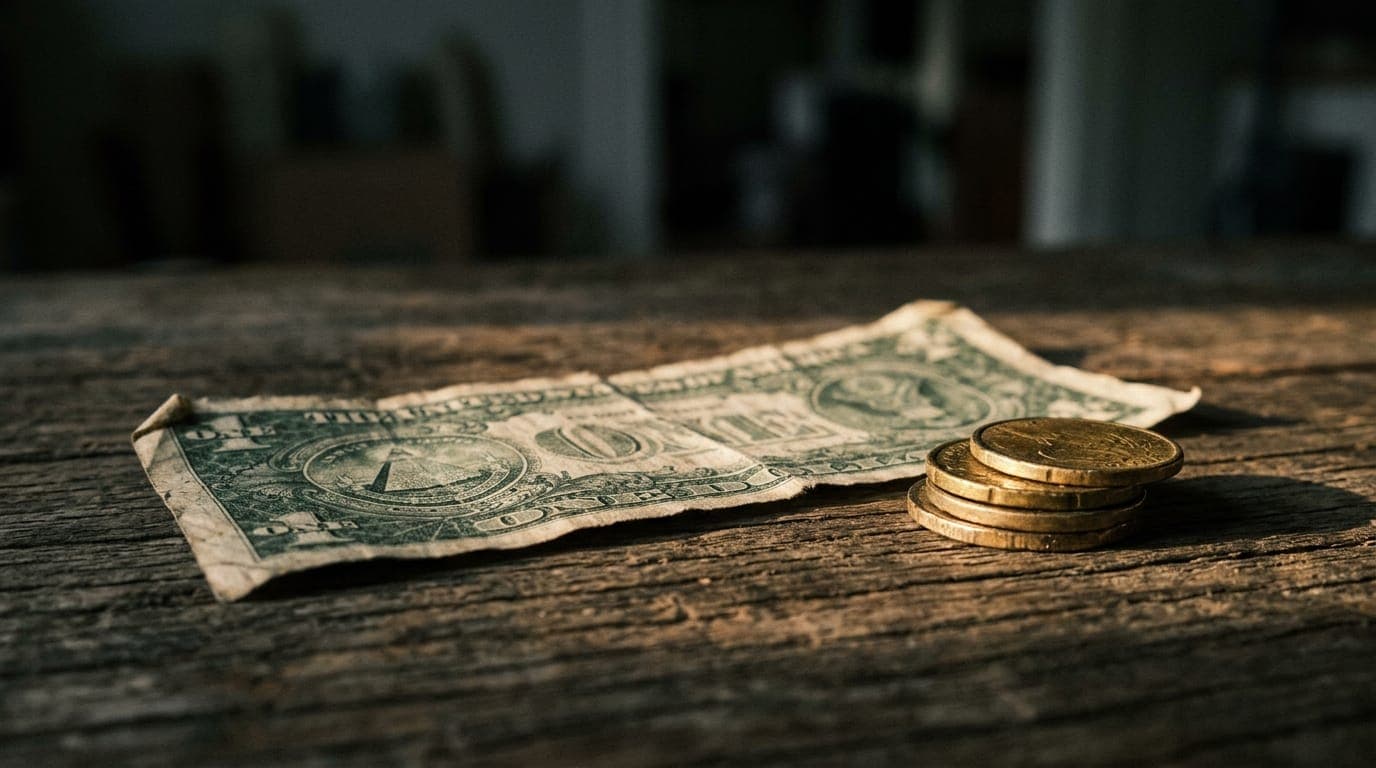
Jeremy Ryan Slate: Rome's Currency Debasement Playbook
Jeremy Ryan Slate joins to walk the full arc of Roman currency debasement, from a 95% silver denarius under Augustus to a bronze slug by the 270s, and Marty connects every step to the modern fiat playbook: QE as coin-clipping, COVID checks as donatives, price controls as Diocletian's Edict.

↓ Jump to the video and timestamps
I've been saying on this show for years that broken money is the root cause of nearly every social, political, and economic dysfunction we're living through. Most people think that's a Bitcoin talking point. Jeremy Ryan Slate showed up with 2,000 years of primary-source data confirming it.
Jeremy is a historian and podcaster who has spent years studying the Roman monetary system, and when I reached out to him about doing an episode specifically on currency debasement, his response was that it's his favorite topic. That's the kind of guest you want on this subject. What followed was one of the clearest maps I've heard of how a great empire coins its own demise, one payroll at a time, and how the mechanism playing out in Washington right now is the same thing as Rome, with better branding.
Rome is a mirror. And if you look at where we are today, the money printing, the military overextension, the price controls being floated, the checks dropped from helicopters during COVID, we're somewhere in the third century.
Key takeaways
- Rome didn't collapse overnight, it debased its way there over roughly 200 years. The denarius went from approximately 95% silver under Augustus to somewhere around 5% by the 270s, one military payroll at a time, until the silver was visibly flaking off coins in the marketplace.
- Septimius Severus set the template every emperor after him followed. Roughly double legionary pay, expand the legions, hand out the largest donative in a generation, and fund it all by clipping the coin. That blueprint ran the empire into the ground across the entire third century.
- When soldiers started getting paid in salt, the game was already up. The military felt the debasement before the civilian economy did. The words "salary" and "worth your salt" are a third-century monetary crisis baked permanently into the English language.
- Diocletian's price controls didn't fix inflation, they created black markets. His Edict of Maximum Prices (around 301 AD) accelerated barter and underground trade rather than stabilizing anything. Every version of this being floated today will produce the same result.
- Constantine fixed the money with a gold standard and bought the Eastern Empire centuries of stability. The solidus held for an extraordinarily long run. The monetary reform gets almost no historical attention because Christianity is the more dramatic story, but sound money is what made the Eastern Roman Empire's survival possible.
- The modern toolkit is identical. Coin-clipping is QE. Donatives are stimulus checks. Minimum wage mandates and UBI proposals are Diocletian's Edict with a press release. The people bearing the cost are always the ones farthest from the printer.
Sound Money Was Rome's Foundation, Until It Wasn't
Before you can understand the debasement, you need to understand what the coin was actually for.
Jeremy's framing here reoriented how I think about ancient coinage. The denarius wasn't just a medium of exchange, it was a propaganda tool. Emperors put imagery on coins to signal strength to the military, because the military was the audience that mattered most. A weak emperor would load his coin with symbols of power to convince the soldiers taking that coin that the guy issuing it was worth following. Trust in money and trust in power were the same thing.
Under Augustus, in the first century, the silver denarius was approximately 95% pure. That's where the baseline sits. By the 270s, deep into what historians call the Third Century Crisis, Slate's read is that the silver content had fallen to somewhere around 2% to 5%. He's careful to flag the uncertainty, the exact purity varied coin by coin, and we genuinely don't know the precise figures, but the direction of travel is not in dispute.
A coin that was nearly pure silver became a bronze slug with a thin silver wash on the outside. You could watch the silver flake off in your hand.
The empire couldn't stop spending on its military, and the only way to fund it was to make the money cheaper. That collapse happened over roughly two centuries, one payroll at a time.
The Military Spending Spiral That Broke the Coin
The year 193 AD is where the debasement really finds its groove.
Commodus, son of Marcus Aurelius, is killed. His successor, a respected senator named Pertinax, lasts roughly 86 days. Why? Because he tried to pull back some of the pay promised to the Praetorian Guard. You don't do that. The Praetorians killed him, then did something that tells you everything you need to know about where power actually sat in Rome: they put the empire up for auction. A man named Didius Julianus bid 25,000 sesterces per guard member, by Slate's account citing Cassius Dio, and bought himself the purple.
He didn't last long either. Septimius Severus marched a legion up from North Africa, had Julianus killed, replaced the troublesome Praetorians with his own men, and then did the thing that set the template for every emperor who followed him through the third century: he roughly doubled legionary pay, expanded the size of the legions, and handed out the largest donative, the gift to the military upon taking power, in a generation.
Every emperor after Severus followed that same blueprint. Had to. Because if you didn't, the next guy who promised it would march on you. The spending spiral locked in, and the only lever available to fund it was the coin. Clip a bit more silver. Add a bit more base metal. Repeat.
Caracalla, Severus's son, took a different approach to the revenue problem. In 212 AD, he extended Roman citizenship to an estimated 30 million people, essentially most free inhabitants of the empire, overnight. Not out of generosity. He changed their tax status, which meant he could now reach their inheritance. When you're running out of silver, you find other ways to extract.
Slate's phrase stuck with me: the Severan blueprint "is going to be a blueprint that every emperor after him into the 3rd century is going to follow." That's the line. Once the precedent exists that military loyalty is purchased with currency, every successor is trapped by it. Sound familiar?
Third-Century Crisis, When the Frog Noticed the Water Was Boiling
The military felt it first. That's always how it goes.
By the third century, soldiers were unhappy enough with debased coinage that commanders started supplementing pay with salt rations. Salt had real utility, preservation, trade, value that didn't depend on the emperor's honesty about silver content.
The Latin word salarium, meaning a salt payment, is where "salary" comes from. "Worth your salt" encodes a third-century monetary collapse into an idiom we still use today without thinking about it.
In the roughly 50-year period from 235 to 284 AD, roughly two dozen men claimed the title of emperor. Legions would raise a commander up, sew together something purple to drape on him, and march on Rome on the promise that this guy would pay better than the last guy. If he couldn't deliver, the same soldiers who raised him would put him down. The Praetorian Guard, by Slate's reckoning, killed numerous emperors across the empire's history, a power-behind-the-throne that auctioned the empire in 193 and kept the knife handy for any emperor who tried to trim their budget.
When I said on tape that this sounds like the deep state, Jeremy confirmed it immediately. That's exactly what the Praetorian Prefect was: the most powerful man in Rome, operating in the shadows behind the nominal ruler. Tiberius handed the entire administration of Rome to his Praetorian Prefect Sejanus while retreating to Capri, only returning when he felt Sejanus had gotten powerful enough to threaten his life. Constantine eventually recognized this structural threat for what it was and disbanded the Guard entirely, closing their headquarters, the Castra Praetoria, for good.
Meanwhile, in the civilian economy, people started noticing the silver flaking off their coins in the marketplace. They responded the way people always respond: they demanded more coins to compensate, prices rose, and when Diocletian tried to fix it with his Edict of Maximum Prices around 301 AD, setting legal caps on what anyone could charge for goods and services, the black market exploded.
People weren't going to be told how much they could earn. They switched to barter. Traded sheep. Moved underground. Price controls have never worked in Rome, in Venezuela, or anywhere else. They treat the symptom and accelerate the disease.
The public, predictably, blamed greed. Not the coin. I said it sarcastically on tape because it deserves the sarcasm: "It's the greedy corporations." That's the misdirection that always works, because the mechanism of debasement is invisible to anyone not looking for it.
People see prices going up and assume the sellers got greedier. They don't see the coin getting cheaper.
The Cantillon Effect, Roman Edition
This is where I want to make my own connection explicit, because it's not just a Roman problem.
The way new money moves through an economy determines who bears the cost of creating it. Richard Cantillon documented this in the 18th century, but Rome was running the experiment 1,500 years earlier.
When the emperor clipped the coin to pay the legions, the legions got the new money first. They spent it before the marketplace had fully adjusted. By the time that money circulated down to the average Roman trying to buy bread, prices had moved. The purchasing power was extracted at the top and the loss arrived at the bottom.
We run the identical mechanism today. The Fed prints via quantitative easing, buying Treasuries, buying mortgage-backed securities, expanding the balance sheet. That money flows first to financial institutions, which buy assets: equities, real estate, hard assets that reprice immediately. By the time that money reaches someone on a salary, prices are already elevated.
They might get a 2.5% to 5% raise. But the prices have already moved past it. Every year, slightly more behind.
The K-shaped economy is a predictable, documented consequence of who gets new money first. The people with access to financial assets, the senators and military commanders in Rome, the asset managers and leveraged investors today, capture the gain. The people at the end of the chain absorb the loss.
Slate added the tax dimension: the middle, small business owners, self-employed workers, gets hit hardest. The very rich have accountants and access. The very poor get some form of redistribution. The productive middle pays full freight on debased purchasing power AND a tax structure designed around neither of their situations.
When states pass $20 minimum wages or politicians float UBI, they're doing what Diocletian did. They're treating a monetary problem with a non-monetary intervention. It makes the underlying problem worse. Every time.
Constantine Fixed the Money, And Bought Centuries More
By the time Constantine arrived, the Roman monetary system had been through multiple failed reforms. Aurelian reconquered a fractured empire in the 270s and tried to issue a new coin, assassinated before he could fully implement it. Diocletian tried new gold and silver coinage. People had lost faith. A crisis of confidence in the currency ran parallel to a crisis of confidence in the state itself.
Constantine's solution had two prongs, and Jeremy is right that the monetary prong gets almost no historical attention because Christianity is the more dramatic story.
The Edict of Milan in 313 AD ended the persecution of Christians, making it legal for the first time. Christianity wouldn't become the official religion of the empire until 380 under Theodosius, but Constantine set that in motion. The function, as Slate frames it, was to give a fractured empire something to believe in again. People on the same page, organized around a shared worldview, are more willing to trust a new monetary reform.
Starting around 314 AD, Constantine began minting gold coins, the solidus, in a gradual program that ran until the late 320s. Not all at once. Accumulated year by year, partly from gold taken from pagan temples as Christianity displaced them.
He didn't flip a switch; he slowly anchored the economy to a commodity nobody could debase. The result was a two-tiered economy, gold keeping the system stable, silver still circulating, but with something real underneath it.
The solidus maintained its integrity for an extraordinarily long run. Centuries, across what we call the Byzantine Empire, though as Jeremy correctly notes, that term didn't exist until the 16th century, associated with historian Hieronymus Wolf. The Eastern Roman Empire is what it was. And it outlasted the Western collapse by hundreds of years.
Constantinople's geography helped. Its tax base was richer. But without sound money, none of that would have been enough. The monetary reform is the thing that made everything else possible.
Constantine also disbanded the Praetorian Guard. He recognized them for what they were: a structural veto on any emperor who threatened their budget, a power center that would kill you if you tried to trim their pay. He closed their headquarters and scattered them. That alone probably added decades to the Eastern Empire's stability.
The Modern Playbook Looks Familiar
We renamed everything and kept all the mechanisms.
Coin-clipping is quantitative easing. Jeremy said it almost as a joke, "can we just call it something so people don't know what it's called? Like maybe QE?", and I said yeah, because that's exactly what happened. "Quantitative easing" means we're printing more money. The obfuscation is the point.
Rome at least had the honesty to physically degrade the coin. We just move digits.
COVID checks were donatives. I said it directly on tape: emperors bought military loyalty with cash gifts every time a new one took power. We dropped checks on the entire population to buy political acquiescence during a crisis. Same function. The inflationary consequences are also the same.
Minimum wage mandates and UBI proposals are Diocletian's Edict of Maximum Prices. They address prices without addressing the money. They accelerate the distortion they're meant to correct. Every time.
I truly believe that a lot of the issues we see today as it pertains to social, political, and economic dysfunction stem from the fact that we've broken the money. Jeremy came on this show and walked me through 200 years of Roman history that confirms it in primary-source detail.
The denarius didn't lose 90% of its silver content because Romans were uniquely corrupt or short-sighted. It happened because if you have the ability to hit the button to print more money, push comes to shove and you're in a position of power, you're going to hit it. That's the behavioral law. Rome proved it. Every empire since has proven it.
The difference between Rome and today is that the Romans had no exit. When the denarius became worthless, you bartered sheep. You moved underground. You waited for a Constantine who might or might not arrive.
We have Bitcoin.
I think we've reached a point, particularly post-COVID, where people are recognizing that something is wrong with the money. The same alarm bells the Romans eventually heard, when the silver started flaking off the coins in their hands.
The awareness is building. And unlike the Romans, we don't have to wait for a good emperor to fix it. The fix is already running. 21 million coins. No emperor required.
In a world where central bankers are tripping over themselves to devalue their currencies, Bitcoin is the victor.
About Jeremy Ryan Slate
Jeremy Ryan Slate is a historian, author, and podcast host who focuses on the intersection of ancient history and modern political economy. He is the host of the Command Your Brand podcast and has spent years studying Roman monetary history, the debasement of the denarius, and the structural parallels between the late Roman Empire and the modern fiat system. He is a recurring voice in the independent media space on questions of sound money, historical monetary reform, and the lessons Rome left behind.
Sources mentioned
- Diocletian's Edict of Maximum Prices, 301 AD: the primary documented instance of Roman price controls and their failure; the original edict survives in fragmentary inscriptions
- Constitutio Antoniniana, 212 AD: Caracalla's citizenship expansion, documented via the Papyrus Giessen; extended Roman citizenship to most free inhabitants of the empire
- Edict of Milan, 313 AD: Constantine and Licinius's decree ending the persecution of Christians
- Edict of Thessalonica, 380 AD: Theodosius's decree making Christianity the official religion of the Roman Empire
- Cassius Dio, Roman History: primary ancient source for the Year of the Five Emperors, the Praetorian Guard's auction of the empire, and Septimius Severus's military reforms
- Rabobank: The Post-WWII Order Is Gone and Central Banks Can't Fix It: related TFTC coverage on institutional monetary breakdown
- Goolsbee Admits the Fed Can't Fix Supply-Shock Inflation Without Pain: the modern parallel, a Fed official acknowledging the limits of monetary intervention against structural price pressure
Watch the conversation
Timestamps
- 0:00 - Intro
- 0:31 - Bitcoin wins in a world of debasement
- 1:16 - Fix the money, fix the world
- 2:49 - What was Rome, and what were coins actually for?
- 8:19 - The fall of Rome's whimper, not a bang
- 11:16 - Salary, salt, and the Third Century Crisis
- 14:02 - Price controls, black markets, Diocletian's Edict
- 14:33 - "It's the greedy corporations"
- 15:22 - COVID checks as donatives
- 16:38 - The Cantillon effect and the K-shaped economy
- 20:40 - Constantine and the two-pronged reform
- 22:37 - The Praetorian Guard as the deep state
- 24:20 - What did sound money actually do for Rome?
Sponsors
- Cash App: For a limited time, new customers can get $21 added to their balance. Just use code TFTC10 when you sign up, and send at least $5 to a friend in the first two weeks. cash.app/app/TFTC
- Square: For up to $200 off eligible Square hardware. square.com/go/tftc
- Bitkey: Use code TFTC10 for 10% off the new Bitkey. bitkey.world
- Aven: aven.com/bitcoin
- CrowdHealth: joincrowdhealth.com/tftc
- Simple Mining: simplemining.io/tftc
- Salt of the Earth: drinksote.com/tftc
Frequently Asked Questions
How did Rome debase its currency?
Roman emperors and their mints progressively reduced the silver content of the denarius over roughly two centuries. The process involved shaving silver from coins, melting them down and adding base metals, and eventually producing coins that were bronze at the core with only a thin silver wash on the outside. By the 270s AD, a coin that had been approximately 95% silver under Augustus had lost the vast majority of that silver content. The primary driver was military spending, each new emperor needed to pay and expand the legions, and clipping the coin was the only available lever.
What was Diocletian's Edict of Maximum Prices, and did it work?
Diocletian issued his Edict of Maximum Prices around 301 AD in an attempt to cap what merchants and workers could charge for goods and services. It failed. Merchants pulled goods off the market rather than sell at mandated prices, barter expanded, and black markets intensified. The underlying monetary debasement that caused the price increases was never addressed, so the price controls just redirected economic activity underground while leaving the core problem intact. It is one of the earliest and most thoroughly documented examples of government price-fixing accelerating the dysfunction it was meant to solve.
How did Constantine fix the Roman currency?
Starting around 314 AD, Constantine introduced the gold solidus through a gradual minting program, accumulating gold partly from pagan temples as Christianity displaced them. Rather than a sudden monetary reset, he slowly re-anchored the economy to a commodity nobody could debase. He also ran a two-tiered system, gold stabilizing the overall structure while silver continued circulating at lower levels. The solidus maintained its integrity for an exceptionally long period across the Eastern Roman Empire. Constantine paired the monetary reform with the Edict of Milan in 313 AD, ending the persecution of Christians, and disbanded the Praetorian Guard, the power-behind-the-throne that had killed numerous emperors and auctioned the empire itself in 193 AD.
What is the Cantillon effect and how does it apply to Roman currency debasement?
The Cantillon effect describes how newly created money flows through an economy unevenly: whoever receives it first benefits before prices adjust, while those who receive it last absorb the loss in purchasing power. In Rome, the emperor's soldiers and commanders received newly minted coins before the civilian marketplace had repriced. Today, the same mechanism runs through the financial system, QE flows first to institutions with asset access, who buy equities and real estate before prices rise; by the time new money reaches wages, purchasing power has already been extracted. The Roman denarius and the modern dollar are running the same experiment on the same people, with the same result.
What was the Praetorian Guard's role in Roman monetary policy?
The Praetorian Guard was the emperor's personal security force, but they became the most powerful political institution in Rome. They assassinated emperors who threatened to cut their pay, and in 193 AD they literally auctioned the empire to the highest bidder, Didius Julianus, who won with a bid of 25,000 sesterces per guard member according to ancient sources. Every emperor who followed had to account for their demands in his fiscal planning. Constantine recognized this structural threat, disbanded the Guard, and closed their headquarters. The parallel to a modern unelected power center that can veto any leader who threatens its budget is not subtle.
Why do "salary" and "worth your salt" come from Roman monetary history?
Both phrases trace back to the Third Century Crisis. As the silver content of Roman coinage collapsed, soldiers lost confidence in their pay. Commanders began supplementing wages with salt rations, valuable because salt could preserve food and function as a medium of exchange when coins couldn't be trusted. The Latin word for this salt payment was salarium, which became "salary." The phrase "worth your salt", meaning someone earns what they're paid, encodes a third-century debasement crisis that soldiers experienced in real time. Everyday language carries the memory of monetary failure most people never think to examine.
Is the US following the same monetary path as Rome?
The mechanism is identical. Military overextension funded by currency debasement, with the debasement renamed so the public doesn't recognize it. COVID stimulus checks function as the donatives Roman emperors used to buy loyalty. QE is coin-clipping with better branding. Minimum wage mandates and UBI proposals are the modern equivalent of Diocletian's price controls, treating a monetary problem with a non-monetary intervention that makes the underlying problem worse. The one difference: the Romans had no exit when the denarius collapsed. Bitcoin exists. That changes the calculus entirely.