Rice Futures Up 50% in 2026, On Pace for Largest Annual Gain Since 2003
Chicago rice futures have surged more than 50% in 2026, on pace for the largest annual gain since 2003, as Strait of Hormuz disruptions collapse fertilizer supply chains and monsoon failures hammer Asian producers.
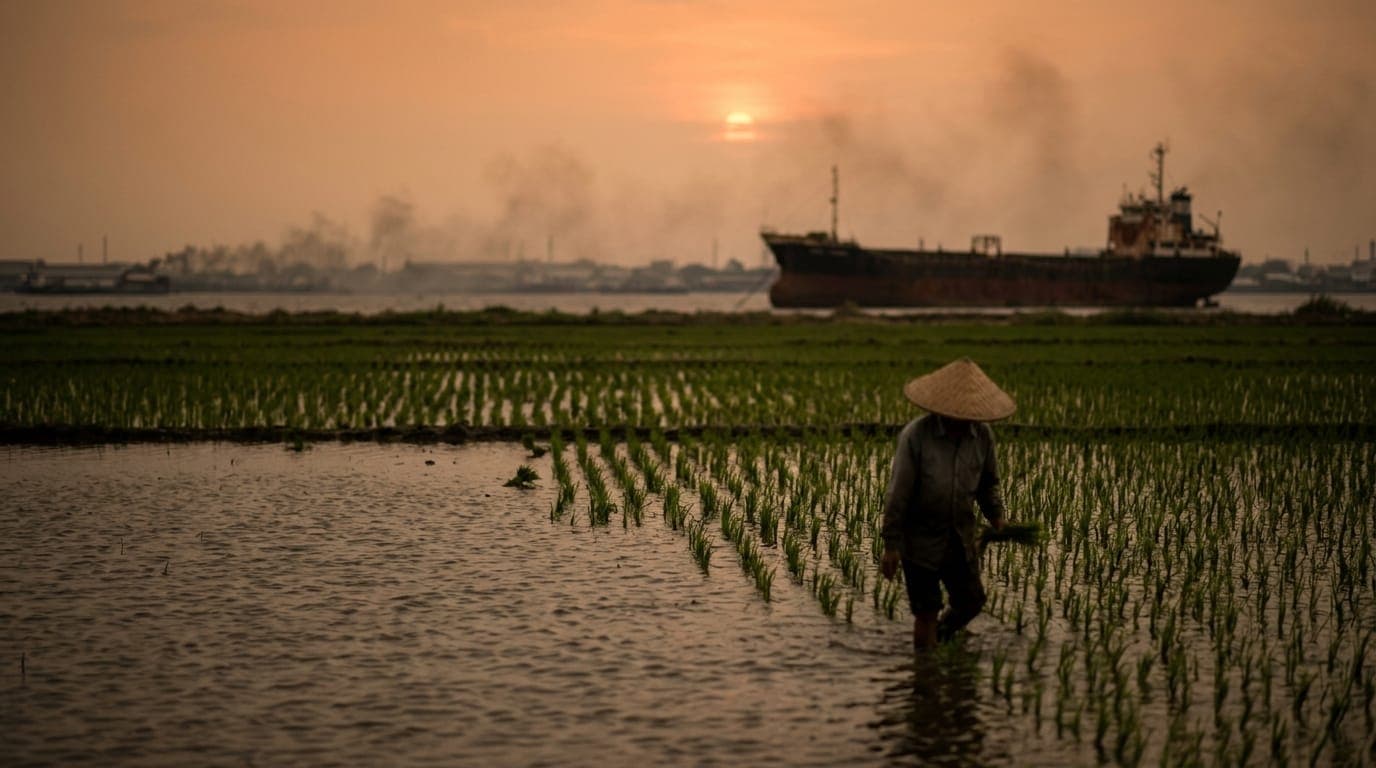
Hormuz-driven fertilizer shortages and monsoon failures are building a food-price shock with no clean monetary policy exit.
Key takeaways
- Chicago rough rice futures have surged more than 50% year-to-date, first reported by Bloomberg, and are on pace for the largest annual gain since 2003 if gains hold through year-end.
- The Strait of Hormuz handles roughly one-third of global seaborne fertilizer trade; its disruption has pushed the World Bank fertilizer price index to its highest level since October 2022 and set up a yield-drop, price-spike feedback loop heading into the 2026-27 planting season.
- Net rice-importing, lower-income economies face food-driven CPI they cannot fix with rate hikes, pointing to subsidies and money-printing responses that accelerate fiat debasement.
Chicago rough rice futures have surged more than 50% year-to-date, first reported by Bloomberg, putting the grain on pace for its largest annual gain since 2003. Benchmark Thai 5% broken white rice prices have risen for six consecutive weeks, with Thai prices reaching $446 per ton as of May 2026, per Bloomberg.
The rally reflects converging supply-side failures: adverse monsoon conditions across the largest producing nations, elevated agricultural input costs driven by Strait of Hormuz disruptions, and a USDA World Agricultural Supply and Demand Estimates forecast, cited by Bloomberg, projecting the first decline in global rice production in 11 years for the 2026-27 season.
The Fertilizer Chokepoint Driving the Spike
The Hormuz angle is the structural core of this story. The strait handles roughly one-third of global seaborne fertilizer trade, approximately 16 million tonnes per year, per CSIS analysis. Gulf producers including Qatar and Saudi Arabia have no viable ocean exit without it. Global urea prices climbed roughly 26% from pre-war levels to $585 per metric ton by March 2026, per the same CSIS report.
The World Bank's Commodity Markets Outlook documents the downstream damage: the fertilizer price index rose more than 12% quarter-over-quarter in Q1 2026, its sixth increase in seven quarters, reaching the highest level since October 2022. The Bank projects fertilizer prices rising more than 30% across 2026, with urea potentially climbing roughly 60%.
Rice farming compounds the exposure. The crop is fertilizer-intensive, and irrigation systems run on diesel-powered pumps, meaning both major input cost lines move together when Hormuz is closed.
The fertilizer-to-crop price ratio is the number the supply-side summary skips. IFPRI flags that in 2022, elevated crop revenues helped farmers absorb elevated input costs. That offset does not exist in 2026. Per IFPRI, maize sits at around $155-165 per metric ton while DAP fertilizer trades at around $700-750 per metric ton. Farmers cut inputs, yields fall, prices rise further. The loop feeds itself.
Where the Damage Lands
India's monsoon rainfall is forecast below normal in 2026, per the India Meteorological Department, which has revised its seasonal outlook to approximately 90% of the long-period average with a significant probability of deficient conditions. BMI commodities analyst Bin Hui Ong, writing in a note cited by Bloomberg, identified Thailand and Indonesia as the most exposed producers.
"We think monsoon-dependent Southeast Asian producers, particularly Thailand and Indonesia, are among the most exposed, as the anticipated dry conditions could significantly overlap with critical planting and early crop development periods," Ong wrote, per Bloomberg.
The secondary effect is sharper than the headline price move. Ong added, per Bloomberg: "We expect the implications to be felt most acutely by net rice-importing and lower-income markets, where higher rice prices can feed directly into food inflation and affordability pressures." Sub-Saharan African nations, where stock buffers are already thin per Ong's note, face the sharpest humanitarian exposure. The UN World Food Programme has warned that up to 45 million additional people could face acute food insecurity if conflict continues, per WFP's own analysis.
The Bloomberg Agriculture Spot Index surged more than 13% in August 2026, its largest monthly gain since July 2012, putting the current period in direct comparison with the pre-Arab Spring food shock.
Central banks in affected economies face a problem rate hikes cannot solve. You cannot grow more rice by raising interest rates. The policy response in net-importing, fiscally constrained economies will be subsidies, price controls, and monetary expansion. That is more fiat debasement, concentrated exactly where populations are most exposed to it. The Hormuz disruption forecast running through 2027 means the fertilizer supply squeeze does not resolve before the next planting cycle closes. Export restriction cascades from China, Russia, Egypt, and Indonesia, documented by IFPRI, will amplify the shortage at the margin.
The 2003 baseline matters for context. Rice's last comparable annual surge preceded the 2008 food crisis, quantitative easing at scale, and the dollar's current reserve-status pressures. The starting conditions in 2026 are structurally weaker across every dimension. For anyone tracking stagflation signals, this is another data point in the same direction.
What to Watch
The thesis fails on its timeline if the Strait of Hormuz reopens fully before the 2026-27 Northern Hemisphere planting season concludes, fertilizer prices normalize within two quarters, and central banks contain food-driven CPI without triggering recession. A Black Sea peace deal, which sent wheat futures lower in recent sessions per Bloomberg market reporting, would be a partial disconfirmation for grain broadly but would not resolve the rice-specific supply and fertilizer dynamics. The USDA WASDE updates and Thai Rice Exporters Association weekly price data are the clearest near-term signals to track.
Update, September 22, 2026
The cost squeeze on American farmers has moved from abstract macro data to ground-level crisis as harvest season peaks. Diesel hit a record U.S. average of $5.85 a gallon on September 4, and has continued climbing, reaching $6.05 per gallon as of mid-September, per AAA.
The national average has since reached $6.31, with parts of California approaching or surpassing $10 per gallon. The numbers at the farm gate are starker: North Carolina farmer Matt Bell told CBS News his combine now burns roughly $600 worth of diesel per day, more than twice what he paid last year, and he burned through his entire annual fuel budget of $35,000 before August ended.
The fertilizer side of the ledger closed no better. Anhydrous ammonia averaged $828 per ton in the six months before the conflict began; by April 17, USDA's Agricultural Marketing Service reported Illinois prices at $1,123 per ton.
Fertilizer costs in central Illinois have risen by more than $20 per acre based on April pricing, and farmers who did not pre-purchase inputs will absorb the full weight of those increases in the 2027 season.
The American Farm Bureau wrote to President Trump calling for relief, and framed the math plainly: a farmer who could buy a ton of urea for the equivalent of 75 bushels of corn before the war now needs 126 bushels for the same ton.
Agricultural economists warn that "quite a number of operations" are now one bad year from exiting the business, and that dynamic was already in motion before the Strait closed.
The gap between what farmers pay for inputs and what they receive for crops is at its widest in recent decades, per survey data from the National Agricultural survey cited by the Center for American Progress. That input-to-output inversion is the same loop the existing article identified at the global level: farmers cut inputs, yields fall, and prices rise further. The diesel shock, now measurable in individual fuel budgets blown out two months before harvest ends, makes clear that the fiat debasement story is not theoretical. It is showing up in the bank accounts of the people who grow the food.
Sources
- CSIS: "Chokepoint: How the War with Iran Threatens Global Food Security" (June 11, 2026)
- World Bank Commodity Markets Outlook / Fertilizer Blog (April-May 2026)
- IFPRI: "Will the Iran crisis lead to another round of food price spikes?" (April 15, 2026)
- IFPRI: "How fertilizer policies could exacerbate Hormuz price shocks" (May 22, 2026)
- Bloomberg: "Rice Prices Extend Rally to One-Year High" (May 20, 2026) (paywalled)
- UN WFP: "WFP projects food insecurity could reach record levels as a result of Middle East escalation"
- Barchart/CME Group, Rough Rice Futures
Frequently Asked Questions
Why does the Strait of Hormuz affect food prices?
The strait is the ocean exit for fertilizer exports from major Gulf producers including Qatar and Saudi Arabia. It handles roughly one-third of global seaborne fertilizer trade. When it is disrupted, urea and ammonia prices rise globally, increasing the cost of growing every major staple crop, rice included.
Which countries face the most acute risk from the rice price spike?
Net rice-importing, lower-income markets with thin stock buffers face the sharpest exposure. Bangladesh, the Philippines, and sub-Saharan African nations have limited fiscal room to absorb food inflation, and their populations spend a higher share of income on staple grains. BMI's Ong specifically flagged sub-Saharan Africa's limited buffer position.
How does a food shock connect to monetary debasement?
Governments in affected economies cannot produce more rice with rate hikes. The politically viable responses are price controls, import subsidies, and currency expansion. Each of those erodes fiat purchasing power. A fixed-supply asset is not insulated from food prices, but it does not participate in the debasement response the way local currencies do.