Tom Luongo

Guest

Tom Luongo

Geopolitical analyst · Publisher of Gold Goats 'n Guns

Tom Luongo is a geopolitical and financial analyst who publishes the Gold Goats 'n Guns newsletter and podcast. His work connects monetary plumbing with the competition between national governments and offshore finance. He has appeared on TFTC fourteen times since 2022, arguing that the Federal Reserve and European financial interests often want different outcomes.

Role
Geopolitical and financial analyst
Publishes
Gold Goats 'n Guns
Newsletter
Gold Goats ’n Guns, launched in 2017
Focus
Offshore dollars and national sovereignty
Earlier career
Research chemistry
On TFTC
9 interviews · Apr 2023 – Oct 2026
Updated

Luongo starts with incentives inside the financial system. A stronger dollar, a change in the benchmark used to price loans, or a restriction on shipping insurance can shift power between institutions without a formal change of government. His Gold Goats 'n Guns work follows those mechanisms into markets and foreign policy. He treats the people operating them as competing factions, so his account regularly departs from the idea that central banks or Western governments act as one bloc.

The TFTC conversations follow that argument from the European banking crisis in April 2023 to tariffs and the offshore dollar market in 2025, then the Strait of Hormuz in October 2026. His interpretations of political events are often contentious. What makes the series useful is the mechanism he proposes for each claim: which balance sheet needs funding, which institution controls a choke point, and which asset would benefit. Nine conversations have written episode pages here; the full podcast feed contains fourteen.

On TFTC · 9 interviews

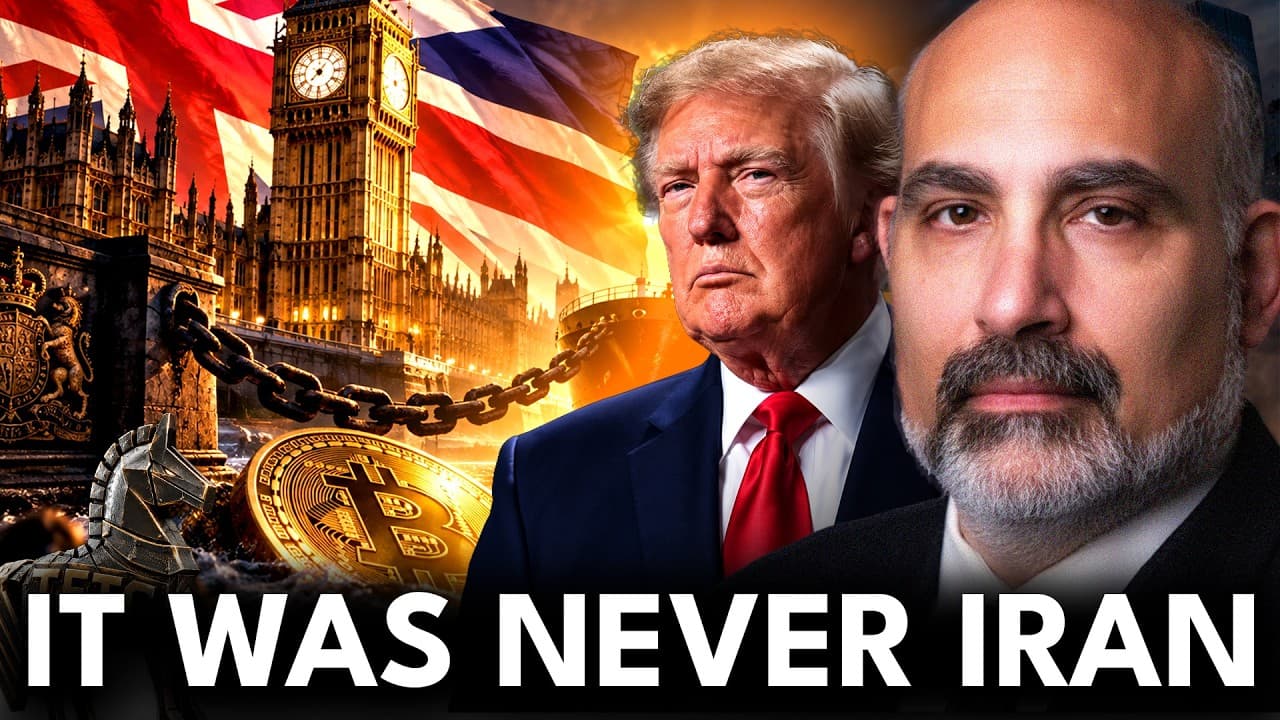
Tom Luongo on the TFTC podcast, set against the Strait of Hormuz, a Lloyd's of London building, and a falling European bond chart

Latest

Tom Luongo: London Closed the Strait of Hormuz

Tom Luongo returns to break down how Lloyd's of London closed the Strait of Hormuz before Iran fired a shot, why France is the Eurodollar's weakest link, and why Bitcoin wins in a world where every central bank is racing to debase.

TFTC - Jerome Powell, Tether and Peak Oil | Tom Luongo

TFTC - Jerome Powell, Tether and Peak Oil | Tom Luongo

Tom Luongo discusses the Federal Reserve's stance on Bitcoin, Wall Street power plays, and global financial strategies, revealing deep-rooted geopolitical and economic tensions that influence global financial sovereignty.

What Tom argues

Positions drawn from Tom’s TFTC appearances, grouped by theme. Quotes are from TFTC’s own recordings and are dated.

The Fed and Europe have different incentives

Luongo's starting point is that a central bank answers to a particular banking system. On TFTC in 2023 he argued that the Fed's tightening threatened European banks; in 2024 he pushed back against the assumption that American commercial banks were equally fragile. His broader thesis is that moving dollar finance away from London's influence changes who can set the terms of global credit. He presents this as a struggle within finance, rather than a single coordinated central-bank plan.

“I think you're underestimating the resilience of the American commercial banking system.”

“The British Empire never ended. It’s still there, but as a financial web.”

Dollar debt keeps creating demand for dollars

He is skeptical of forecasts that trade agreements alone will end dollar dominance. His October 2026 explanation begins with outstanding dollar obligations: borrowers still need the currency in which they owe money, even when governments say they want alternatives. He expects the structure of dollar finance to change before that demand disappears. Stablecoins, in his account, are one way to bring more of the dollar system's funding back onto American government debt.

“We're moving into a stablecoin market, which is all going to be backed by T-bills.”

“It’s all about the bond market, dude.”

Insurance can close a trade route

In October 2026 Luongo argued that the effective restriction on tanker traffic ran through shipping insurance. His claim was that London could prevent voyages by withdrawing cover even without physically blocking a ship. He connected the conflict to the value of oil-linked financial positions and the institutions exposed to them. These are his interpretations of the war's financial incentives, and the distinction between a physical blockade and an insurance restriction is central to his case.

“The bank the tankers can't move because of legal reasons because they don't have any insurance, so they can't move.”

“The Brent paper oil market is desperate to keep the price of oil up because somebody's going to go broke if it collapses.”

Tariffs as a way to break financial arbitrage

Luongo supported the trade-reset objective in the April 2025 conversation. He argued that persistent surpluses reflected structural advantages that tariffs could disrupt, and that the resulting changes could make domestic production more attractive. That is a different emphasis from simply forecasting a higher consumer price for imported goods. He treats tariffs as one instrument in a contest over industrial capacity, and judges them by whether the underlying trade and financing arrangements change.

“When you see a durable trade surplus, it's because something’s getting in the way.”

“This is one of the greatest opportunities to build things in America we’ve ever had.”

A haven trade can lift normally competing assets

His November 2024 forecast was specific: European stress could send money into American assets and hard money at the same time. He included the dollar and Treasury bonds alongside gold and Bitcoin, rather than making the usual dollar-versus-gold trade. The dates matter because this was a forecast about capital fleeing a particular region. It should be read as a scenario he advanced then, with currency targets attached, rather than a permanent description of market correlations.

“Five asset classes not normally correlated are all going to go up together: gold, Bitcoin, stocks, bonds, and the dollar. It's going to be a massive Safe Haven trade as Europe collapses.”

“What you're seeing is the death throes of people who thought they had everything buttoned up. Their systems are brittle and fragile.”

Bitcoin connects monetary reform to energy

Luongo's Bitcoin case runs through physical production. In April 2025 he described mining as a way to monetize energy that would otherwise be wasted. By October 2026 he was placing Bitcoin in a monetary system where governments compete to cheapen their currencies. He sees value in an asset whose supply cannot be changed by those governments, while treating the ability to turn energy into revenue as part of the same economic argument.

“Bitcoin’s strongest attribute is that it tokenizes wasted energy and destroys inefficiencies.”

“I believe that in a world where central bankers are tripping over themselves to devalue their currency, Bitcoin wins.”

Institutional adoption comes with a control question

He welcomed Bitcoin's entry into mainstream finance without assuming every institutional use would preserve its original advantages. In May 2024 he read the ETF approvals as a signal that the Fed accepted Bitcoin as financial collateral. His question was who would control that collateral and its financing. In December 2025 he applied the same skepticism to any embrace of Bitcoin by the European institutions he criticizes: adoption alone would not settle the question of incentives.

“I think the Fed has decided that Bitcoin is part of the financial system and is a good collateralizable asset, but they want to have control of how it collateralizes.”

“If London and Brussels ever embraced Bitcoin, I’d start asking hard questions.”

Sovereignty has to reach ordinary ownership

Luongo carries the institutional argument down to property and the ability to build a life without permanent dependence. In September 2025 he connected housing finance and Fannie Mae and Freddie Mac to the question of whether Americans could own assets on workable terms. His rhetoric is combative, but the economic objective is consistent with his newsletter's emphasis on self-sufficiency: reform should leave people with more control over their property and their associations.

“We are here to end feudalism.”

“Freedom of speech is freedom of association, and also freedom from association.”

Elsewhere

Notable appearances on other shows, newest first.

Common questions

Who is Tom Luongo?
Tom Luongo is an independent geopolitical and financial analyst and the publisher of Gold Goats 'n Guns. His newsletter, blog and podcast cover how political conflicts affect currencies and financial markets. He previously worked in research chemistry. On TFTC he is known for distinguishing the interests of the Federal Reserve and American banks from those of European and offshore financial institutions.
What is Gold Goats ’n Guns?
It is Luongo's publishing business, with a public blog and podcast and a paid monthly newsletter. He launched the newsletter in September 2017. The name reflects his stated emphasis on self-sufficiency, and the research connects geopolitical events with financial markets and investment ideas.
Why does he distinguish the Fed from European banks?
Luongo argues that institutions competing for control of dollar funding do not share a single interest. He reads tighter Fed policy and changes in dollar-market plumbing as pressure on European and offshore balance sheets. That is his interpretation of the incentives, and it is the through-line connecting his TFTC discussions of banks, tariffs and foreign policy.
What did he say about the Strait of Hormuz?
In October 2026 he argued that the practical restriction on tanker traffic came through the withdrawal of shipping insurance, giving London financial influence over the trade route. He also connected oil prices to derivative exposures. The episode develops his thesis about the conflict; the hub preserves it as a dated position.
What does Tom Luongo think about Bitcoin?
He sees Bitcoin as a monetary alternative when central banks devalue their currencies and as a way to turn otherwise wasted energy into value. He also asks who controls institutional Bitcoin collateral. His support for the asset does not mean he assumes every ETF or stablecoin arrangement serves the same purpose as holding Bitcoin directly.
How many times has Tom Luongo been on TFTC?
Fourteen times from April 2022 through October 2026 in TFTC's full podcast feed. Nine of those conversations have written episode pages listed here. The members-only early version of episode 604 is a second publication of the same interview and is counted once.
Where can I follow his work?
His public writing and podcast are at tomluongo.me, his paid newsletter is on Patreon under GoldGoatsNGuns, and he posts as @TFL1728 on X.

Tom’s own work