Latest
TFTC - How Bitcoin Replaces the Dollar | Parker Lewis
Marty Bent and Parker Lewis explore Bitcoin’s role as money and currency, its real-world adoption, self-custody, and regulatory challenges.

Guest
Author of Gradually, Then Suddenly · Head of Business Development at Zaprite
Parker Lewis is the author of Gradually, Then Suddenly, a framework for understanding Bitcoin as money, and Head of Business Development at Zaprite. Previously at Unchained, he now works on helping businesses accept Bitcoin payments. He has been interviewed on TFTC fourteen times since 2019 and has also written for the site.
Lewis approaches Bitcoin through a problem with the existing dollar system: a growing stock of debt depends on a much smaller monetary base and repeated central-bank intervention. His Gradually, Then Suddenly essays explain why he believes Bitcoin solves that problem. At Zaprite the argument becomes operational. The company helps merchants accept payments into wallets they choose, so people who want to earn Bitcoin can do so through their business rather than only through an exchange.
His TFTC appearances connect monetary theory with ordinary trade. The March 2023 banking-crisis conversation starts with debt and liquidity; the May 2024 episode asks which monetary structure protects the individual; the October 2024 and March 2025 conversations bring that back to invoices and payment costs. Six of his fourteen main-show interviews have episode pages below. He also co-hosts TFTC's Center of Hash mining-and-energy series, which is a separate role from his guest appearances.
Latest
Marty Bent and Parker Lewis explore Bitcoin’s role as money and currency, its real-world adoption, self-custody, and regulatory challenges.
Parker Lewis examines the looming U.S. liquidity crisis, the limitations of Trump’s economic policies, and Bitcoin’s growing relevance as a hedge against systemic financial risks.
This podcast explores the intersection of Bitcoin, inflation, and societal issues, arguing that adopting Bitcoin as a payment method is key to addressing the systemic problems caused by fiat currency devaluation.
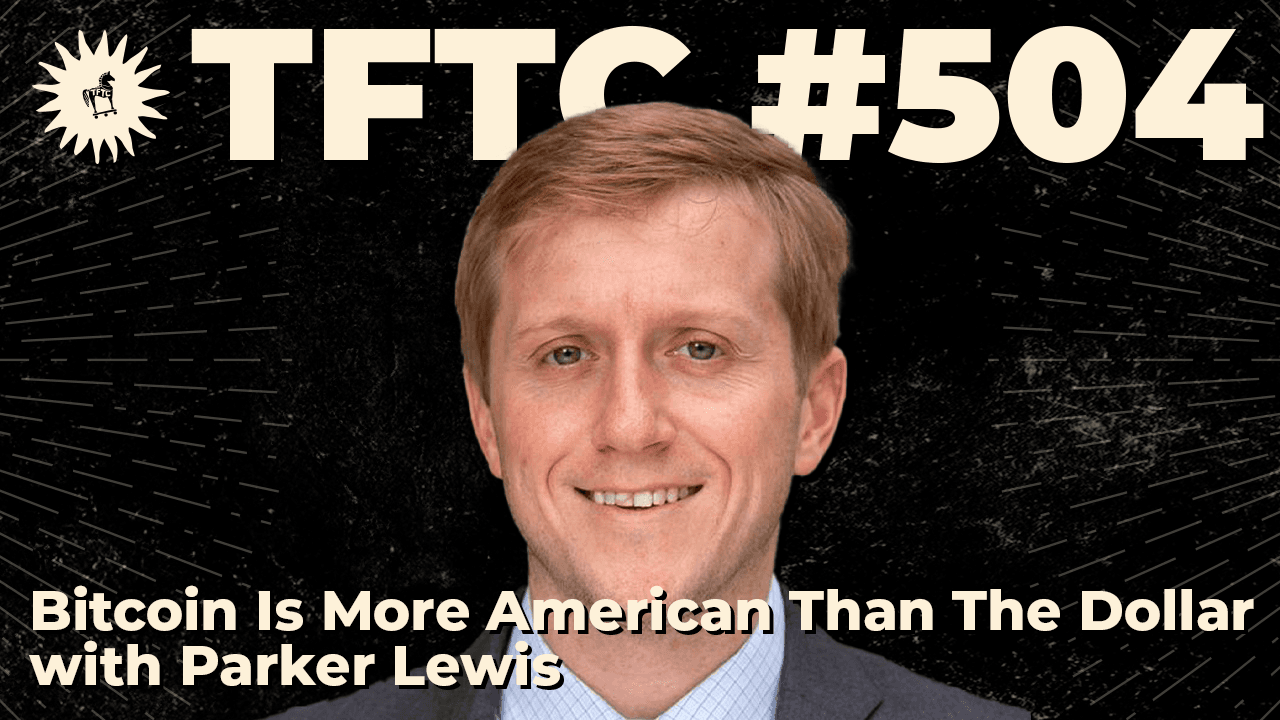
Bitcoin, with its decentralized nature and fixed supply, better reflects American constitutional principles than the US dollar, which centralizes power and undermines governance checks and balances.

The debate around Bitcoin's role in the future of money has been further fueled by the actions of prominent figures like Senator Elizabeth Warren, who has historically opposed big banks but now appears to align with them in criticizing Bitcoin.
Banks are failing left and right. Many want to pinpoint bitcoin and "crypto" or poor risk management practices by banks as the cause of the contagion event that is under way, but the core of the problem is the Federal Reserves.
Positions drawn from Parker’s TFTC appearances, grouped by theme. Quotes are from TFTC’s own recordings and are dated.
Lewis rejects the separation of Bitcoin's savings function from its use in trade. In his account, a person wants to hold money because other people will accept it for useful things later. More opportunities to pay in Bitcoin strengthen that reason to hold it. The October 2024 discussion applied the point to businesses: accepting payment is part of building the monetary network, even when most of a merchant's customers still arrive with dollars.
“Money’s function to store value is necessarily tied to its ability to exchange. If you can’t exchange it, it doesn’t store value.”
“The more exchange that’s available, the more valuable Bitcoin becomes.”
In March 2025 he pushed against describing Bitcoin solely as a commodity to be held on an investment platform. The conversation covered real invoices and payments made through Zaprite. His claim is that the activity already exists, even while it remains a small share of commerce. He thinks definitions should begin with what the system permits people to do: hold a scarce asset and transfer it directly to settle a purchase.
“Bitcoin is money and currency. If you define it as just a commodity, you’re missing the full picture.”
“Bitcoin is not just a store of value, it’s money that people are actively using in their businesses today.”
Lewis's payments work gives him a way to explain adoption without starting with a price chart. A merchant already pays to accept conventional transactions, and those costs change what the business can keep from a sale. Bitcoin offers another rail and lets a merchant choose to receive the asset itself. His comparison on TFTC was an argument for testing that alternative in a business, with the customer's and merchant's settlement preferences made explicit.
“If you’re using credit cards, you’re paying a 4% tax to the system. With Bitcoin, that fee is virtually eliminated.”
“If the fiat currency is the problem, and Bitcoin is part of the solution, then being able to take Bitcoin directly from my customers is part of that solution.”
The March 2023 bank failures and January 2025 outlook share the same starting point. Lewis sees a financial system with far more debt than the base money available to discharge it. Withdrawing base money makes that imbalance harder to finance. He expects intervention when the resulting liquidity strain becomes intolerable, but distinguishes the Treasury's political objectives from the Fed's institutional ones. The mechanism is an explanation of recurring pressure, rather than a calendar for the next rescue.
“The Fed can’t avoid a liquidity crisis. The only way to prevent it is to print massive amounts of money.”
“The U.S. government and the Federal Reserve have distinct motives, and they are not always aligned.”
His confidence in Bitcoin over a long period does not mean he expects it to behave like an established reserve asset during every market selloff. In January 2025 he argued that too few people understood it for that role to be secure. Adoption changes the pool of people who will choose to hold it when other assets fall. He contrasted that adoption thesis with owning Treasuries on the assumption that one can correctly time the next Fed intervention.
“Bitcoin is not yet a safe-haven asset because fewer than 1% of the world understands it. But it’s mathematically metered to go up as adoption grows.”
“If you’re buying treasuries today, you’re making a bet on when the Fed will intervene. Bitcoin is a simpler, less risky alternative.”
The May 2024 conversation connected Bitcoin's technical rules to a political argument. Lewis sees the individual as the foundation of a free society, and censorship resistance as necessary to keep a fixed monetary supply meaningful. A supply promise that can be overridden by a gatekeeper is a weaker promise. He connects that principle to his preference for direct ownership and for payment systems that do not require surrendering control to a new intermediary.
“If the rights of the individual are compromised, then the security of the nation...it's derived from the strong individual. The protection of the individual is what makes the whole worth protecting.”
“Bitcoin can only enforce its fixed supply because it is resistant to censorship...those properties that are so valuable about bitcoin...exist because the structure of governance within bitcoin.”
In October 2024 Lewis carried the monetary argument into the quality of ordinary goods. If a currency keeps losing purchasing power, producers face pressure to cut inputs or raise prices, and consumers have to adapt to those compromises. He used food as a concrete example. His proposed response is connected to payments: give producers and customers the option to exchange in money they want to hold, rather than treating monetary reform as a discussion confined to investors.
“The debasement of money creates the debasement of everything around you.”
“It’s not just that the food’s broken, it’s that the incentives are tied back to the broken money system.”
Lewis is wary of legal categories that recognize Bitcoin as an asset while constraining its monetary use. In the March 2025 episode he argued that regulation should accommodate the technology's capabilities, including direct exchange. He also questioned designs that put a fiat layer in the middle of a Bitcoin transaction. The through-line is practical: preserve the option to receive and spend Bitcoin itself, rather than making every user return to the old rails.
“Regulation should fit Bitcoin, not the other way around. Otherwise, bad policy will create unnecessary friction.”
“The only reason to put fiat currency on top of Bitcoin is to restrict its use.”

The fixed supply of Bitcoin, despite its perceived inelasticity, is what will drive its adoption as a global medium of exchange.

The book can be purchased exclusively at TheSaifHouse.com
Notable appearances on other shows, newest first.
 Natalie Brunell · Aug 2026Parker Lewis: Understanding Digital Credit vs Buying BitcoinA discussion with Natalie Brunell about direct Bitcoin ownership, digital credit and where their views differ.
 What Bitcoin Did · Dec 2024THE RISE OF BITCOIN w/ Parker LewisThe monetary-system argument and the possibility of nation-state Bitcoin adoption.
 Preston Pysh · Mar 2024Is Bitcoin Property, Currency, or Both? w/ Parker Lewis & Will Cole (BTC174)Lewis and Will Cole join Preston Pysh to distinguish property, money and currency.
A framework for understanding Bitcoin as money, developed from his essay series.
His ongoing writing on Bitcoin and the monetary system.
His explanation, with Will Cole, of why they moved into Bitcoin payments.