Michael Howell

Guest

Michael Howell

Founder and managing director of CrossBorder Capital

Michael Howell is the founder and managing director of CrossBorder Capital, the London research firm he set up in 1996 to track money flowing through the world's financial markets, and the author of Capital Wars: The Rise of Global Liquidity. His Global Liquidity Index is the most widely cited measure of that flow. He has been on TFTC four times since April 2025.

Role
Founder & Managing Director, CrossBorder Capital
Founded
CrossBorder Capital, 1996
Book
Capital Wars: The Rise of Global Liquidity (2020)
Newsletter
Capital Wars on Substack
Known for
The Global Liquidity Index
On TFTC
4 interviews · Apr 2025 – Aug 2026
Updated

Howell's method is to follow money rather than earnings. The Global Liquidity Index he built at CrossBorder Capital measures the flow of funding through markets in some ninety economies, and his conclusions follow from one premise he restates in every conversation: in a world carrying $350 trillion of debt, financial markets exist to refinance old borrowing rather than to finance new investment, and the crises come when the liquidity to roll that debt runs short. He began at Salomon Brothers in the 1980s and fitted the 65-month cycle he still uses in the year 2000.

The TFTC conversations track one cycle. In April 2025, days after Liberation Day, he set out the collateral-and-repo plumbing and said the crunch was not immediate; in August he described the Fed and Treasury targeting bond volatility; in February 2026 he called the peak in global liquidity at $189 trillion and warned Bitcoin would fall further before it rose; by August he was arguing that a hot nominal economy would force the Fed to hike. Read in order they are a single forecast being marked to market.

On TFTC · 4 interviews

Michael Howell and Marty Bent on the TFTC podcast set, with bond yield charts and the Federal Reserve building in the background

Latest

Michael Howell: Yields Must Rise, Fed Must Hike

Michael Howell returns to walk through the nominal GDP math that forces yields higher, the yield volatility control the Fed is quietly running, why China is driving gold, and why Bitcoin remains the best documented hedge against the debasement that's coming.

What Michael argues

Positions drawn from Michael’s TFTC appearances, grouped by theme. Quotes are from TFTC’s own recordings and are dated.

All money that's anywhere must be somewhere

Howell's framework starts with a definition: liquidity is the flow of money through financial markets, not the stock of it, and markets price the change in that flow at the margin. From there follows the line he repeats in every conversation — cash that is financing a strong real economy is not available to lift asset prices. He fitted a 65-month cycle to the data in 2000 and has not moved it since; it is, he says, a debt-refinancing cycle.

If you look at the frequency of that cycle, it pretty much is in line with the average maturity of debt in the world economy. So it's a debt refinancing cycle.

Money moves markets. If there's a lot of cash coming in, asset prices are likely to go up. And if money is leaving, asset prices are likely to come under pressure.

All money that's anywhere must be somewhere, and if it's going into the real economy it's not there to drive asset prices — Bitcoin or whatever — upwards.

The absolute level of liquidity is not falling yet, but the momentum has definitely slowed down. And at the margin, markets price off the margin.

Strong economies don't always have strong financial markets, particularly if central banks are not doing that much.

Debt is never repaid, only refinanced

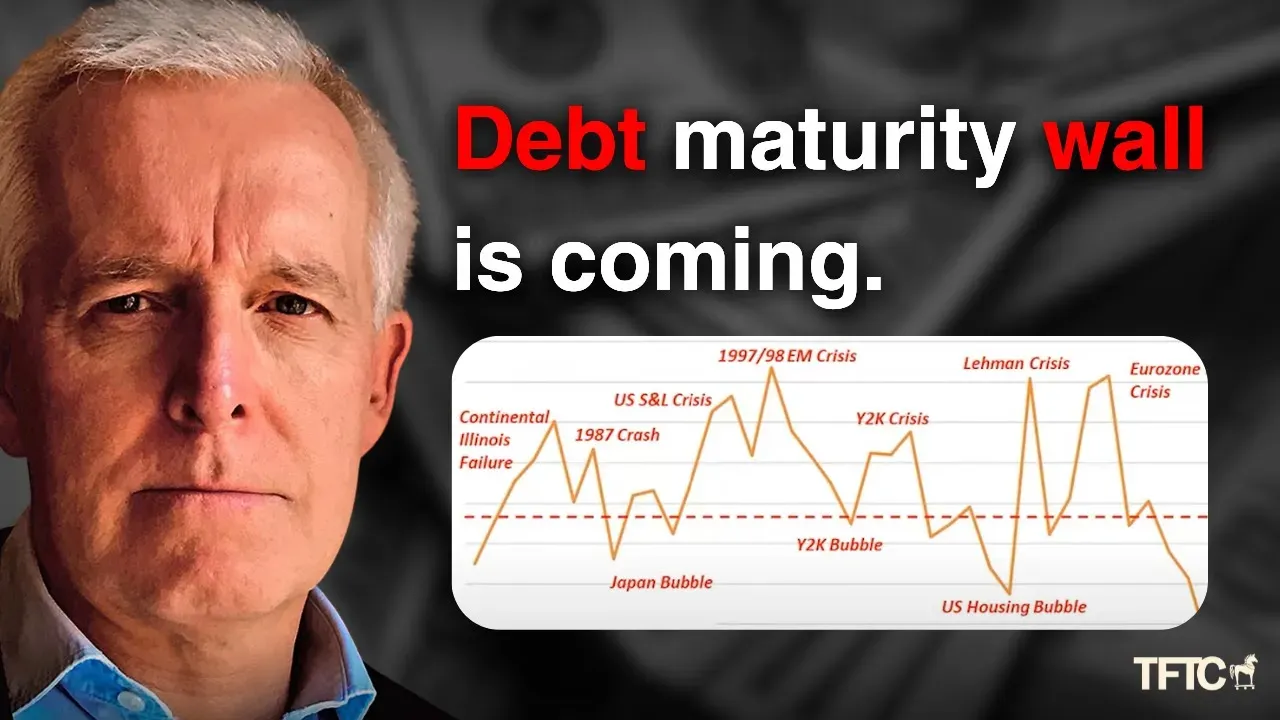
The heart of Capital Wars, restated on TFTC each time with more urgency as the debt termed out at zero rates during Covid approaches its maturity wall. Financial markets today are refinancing machines rather than capital-raising ones, three-quarters of lending is collateral-backed, and the ratio to watch is debt to liquidity rather than debt to GDP: above roughly two-to-one, refinancing fails and crises follow.

No longer is the capital market used to finance new capital spending. Those days have long gone. We're in a world that's dominated by debt, and in particular debt refinancing.

I would venture that every financial crisis we've experienced in the last 30 years has ultimately been a refinancing crisis.

The thing to look at is not debt to GDP, which is what all economists are telling us we need to be monitoring, but the debt to liquidity ratio.

The spoiler alert is that debt is never paid back. It's only ever refinanced.

In 4,000 years we haven't had zero interest rates. But we did have it in Covid.

New credit relies on old debt as collateral. It's virtuous until it's vicious.

Yield volatility control, not yield curve control

His explanation of why the Treasury market has held together despite everything: not a target for yields but a target for bond volatility, engineered through short-dated issuance and buybacks so that leveraged funds keep buying the cash bond. He was accused of a conspiracy theory for saying so in 2025 and had adopted the phrase as a term of art by 2026.

The US may well be the cleanest shirt in the laundry. But hey, it's in the laundry.

I think it's being engineered lower. I think the Treasury and the Fed realize that they've got to get volatility down. If they get volatility down, that's liquidity enhancing.

You're shifting from a regime of Fed QE to a situation where the Treasury is more and more responsible for liquidity easing. It's taken on the mantle.

There seems to be deliberate manipulation of volatility in the market. I call that yield volatility control, not yield curve control.

History shows that it's the long end of the market that determines the short end of the market, and not, as textbooks tell us, the short end that drives the long end.

Bills are the printing press

Howell's answer to the debasement debate: the printing is happening, but through the banking system's purchase of short-dated government paper rather than the Fed's balance sheet, which is why it is under-noticed. Four-fifths of US gross issuance is now under two years to maturity, and the path of least resistance for every indebted government is to keep it that way.

Ultimately it's better to devalue that debt en masse through printing liquidity. And that's, I think, the path of least resistance that the politicians and the central bankers will ultimately come to.

If a credit provider buys government debt, they monetize the government debt, so it's effectively printing money.

Eighty percent of US gross issuance is now under two years, which is an eye-wateringly large figure.

If the bank balance sheets are expanding, that is called monetization of debt. And that is exactly what's going on. That's printing money. It's just a rather more prosaic version of the printing press.

Stanley Druckenmiller said this is crazy, these are the numbers you would apply to a Latin American economy. The paradox is that some of the Latin American economies have actually cleaned their act up.

China drives gold; global liquidity drives Bitcoin

A position that separates him from most of the gold commentary of 2025 and 2026. He argues the gold rally was driven by the People's Bank of China devaluing the yuan against real assets, with Shanghai as the marginal price-setter, while Bitcoin tracked global liquidity downward — the two assets trending together over years and cycling apart within them.

Since the year 2000 the stock of US Treasuries has increased by 9.6 times. The gold price has gone up over that same period by 9.65 times.

Gold is like the pole star in the sky that navigators use to get their bearings. Gold doesn't really move. It's everything else that falls against it.

The Shanghai Gold Exchange is really driving things. There's a premium on Shanghai gold, a persistent premium, because they're bidding for it.

Why is it that Bitcoin is going down? Because global liquidity is challenged. And why is the gold market going up? That's all to do with China.

In the long term, gold and Bitcoin are correlated very strongly, but in the short term they're negatively correlated. They trend together, but they cycle apart.

Bitcoin is the most liquidity-sensitive asset on the planet

His case for Bitcoin is statistical rather than ideological: an eight-times sensitivity to liquidity against gold's two, which makes it both the earliest warning of tightening and the most efficient hedge against the monetary inflation he considers inevitable. He would rather buy it cheaper, and says so.

Bitcoin, in my view, is definitely the future. And I think that the US officially has to endorse that pretty quickly before somebody else does.

They're the most liquidity sensitive assets on the planet, and they're a barometer, or canary in the coal mine, for tightening liquidity conditions.

I'd still be a long-term buyer even at these levels, but I still think that you can pick it up cheaper.

For every 10% move in liquidity you get an 80% move in cryptocurrencies. In the case of gold and silver, about two times.

You need very little crypto in a portfolio to give you pretty comprehensive coverage against monetary inflation. Maybe at most 5% of a portfolio.

Capital wars: the state gets bigger and yields must rise

The regime he thinks investors are underestimating: governments competing for AI, energy and industrial capacity will run their economies hot, nominal growth will run well above bond yields, and the aged-first welfare model of the West will have to be rethought. It is the frame of his book, applied to 2026.

We're going to see Make Japan Great Again before we see MAGA.

This gap of more than 200 basis points between nominal GDP and the 10-year bond is unsustainable compared to history. Yields have got to rise.

We're in a regime change, and that regime change is coloured by the whole notion of — either you call it trade wars or, more accurately, capital wars.

Capital spending booms are always inflationary.

We've inherited a system whereby it's the aged who get income support, where it actually should be the young who get income support.

Elsewhere

Notable appearances on other shows, newest first.

Common questions

Who is Michael Howell?
Michael Howell is the founder and managing director of CrossBorder Capital, a London research firm that tracks liquidity and capital flows in around ninety economies. He developed the quantitative approach as research director at Salomon Brothers from 1986, was head of research at Baring Securities from 1992, and founded CrossBorder in 1996. He is the author of Capital Wars: The Rise of Global Liquidity.
What is the Global Liquidity Index?
A measure of the momentum of money flowing through the world's financial markets — funding available to buy assets and roll over debt — rather than of retail money supply such as M2. Howell's index runs on a roughly 65-month cycle he first fitted in 2000, and it is the most widely cited liquidity measure in macro. On TFTC in February 2026 he called its peak at about $189 trillion.
What does “all money that's anywhere must be somewhere” mean?
It is Howell's shorthand for why a strong economy can coincide with weak markets: liquidity that is financing real activity — capex, working capital, a large fiscal deficit — is not available to bid up asset prices. He used it in 2026 to explain Bitcoin's fall while the US economy ran hot.
What is yield volatility control?
Howell's term for a policy he believes the Treasury and the Fed are running: keeping Treasury-market volatility low through short-dated issuance and bond buybacks so that leveraged funds keep buying Treasuries. He distinguishes it from yield curve control, which targets the level of yields, though he concedes it amounts to a form of the same thing.
What does Michael Howell think about Bitcoin?
That it is the most liquidity-sensitive asset in the world — roughly eight times the sensitivity of gold — which makes it both an early warning of tightening and the most efficient hedge against monetary inflation. He has said on TFTC that everyone needs gold and Bitcoin in their portfolio in some form, that a 5% allocation buys comprehensive protection, and that he expected to buy it cheaper during the 2026 downswing.
Why does he say China drives the gold price?
Because in his data the gold rally of 2025–26 tracks People's Bank of China liquidity injections far more closely than Western monetary policy. China needs to devalue the yuan against real assets to work off its debt, cannot let capital out through crypto, and so the Shanghai gold market has become the marginal price-setter for gold worldwide.
How many times has Michael Howell been on TFTC?
Four times between April 2025 and August 2026, roughly every four months through one liquidity cycle. Every conversation is listed on this page.
Where can I follow his work?
His weekly analysis is on the Capital Wars Substack, CrossBorder Capital's research is at crossbordercapital.com, and the firm posts as @crossbordercap on X.


Michael’s own work

  • Capital Wars: The Rise of Global LiquidityBook · 2020

    Palgrave Macmillan. Defines and measures global liquidity and argues it, not interest rates, drives asset markets.

  • Capital WarsNewsletter

    His Substack — the weekly read on the liquidity cycle Marty cites on the show.

  • The research firm he founded in 1996, monitoring credit, liquidity and capital flows across some ninety economies.

  • The index family behind the GLI.