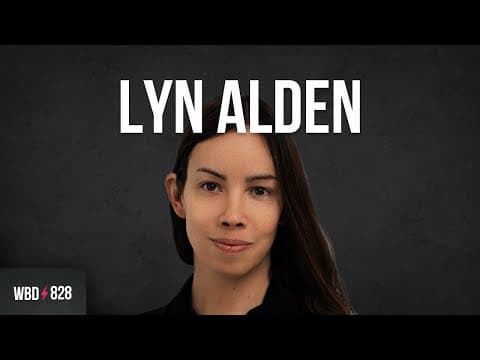
Lyn Alden

Guest

Lyn Alden

Founder of Lyn Alden Investment Strategy · Author of Broken Money

Lyn Alden is the founder of Lyn Alden Investment Strategy and the author of Broken Money, a history of money through the lens of technology. An electrical engineer by training, she researches the monetary system and global markets. She has appeared on TFTC four times since 2020, discussing fiscal constraints, energy and Bitcoin.

Founded
Lyn Alden Investment Strategy, 2016
Book
Broken Money (2023)
Education
Electrical engineering; engineering management
Earlier career
Engineer and head engineer, FAA Cockpit Simulation Facility
Research
Monetary systems and global markets
On TFTC
2 interviews · Mar 2023 – May 2025
Updated

Alden founded her research firm in 2016 while working in engineering, then moved into investment research full time. Her engineering background shows in the way she asks which part of a system limits what the rest can do. Broken Money follows that method through monetary history: communications could move instructions quickly long before final settlement could move at the same speed. Her public research applies the same attention to the mechanics of dollar debt and the energy system.

The TFTC conversations pair a long-run concern about the monetary order with resistance to easy collapse forecasts. In March 2023 she argued that the Fed was using a familiar unemployment-and-inflation framework in a different fiscal environment. In May 2025 she applied the dollar-system argument to tariffs and reindustrialization. Two of her four feed interviews have written TFTC pages here. Her Unchained, What Bitcoin Did and MacroVoices appearances are separate conversations, listed below rather than counted as TFTC interviews.

On TFTC · 2 interviews

Lyn Alden on the TFTC podcast discussing Triffin's dilemma, the dollar, and reserve assets

Latest

Lyn Alden on the Dollar's Triffin Trap and What Replaces It

Macro analyst Lyn Alden on why reserve-currency status quietly costs the US its industrial base, why there's more inflexible demand for dollars than there are dollars to repudiate, and where gold and Bitcoin fit as neutral reserve assets once the system shifts.

What Lyn argues

Positions drawn from Lyn’s TFTC appearances, grouped by theme. Quotes are from TFTC’s own recordings and are dated.

Reserve-currency status has a physical cost

Alden frames the dollar's position as an exchange of benefits and costs. Under Bretton Woods the pressure appeared as gold leaving the United States. In the current arrangement, she argues, an overvalued reserve currency favors imports and financial assets while making domestic production less competitive. Her May 2025 explanation ties the trade deficit to the demand for dollar assets abroad. Rebuilding the industrial base therefore requires confronting some of the advantages Americans also receive from the existing system.

“So for example, back in the Bretton Woods era, the cost was that we kept draining our gold reserves.”

“And in the current formation, instead, we kind of pay for it with our industrial base.”

Dollar debt makes the system durable

She rejects the idea that dissatisfaction with the dollar is enough to make it disappear. Debtors need dollars to meet dollar obligations, which creates demand independent of whether they like American policy. In the May 2025 conversation she used that mechanism to explain why near-term dollar-collapse forecasts repeatedly fail. She also treats reserve status as a share that can change gradually. A more diversified reserve system can develop while a very large stock of dollar debt continues to be serviced.

“And part of that, so all of that debt creates demand for dollars.”

“It's really a percentage thing.”

Tariffs need to be judged at three different levels

Alden separated the 2025 tariff project into its mandate, its plan and its execution. She considered addressing the trade deficit a legitimate objective and had been writing about it for years. Her criticism sharpened as she moved from the objective to the design and then to the speed and scale of implementation. That structure allows her to support rebalancing trade while questioning whether a particular measure or rollout makes the intended result more likely.

“One is kind of the mandate, two would be the plan and three would be the execution.”

“So I think when you go from plan, like when you go from mandate to plan to execution, each step was kind of a little weaker than, than the prior one.”

Reindustrialization requires more electricity

Energy is the constraint she keeps putting underneath the trade argument. In May 2025 she pointed to stagnant American electricity production alongside China's expansion, then to the difficulty of rebuilding capacity when important equipment is itself made abroad. Tariffs cannot produce a power plant or a functioning supply chain immediately. Her preference is to start building rather than wait for the monetary or political arrangement to become ideal, because the physical lead times remain either way.

“As part of our stagnant industrial base, we've had stagnant electricity production in the US for decades, whereas China has ramped up to unfathomable degrees.”

“There's no benefit from waiting, only cost from waiting.”

An unemployment model can miss a supply problem

In March 2023 Alden questioned the Fed's reliance on a tight relationship between unemployment and inflation. She argued that restricting demand could damage interest-sensitive parts of the private sector without fixing energy and transportation constraints. Her comparison with the Volcker era also depended on who was creating money: private-bank lending had a different role from large fiscal deficits. The point was that a familiar tool can have a different effect when the source of the pressure changes.

“It's basically a very demand driven lens.”

“But basically that tight monetary policy made sense in an era where banks were doing most of the money creation.”

Fiscal dominance narrows the central bank’s choices

Alden's fiscal argument was already present in the March 2023 interview. A government carrying a large debt load pays more interest when rates rise, which changes the politics and the economic effects of tightening. She compared that environment with the 1940s, when the Treasury's financing needs constrained monetary policy. Her expectation was that public finances would make interest-rate decisions increasingly political, rather than allowing the Fed to treat the Treasury's balance sheet as an unrelated issue.

“So the 1940s banks weren't lending much, but instead the government was running absolutely massive monetized deficits.”

“They had to keep them low despite high inflation.”

Bitcoin’s potential is larger than its present market depth

Her March 2023 discussion distinguishes a neutral settlement asset from a market already large enough to serve every sovereign need. She thought Bitcoin could become relevant to reserve diversification as it grew, while noting that its market depth and volatility still limited that role. This is consistent with her broader approach to monetary transitions: the direction can be meaningful without the new system being ready to replace every function of the old one immediately.

“You know, if Bitcoin gets big enough, you know, that gets interesting.”

“And, you know, the depth of the, the Bitcoin market is not really in line yet with global trade numbers.”

Adoption needs better custody and practical alternatives

Alden is interested in what people can do with a new monetary technology, not only how many exchange accounts exist. In March 2023 she warned that adoption concentrated in a few large custodians could create a single point of failure for millions of users. She was interested in tools that spread custody risk and make community-scale alternatives possible. That is also where her optimism enters: identifying a broken mechanism is useful when people can build a better one.

“And so there's this gigantic global centralized honey pot.”

“And so both in energy and in money, you know, there are severe problems in the present, but there are, you know, technologies that make this better over time.”

Elsewhere

Notable appearances on other shows, newest first.

Common questions

Who is Lyn Alden?
Lyn Alden is an investment strategist and the founder of Lyn Alden Investment Strategy, which she started in 2016. She trained in electrical engineering and engineering management and worked at the FAA's Cockpit Simulation Facility before moving into research full time. She is the author of Broken Money, a history of money viewed through technological change.
What is Broken Money about?
Published in 2023, Broken Money examines how technology has shaped the way people store value and settle transactions. It follows monetary systems from earlier forms of money through modern banking and Bitcoin. The gap between fast communications and slower final settlement is an important part of Alden's explanation of why finance became centralized.
What does she say reserve-currency status costs the United States?
She argues that demand for dollar assets helps keep the dollar expensive, which benefits finance and imports but makes domestic manufacturing less competitive. In May 2025 she compared the resulting pressure on the industrial base with the loss of gold reserves under Bretton Woods. Rebalancing trade means accepting changes to some of the benefits of the existing system.
Does Lyn Alden expect the dollar to collapse immediately?
No. She emphasizes that a large stock of dollar-denominated debt creates continuing demand for dollars. She also treats reserve status as a share rather than an all-or-nothing title. Other reserve assets can gain a role over time without all dollar obligations or dollar markets disappearing at once.
What did she say about the 2025 tariffs?
She separated the policy into mandate, plan and execution. She supported addressing the structural trade imbalance but was less positive about the plan and more critical of how quickly tariffs were raised. She also argued that industrial rebuilding requires electricity and supply chains, which cannot be created instantly by changing a tariff rate.
What does Lyn Alden think about Bitcoin?
She sees it as a potentially important monetary and settlement technology and is interested in tools that improve custody and practical use. Her TFTC discussions distinguish that long-run potential from the market depth needed for large-scale sovereign settlement. She also warns against calling adoption decentralized when users depend on a few giant custodians.
How many times has Lyn Alden been on TFTC?
Four interviews from August 2020 through May 2025 in the full TFTC feed. Two have written episode pages here: episode 402 in March 2023 and the May 2025 trade discussion. The Unchained interview summarized in February 2024 is not a TFTC interview, nor are the What Bitcoin Did, MacroVoices and Bitcoin Magazine appearances summarized elsewhere on the site.
Where can I follow her work?
Her research, public newsletter and book information are at lynalden.com. She posts as @LynAldenContact on X and publishes videos through Lyn Alden Media.


Lyn’s own work

  • Broken MoneyBook · 2023

    A history of monetary technology and the systems built around it.

  • Her public essays, newsletter archive and investment research service.

  • Her near-future science-fiction thriller, separate from her financial research.