Luke Gromen

Guest

Luke Gromen

Macro analyst · Founder of Forest for the Trees (FFTT)

Luke Gromen is a macro analyst and the founder of Forest for the Trees (FFTT), the research firm he started in 2014 after eighteen years in institutional equity research. He is best known for arguing that the post-1971 dollar system is ending and that gold has already replaced the Treasury bond as the world's primary reserve asset. He has appeared on TFTC since 2020.

Role
Founder, Forest for the Trees (FFTT)
Founded
FFTT, 2014
Newsletter
Tree Rings
Books
The Mr. X Interviews, 2 vols. (2018, 2020)
Based
Cleveland, Ohio
On TFTC
3 interviews · Jun 2023 – Jun 2026
Updated

Gromen's argument has a single spine: the United States runs a deficit it cannot cut, funded by a bond market that foreign central banks stopped buying on net a decade ago, and every apparent crisis since — the 2023 bank failures, the 2025 rare-earth standoff, the AI capex boom — is the same fiscal arithmetic surfacing somewhere new. He founded FFTT without outside investors so that he could write that argument without softening it, and he writes it from Cleveland, where he watched the industrial base leave before the coasts noticed.

The TFTC conversations track the argument as events catch up with it. In June 2023 he was calling Treasury duration risk the most mispriced narrative on Wall Street; by October 2025 he was describing gold's overtaking of Treasuries in central-bank reserves in the past tense; by June 2026 the question had narrowed to when the Fed caps yields and how much inflation it tolerates first. He has been on the show seven times since 2020; the three most recent conversations are written up below.

On TFTC · 3 interviews

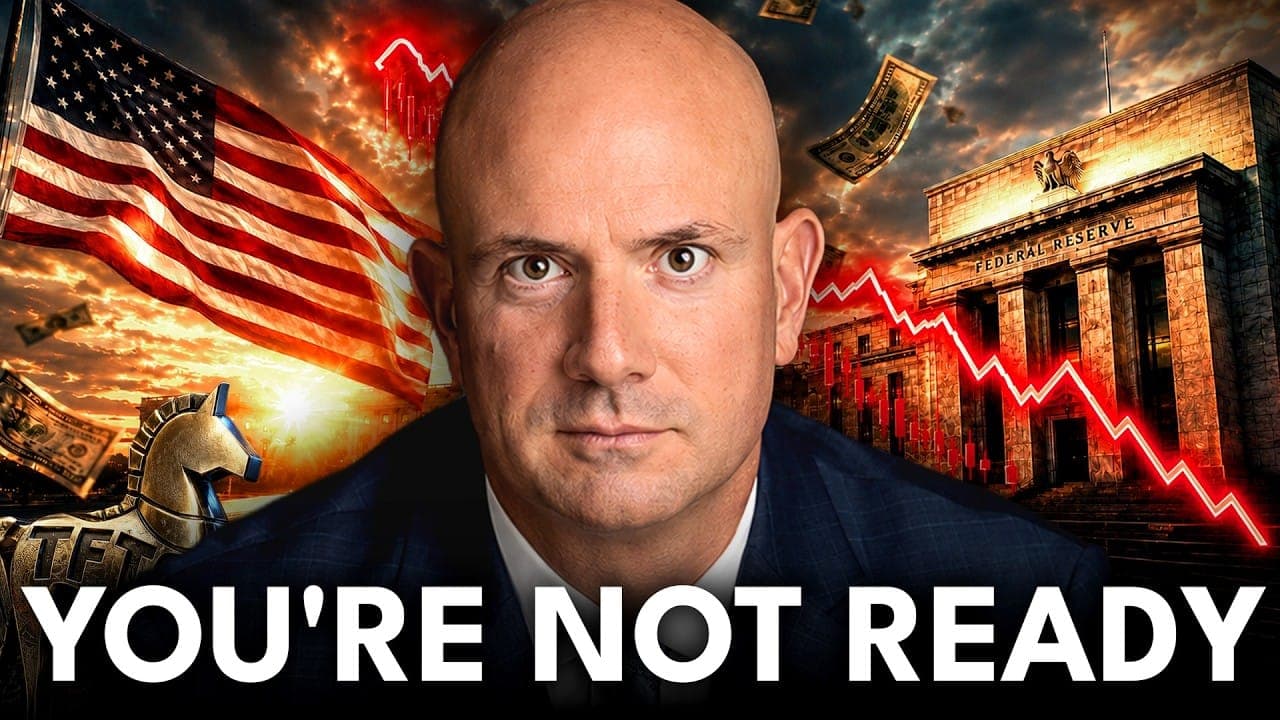
Luke Gromen on the TFTC podcast, set against the US flag, the Federal Reserve, and a falling chart

Latest

Luke Gromen: The Bond Market Says Tick-Tock

Luke Gromen returns to lay out the trap: the deficit can't be cut without triggering a depression, so the Fed will end up capping bond yields by printing into an inflation spike. Plus the Hormuz supply shock, AI eroding the tax base, and why gold is leading the exit with Bitcoin behind it.

What Luke argues

Positions drawn from Luke’s TFTC appearances, grouped by theme. Quotes are from TFTC’s own recordings and are dated.

The math that ends in capped yields

Gromen's core position has not changed across three years of TFTC conversations; the numbers under it have. Interest plus entitlements now exceed federal receipts, and the only line items large enough to cut are defense and the entitlements themselves, which no Congress will touch. He read the 2023 bank failures as a symptom of that arithmetic rather than a banking problem, and by 2026 he had stopped asking whether the Fed would cap bond yields and started asking when — and how far inflation would be allowed to run before it did.

This banking crisis has always been not a banking crisis. It's been a symptom, the latest symptom, of a US fiscal crisis.

The fact that we are running an 8% of GDP deficit with 3.6% unemployment tells you the system is structurally broken.

There's nothing more inflationary than an insolvent sovereign that is printing money to keep the nominal value of its sovereign debt high.

That really is the economic question of the moment: when are they going to start printing money into an inflation spike to cap bond yields? They're going to have to.

You can't cut interest without cutting rates, which will make inflation worse. So the only things big enough to cut are defense and entitlements.

I don't think they would ever want to do explicit yield curve control. They may not ultimately have a choice. But that's the Hotel California: once you check in, you can't check out.

Treasuries have risk, and gold is already the reserve asset

The claim he is most identified with, and the one he is most careful to state precisely: not the end of the dollar as reserve currency, but the end of the post-1971 structure in which the Treasury bond was the reserve asset. In June 2023 he called Treasury duration risk the most mispriced narrative on the street. By October 2025, with gold overtaking Treasuries in central-bank reserves, he was describing the transition in the past tense.

The most mispriced narrative on the street today, by far — it's not even close, in my view — is U.S. Treasury bonds. For the first time, they have risk.

When you don't trust anybody, you go to gold, and you'll settle in gold.

I have never said end of dollar reserve status. It's the end of the post-'71 structure of reserve status — the dollar as primary reserve currency, the Treasury bond as primary reserve asset. It happened.

There's now more gold in global central bank reserves than there are US Treasuries. How do you sit there and argue that it's not overtaking the dollar in the system?

Trust is breaking down, and if you don't hold it, you don't own it.

There's nothing more bullish for a neutral reserve asset than sovereign insolvency.

China's leverage runs through logistics

Gromen has argued for a decade that the United States de-industrialized its own defense base, and he treats China's 2025 rare-earth restrictions as the moment that argument stopped being deniable. His framing is relative fragility rather than GDP: the Treasury market breaks in days, China's economy bends over months, and a few hundred million dollars of critical minerals sit underneath a trillion-dollar military.

We have de-industrialized the US defense industrial base. And that's a problem as a national security imperative.

China has a lot more leverage than a lot of the Western commentators are admitting.

We know the Treasury market will blow up in five to seven trading days if there's a hard divorce, whereas China probably would be able to hunker down and be all right for five to seven months.

Amateurs study tactics, professionals study logistics. We've been more focused on tactics, and they've been arguably more focused on logistics.

If we have all the cards, why are we going there?

Reshoring is inflationary by construction

He is for re-industrialization and blunt about its price. The dollar system was built to export manufacturing and import capital; reversing that, in his account, means a weaker dollar, a Fed that ends up owning the bond market, and a skilled-labor shortage that no policy fixes on the required timeline. Having watched Cleveland hollow out first-hand, he has little patience for anyone who expects the factories back without the currency paying for them.

The Rust Belt is America's emerging market.

When you chronically manage short term on borrowed money over and over and over, a reckoning comes at some point, and the reckoning's here.

To get the labor, the bond market has to die on a real basis.

We offshored this stuff to support the dollar. Why do people think that bringing it back can be done without waylaying the dollar?

Everybody else makes stuff and then they send the money here and we move the money around. That system is well beyond the end of its useful life.

The stablecoin gambit

Gromen reads the 2025 stablecoin legislation as fiscal policy in a technology costume: a way to refinance the deficit in near-cash markets once the long end of the curve could no longer absorb the issuance. He thinks it can work for a while, notes that it needs a far higher Bitcoin price to work at scale, and by mid-2026 was pointing out that bank deregulation and the stablecoin push were competing for the same T-bill buyers.

Let's call the stablecoin gambit for what it is. They should have called it: we can't issue bonds at the long end of the curve in sufficient amounts at prices that don't blow up our debt anymore, so we are refinancing all of our debt in near-cash markets.

Stablecoins to finance large amounts of the deficit is just the kissing cousin of printing cash to pay for the deficit. Why is it happening? Because it has to.

The Treasury seems to be standing up Bitcoin de facto as a competing reserve asset to gold.

Do you want stablecoins to buy Treasuries and T-bills, or do you want banks to buy Treasuries and T-bills? Because right now two different hands in the same administration are working at cross purposes.

AI and the tax base

His objection to the AI build-out is not the valuations, which he concedes are defensible in isolation, but the funding: hyperscalers borrowing to build something that replaces the six-figure salaries the Treasury depends on, at the moment the Treasury can least afford to lose them. He expects the strain to show up in sovereign yields before it shows up in the stocks.

Deflation is the midwife of hyperinflation in highly leveraged societies.

These tech companies are actively borrowing money on net, and they're borrowing money to undermine the tax base of the United States government.

You're talking about taking jobs that are paying multiple hundreds of thousands of dollars a year and replacing them with something you can subscribe to for 20 bucks a month.

It was one thing when Luke Gromen said it — oh, Luke's just a doomer. Well, is Ken Griffin a doomer too?

Where Bitcoin fits

Gromen came to Bitcoin through gold and still ranks them in that order: gold first, because central banks can settle in it now; Bitcoin next, adopted from the bottom up. He has argued since 2023 that each cycle trades less like a tech stock and more like a neutral reserve asset, warned in 2026 that it still trades like a tech stock when rates are rising, and keeps returning to one instruction — buy a little regularly and hold your own keys.

With each successive cycle, in my view, we've seen it act more like gold, as a counterparty-risk-free asset, and less like a high-beta tech stock.

If the US wanted to leapfrog what Russia, China and Iran are doing with gold, they would go to Bitcoin. They would say, we're going to settle US deficits in Bitcoin instantaneously at a market rate. Game, set, match.

The only way it narrows wealth inequality is if people start buying some every week and self-custody it. Because otherwise they're just going to rug-pull you.

I'm a tech moron, and so if I can do it, anybody can do it.

Bitcoin, I think, is ultimately going to serve that role, starting with the people rather than the officialdom. But in the short run it trades as sort of high-beta tech.

Elsewhere

Notable appearances on other shows, newest first.

Common questions

Who is Luke Gromen?
Luke Gromen is a macro analyst and the founder of Forest for the Trees (FFTT), an independent research firm based in Cleveland. Before founding it in 2014 he spent eighteen years in institutional equity research at Midwest Research and Cleveland Research Company, where he was a founding partner. He holds a BBA from the University of Cincinnati, an MBA from Case Western Reserve and the CFA designation.
What is Forest for the Trees?
FFTT is the research service Gromen writes for institutions and individual investors. Its subscription product is called Tree Rings, and its weekly letter is “View from the Treetops.” He founded it without outside investors, which he has said was the point: he wanted to be able to write what he wanted to write.
What does Luke Gromen say about gold and the dollar?
That the post-1971 structure — the dollar as reserve currency and the Treasury bond as reserve asset — has already ended, with gold replacing the Treasury as the asset central banks hold and settle in. He is careful to say this is not the end of the dollar as a currency; people will keep using it, it will just buy less. On TFTC in October 2025 he pointed out that gold had overtaken Treasuries in global central-bank reserves.
What is the “stablecoin gambit”?
Gromen's name for the 2025 push to expand dollar stablecoins, which he reads as a way for the Treasury to refinance the deficit in near-cash markets once it could no longer issue enough long-dated bonds at tolerable yields. He compares it to printing money to pay the deficit, thinks it can work for a period, and notes it requires a much higher Bitcoin price to work at scale.
What does Luke Gromen think about Bitcoin?
He is a long-term holder who expects it to become a neutral reserve asset from the bottom up, after gold does so at the central-bank level. He has argued since 2023 that it behaves more like gold with each cycle, warns that it still trades like a high-beta tech stock when interest rates are rising, and tells listeners to buy a little regularly and keep their own keys.
How many times has Luke Gromen been on TFTC?
Seven times since August 2020. The three most recent conversations — June 2023, October 2025 and June 2026 — are written up on this page; the earlier appearances predate the site's episode archive.
Where can I follow his work?
His research is at fftt-llc.com and fftt-treerings.com, his weekly video Q&As are on the FFTT YouTube channel, and he posts as @LukeGromen on X.

Luke’s own work

  • The Mr. X Interviews, Vol. 1Book · 2018

    A fictional dialogue with a US sovereign creditor about the dollar's place in the world.

  • The Mr. X Interviews, Vol. 2Book · 2020

    The sequel, written into the 2020 crisis.

  • Tree RingsNewsletter

    FFTT's research subscription; the weekly “View from the Treetops” is the public-facing letter.

  • The research firm he founded in 2014 and wholly owns.