Taiwan Indicts Nine Over Illegal Nvidia B300 Server Exports to China
Taiwan's Keelung prosecutors indicted nine people on August 24, including employees at Nvidia's Taiwan office and Supermicro's Taiwan branch, for smuggling 74 Nvidia B300 AI servers to China via Indonesia and Japan. Fifty-six additional servers were seized at the border.
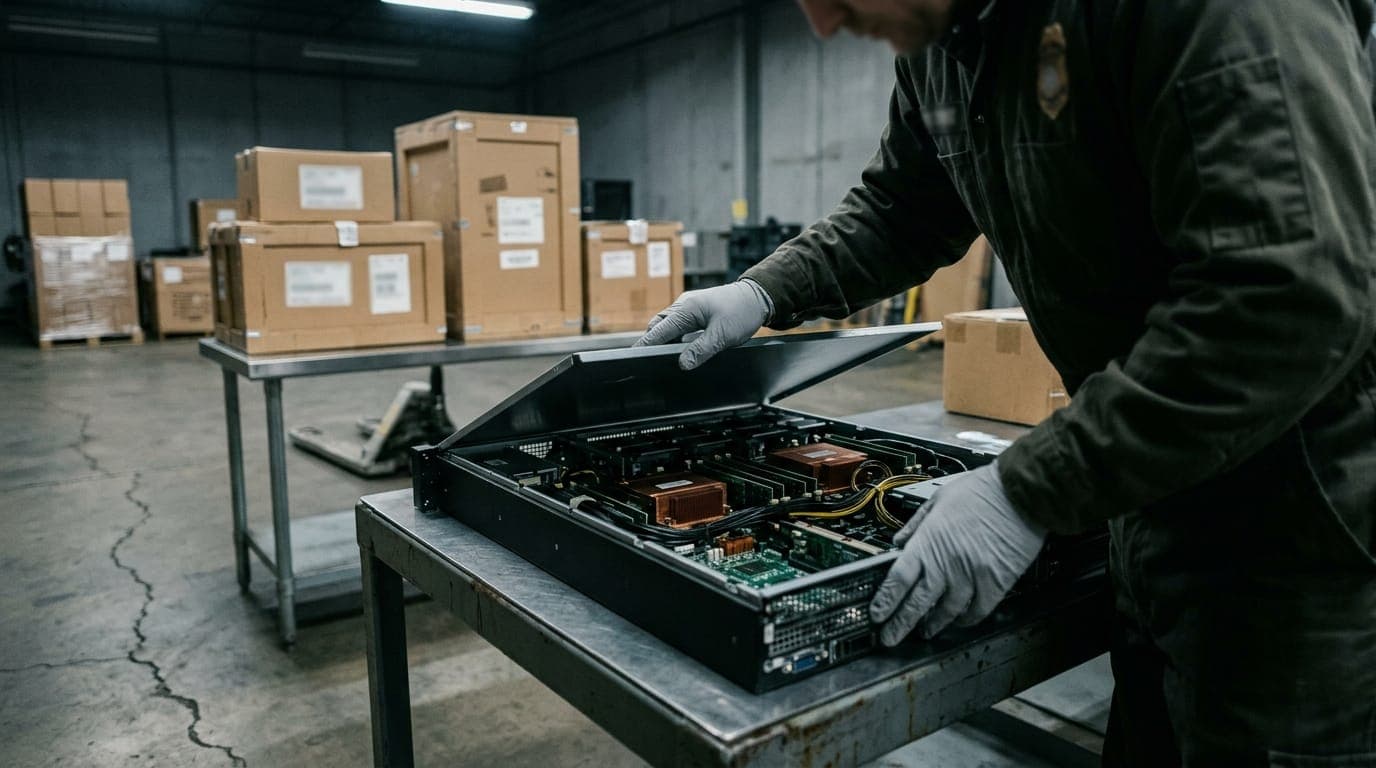
Employees at Nvidia's own Taiwan distribution office and Supermicro's Taiwan branch ran the ring, smuggling 74 Blackwell-generation servers through Indonesia and Japan.
Key takeaways
- Taiwan's Keelung District Prosecutors' Office indicted nine people on August 24, 2026, including a distribution manager at Nvidia's Taiwan office and two sales managers at Supermicro's Taiwan branch, for illegally exporting 74 Nvidia B300 AI servers to China.
- Defendants allegedly forged end-user documents to make 130 ordered servers appear destined for a Taiwanese data facility; 74 reached China via Indonesia and Japan while 56 were seized at the border.
- The scheme mirrors a parallel U.S. DOJ case against Super Micro co-founder Wally Liaw, unsealed five months earlier, alleging roughly $2.5 billion in server purchases diverted to China.
Taiwan's Keelung District Prosecutors' Office indicted nine people on August 24 for illegally exporting Nvidia B300 AI servers to China, per the prosecutors' statement as first reported by Reuters. Among those charged: a distribution manager surnamed Chang at Nvidia's Taiwan office and two sales managers surnamed Lin and Wang at Supermicro's Taiwan branch, making this a case where the companies' own employees ran the circumvention operation from the inside.
How the Smuggling Ring Worked
The defendants ordered 130 Supermicro servers equipped with Nvidia B300 GPUs and used forged end-user documents to make the shipments appear destined for a rented server facility in Taiwan. Seventy-four servers reached China, routed through Indonesia (50 units) and Japan (8 units), with the remainder going direct. Taiwan customs officials intercepted 56 additional servers at the border before export.
The CEO of Albatron Technology, a Supermicro distributor, and a staff member from Chief Telecom were also indicted. One defendant, linked to a company connected to the scheme, remains at large. Eight of the nine defendants face charges of breach of trust and document forgery; three of those also face embezzlement charges.
Prosecutors called it a coordinated operation across multiple levels of the supply chain. Per the Keelung statement, as quoted by the Taipei Times: defendants "colluded with one another at various levels for enormous profit, illegally exporting high-end servers, increasing corporate compliance costs, and severely damaging our nation's international image." Initial searches were launched on May 20, 2026. Neither Nvidia nor Super Micro responded to press requests for comment.
Permissioned Compute Generates Its Own Black Market
The B300 is part of Nvidia's Blackwell GPU generation, among the most capable AI accelerators on the planet and restricted from export to China under U.S. controls that have been in force since 2022. The restriction exists precisely because these chips are that valuable. That same scarcity is what made the ring profitable enough to run.
The insider structure of this scheme matters. These weren't rogue third-party brokers stumbling onto a loophole. They were distribution-layer employees at the companies holding the keys to the most controlled compute on the planet. The Keelung statement notes that defendants were fully aware that Nvidia and Super Micro have "rigorous internal control procedures" regarding exports, and proceeded anyway. The indictment is the answer to that claim.
This is the predictable output of centralized compute control. When a government designates a resource as a strategic weapon and routes it through a single-country distribution chain, it doesn't create security. It creates a black market with insiders at every node and a premium on whoever can get the product across the line. The corruption surface scales with the scarcity.
The AI supply chain fragility exposed in adjacent sectors follows the same logic: concentrated control over critical infrastructure produces concentrated points of failure and exploitation.
The parallel U.S. case underscores the scale of the problem. In March 2026, the DOJ unsealed an indictment against Super Micro co-founder Yih-Shyan "Wally" Liaw and two others, alleging roughly $2.5 billion in server purchases diverted to China, including approximately $510 million in a single three-week window in spring 2025. Two separate indictments, on two continents, targeting the same supply chain, within five months. That is a pattern, not an anomaly.
Wall Street's massive AI chip financing bet assumes this distribution infrastructure is stable and compliant. Every case like this chips away at that assumption.
The Falsifiable Thesis and What to Watch
The thesis here: nation-state compute control doesn't stop diversion, it incentivizes it, and the more governments tighten the controls, the more the distribution chain itself becomes the exploit. The trigger that disproves it is straightforward. If post-indictment enforcement, including multi-government cooperation, hardware attestation, and on-chip geofencing, demonstrably eliminates diversion at scale across the Taiwan and Southeast Asia corridor for 24-plus consecutive months with no material smuggling cases, the case for centralized control producing its own circumvention pressure needs revision. That has not happened.
What to watch: whether Taiwan moves toward a dedicated export-control statute (current charges relied on breach-of-trust and forgery statutes, not a purpose-built export law), how the Liaw case in the U.S. proceeds, and whether multi-government enforcement cooperation tightens the Indonesia and Japan transit routes that served as the conduit here. Any of those outcomes would signal the system is adapting. The absence of them would signal more of the same.
Sources
Frequently Asked Questions
What are Nvidia B300 GPUs and why are they restricted from export to China?
The B300 is part of Nvidia's Blackwell GPU generation, designed for high-performance AI training and inference workloads. The U.S. government has restricted export of advanced AI accelerators to China since 2022, citing national security concerns about military AI development. The B300 falls squarely within those restrictions because of its computational capability.
How does the Taiwan case connect to the U.S. DOJ indictment of Wally Liaw?
On March 19, 2026, the U.S. DOJ unsealed an indictment against Super Micro co-founder Yih-Shyan "Wally" Liaw and two others alleging roughly $2.5 billion in Supermicro server purchases diverted to China, including approximately $510 million in a single three-week window. The Taiwan indictment targets a separate but structurally identical scheme involving Supermicro servers and Nvidia GPUs routed through the same general supply chain. Two indictments targeting the same distribution chain within five months suggests the diversion problem is broader than any single operation.
Why were breach-of-trust and forgery charges used instead of export-control violations?
Taiwan does not yet have a purpose-built export-control statute equivalent to U.S. export administration regulations. Prosecutors charged breach of trust, document forgery, and in some cases embezzlement, using the tools available under existing Taiwanese law. That statutory gap is itself a notable detail: the most significant tech-export smuggling case in Taiwan's recent history was prosecuted under general commercial-crime statutes.