Nuclear Has Won the Argument. Now No One Will Go First.
The WNA's 51st Symposium produced a blunt verdict from Cameco's CEO: nuclear no longer needs to sell the story. The IAEA backed it up with its sixth consecutive upward revision to long-term capacity projections. The catch: in the West, every utility is racing for bronze.
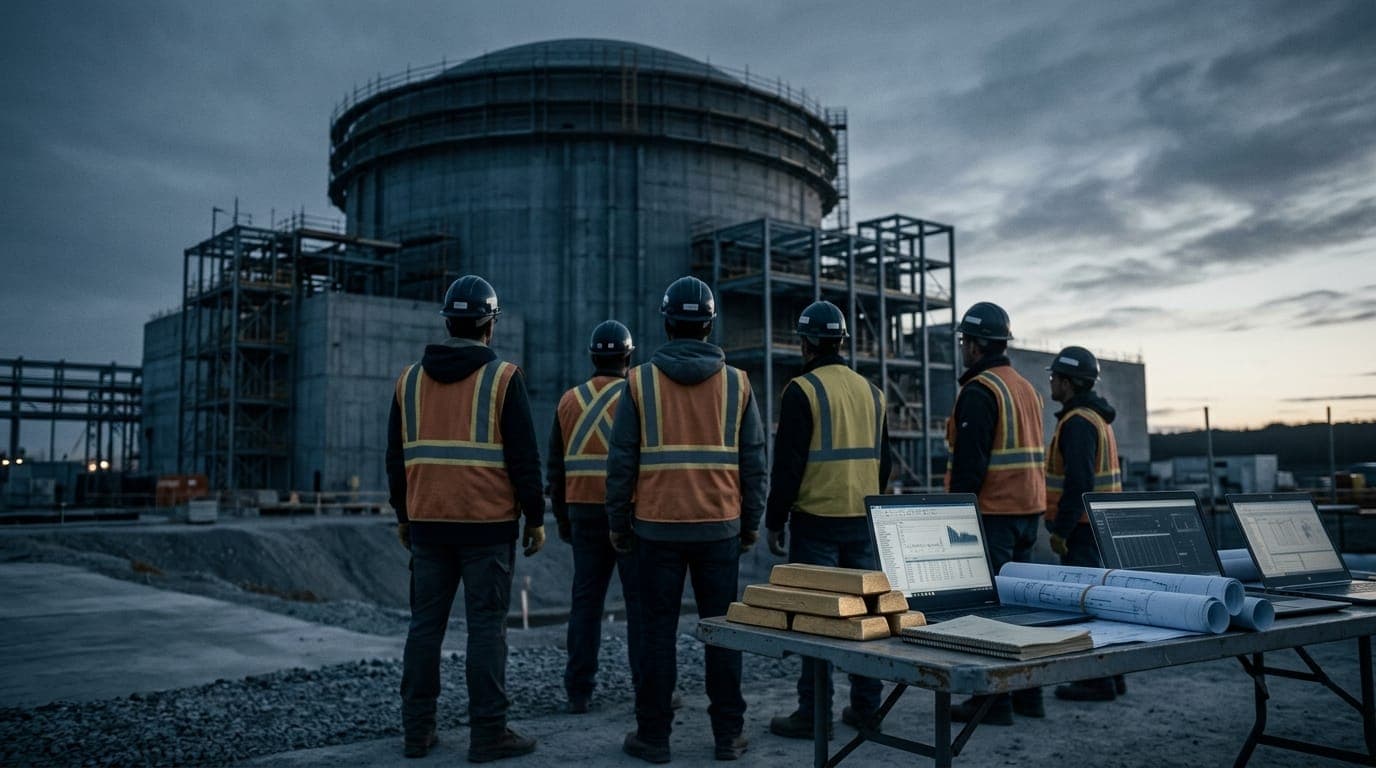
The WNA's 51st Symposium drew a record crowd and a blunt verdict. The execution gap is where the story gets complicated.
Key takeaways
- The WNA Symposium (September 9-11, London) drew 1,200+ delegates from 50+ countries, per WNA's official post-event page, with Cameco CEO Tim Gitzel declaring nuclear no longer needs to sell its story, only act on it.
- The IAEA raised its long-term nuclear capacity projections for the sixth consecutive year, now projecting up to 1,284 GWe by 2060 (roughly 3.4x today's fleet) in a forecast explicitly not reverse-engineered from a net-zero scenario.
- For Bitcoin miners, the supply-side implication is direct: the baseload nuclear power they compete for is being pre-contracted by AI hyperscalers, the existing fleet is aging faster than it's being replaced, and the window to lock in long-term nuclear-adjacent power at competitive rates is narrowing.
The World Nuclear Association's 51st Symposium closed September 11 in London with something the industry hasn't had in years: a consensus that the argument is over. The question now is whether anyone will actually build.
The Verdict from the Floor
Cameco President and CEO Tim Gitzel, whose company holds a 49% stake in Westinghouse (Cameco SEC filing, FY2024), put it plainly during his WNA fireside chat, as reported via Bank of America's research note: "We don't need to sell the [nuclear] story anymore, we just need to convert it to action."
CIBC analyst Anita Soni, who attended the three-day event, framed the shift the same way: "Nuclear energy has largely won the policy and market acceptance debate, with attention now turning to execution at scale."
The attendance itself makes the point. According to WNA's official post-event data, more than 1,200 delegates from 50+ countries and 684 organizations showed up, a post-Fukushima high for the symposium.
The catch arrived in Gitzel's second quotable line: "Everyone is racing for bronze." Most Western utilities would rather be the third mover on a new large reactor build than risk being the first. That dynamic, every participant watching the others, is the precise mechanism that could keep "execution phase" as a phrase on a conference slide rather than a description of actual construction activity.
The WNA event lined up with the IAEA's 2026 nuclear capacity outlook, released September 14. The agency raised its projections for the sixth straight year. Under the high case, global capacity reaches 1,045 GWe by 2050 and 1,284 GWe by 2060, roughly 3.4x the 377.1 GWe operating across 413 reactors at end of 2025. Notably, the IAEA stated its projections do not represent a net-zero pathway, meaning these numbers reflect assessed build trajectories, not a climate scenario worked backward.
The Fleet Is Older Than the Headlines Suggest
Here is the number the bullish capacity charts tend to omit: nuclear generation grew 1.1% in 2025 while overall electricity generation grew 2.7%. Nuclear's share of global power fell to 8.4% from 8.7%.
The reason is fleet age. The existing reactor base is old. Even in the IAEA's high case, a meaningful portion of today's capacity retires before 2060. The industry has to build aggressively just to hold its current share of the grid, and in 2025 it didn't manage that. Per IEA data, roughly 3 GW of new capacity came online while roughly 3 GW retired, leaving net capacity essentially flat.
The WNA Finance Summit's headline figure captures the scale of the ask: meeting the "Tripling Declaration" (the 2023 COP28 pledge signed by 31 countries to triple global nuclear capacity by 2050) would require approximately $6 trillion over 25 years, per WNA Finance Summit panels as reported by Bank of America. Annual nuclear capex would need to rise from roughly $80 billion today to more than $250 billion per year by 2050. The notable shift at this year's summit, per BofA's note, is that the conversation moved from "is there enough capital?" to "can the industry actually deploy it?"
On small modular reactors, the IAEA's full 2026 outlook now projects SMRs taking 23-28% of global new nuclear capacity by 2060 (23% in the low case, 28% in the high case), up from 5% and 24% respectively in last year's edition.
That trajectory has direct implications for uranium market structure and the broader DOE enrichment capacity gap that sits behind any serious build-out scenario.
What This Means for Bitcoin Miners' Power Stack
The energy security framing at WNA 2026 matters beyond uranium equities. The new nuclear that does get built is being pre-contracted by AI hyperscalers and utilities operating under national energy security mandates. It is not being left on spot markets for industrial buyers.
Bitcoin miners competing for baseload power face a structural cost problem that gets harder each year the execution gap persists. Miners who locked in long-term agreements near nuclear, hydro, or stranded-gas sources early are sitting on a widening cost advantage. Those competing on spot or short-term contracts are increasingly bidding against hyperscaler capex programs measured in the tens of billions. Ethiopia's recent miner power cuts are a preview of what sovereign grid prioritization looks like when supply gets constrained.
The falsifiable thesis here is straightforward: if Western reactor construction timelines slip another five-plus years on the next wave of large-reactor starts, the "execution phase" collapses back into the narrative phase. The "racing for bronze" dynamic Gitzel described is the exact mechanism that makes that outcome possible. The concrete test: watch whether any major Western utility breaks ground on a first-of-kind large reactor in the next 24 months, or whether SMR timelines from the current generation of developers slide again.
What to Watch
The IAEA's September 14 release gives policymakers and capital allocators a clean baseline. The next pressure point is whether any utility announces a firm construction commitment before the next WNA symposium, or whether the 2027 edition opens with the same "racing for bronze" characterization and a slightly updated IAEA high-case number.
Sources
- IAEA 2026 nuclear capacity projections press release
- IAEA Energy, Electricity and Nuclear Power Estimates 2026, 46th edition
- WNA Symposium 2026 official post-event page
- Tim Gitzel quotes and WNA Finance Summit figures: first reported via Bank of America research note, as cited at WNA 2026, per ZeroHedge
Frequently Asked Questions
Does the nuclear build-out produce new baseload power fast enough to affect Bitcoin miners' energy costs in the next five years?
Almost certainly not at scale. Lead times for large reactors in the West run 10-15 years from decision to grid connection, and no major Western utility has broken ground on a first-of-kind build. SMRs are the faster path, but the leading developers are still in licensing and early construction phases. The structural pressure on miners' power costs is real now; meaningful new nuclear supply relief is a late-2030s story at the earliest.
What is the Tripling Declaration and who signed it?
The Tripling Declaration is a pledge made at COP28 in December 2023 by 31 countries to triple global nuclear capacity from roughly 2023 levels by 2050. The WNA Finance Summit's $6 trillion capex estimate is the price tag attached to meeting that target.
Why are Western utilities waiting to build if nuclear has won the policy debate?
The core problem is first-mover risk. Building a new large reactor design in the West means absorbing the learning-curve cost: schedule overruns, supply chain build-out, regulatory novelty, and construction workforce ramp-up. The utilities that went second or third on a given design (or in a given regulatory jurisdiction) historically paid far less than the pioneers. Vogtle Unit 3 and 4 in the United States came in well over budget and years late, with an original estimate of roughly $14 billion ballooning to a final cost in the range of $32-36 billion depending on what financing costs are included, and those were the first AP1000s built in the U.S. in decades. Every CFO in the sector read that case study. The rational play, at the individual firm level, is to let someone else absorb the first-mover cost and replicate what works. Collectively, that produces Gitzel's "racing for bronze" problem: everyone is waiting, and the capacity the world needs doesn't get built.