DOE Picks Five States for $50B Nuclear Lifecycle Campuses
The DOE selected Utah, Tennessee, Oklahoma, Louisiana, and Idaho as finalists for Nuclear Lifecycle Innovation Campuses. For Bitcoin miners, these five states just became the most credible candidates for long-term nuclear baseload co-location.
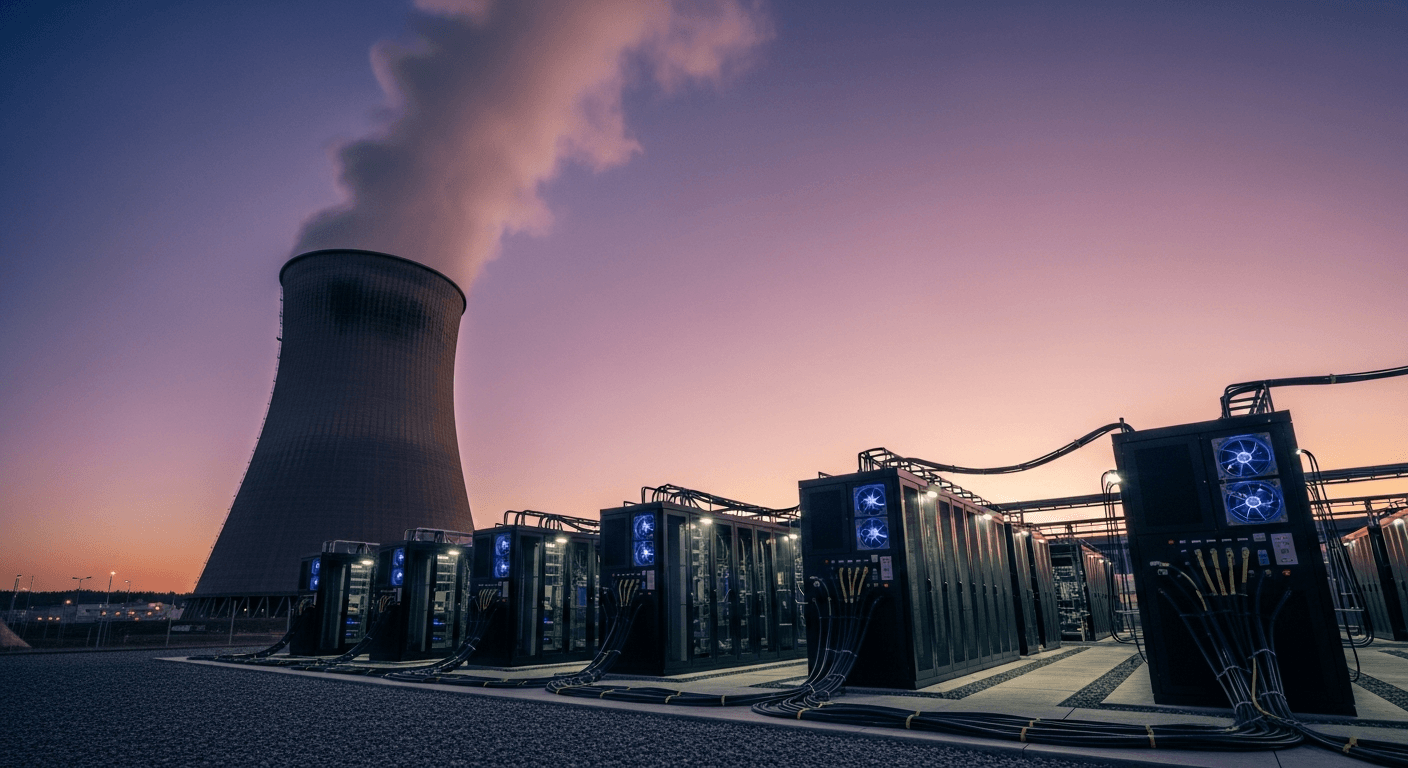
This shortlist is a preview of where energy-intensive compute will anchor for the next decade.
Key takeaways
- The DOE selected Utah, Tennessee, Oklahoma, Louisiana, and Idaho on July 24, 2026 as finalists to host Nuclear Lifecycle Innovation Campuses, each potentially drawing up to $50 billion in investment and 25,000 jobs, out of 28 applications from 26 states.
- NLICs are explicitly designed to co-locate data centers alongside the full nuclear fuel cycle, making the five finalist states the most credible candidates for long-term, low-cost baseload power for Bitcoin mining and AI compute.
- Texas and New Mexico, both aggressive self-marketers as pro-nuclear states, are conspicuously absent. Both supported reactors when the economics were favorable but fought used fuel storage through legislation and litigation, disqualifying them from a program that requires owning the entire lifecycle.
The U.S. Department of Energy announced on July 24, 2026 that Utah, Tennessee, Oklahoma, Louisiana, and Idaho will advance as potential hosts for Nuclear Lifecycle Innovation Campuses. Energy Secretary Chris Wright signed Memorandums of Understanding with all five states after reviewing 28 applications from 26 states. Each campus could attract up to $50 billion in capital investment, generate nearly $10 billion in state and local tax revenue, and support roughly 25,000 jobs, per the DOE release.
What an NLIC Actually Is
These are not reactor parks. Per the DOE's NLIC program page, each campus is designed to handle the entire nuclear fuel cycle in one place: uranium enrichment, fuel fabrication, reprocessing and recycling of used nuclear fuel, and final waste disposition. Depending on the host state, a campus can also include advanced reactors, power generation, advanced manufacturing, and co-located data centers.
That last item is the one that matters for miners. The DOE is explicitly pre-selecting jurisdictions for the most power-dense compute infrastructure in the country. These are not facilities that might eventually serve data centers. They are planned with that co-location baked in from the start.
"These campuses would have the potential to be used for research, development, piloting of fuel manufacturing, upgrading, test reactors, all the way through the reprocessing and long-term storage," said DOE Under Secretary for Nuclear Energy Kyle Haustveit.
The RFI that launched this process was issued January 28, 2026, with responses due April 1. The selection of five finalists followed three months of review.
The Texas Problem Is a Miner Problem Too
The absence of Texas and New Mexico from this shortlist deserves attention, and not just as a nuclear policy footnote.
Texas spent years positioning itself as the future of advanced nuclear development. The state established the Texas Advanced Nuclear Energy Office (TANEO) via House Bill 14 and created the $350 million Texas Advanced Nuclear Development Fund to support reactor development and supply-chain projects. Yet when Orano USA and Waste Control Specialists proposed a consolidated interim storage facility for used nuclear fuel in Andrews County, the state's enthusiasm collapsed. Governor Abbott urged the NRC to reject it. Texas legislators passed a law opposing high-level waste storage. The state litigated the NRC license to the Supreme Court.
Reactors: yes. The fuel that ran through them: somebody else's problem.
New Mexico produced the same pattern. The state committed economic-development funding for Kairos Power's advanced reactor work in Albuquerque. When Holtec International proposed its HI-STORE consolidated interim storage facility in Lea County, which the NRC licensed in 2023, New Mexico's governor and legislature fought it through legislation and permit threats. Even after a favorable Supreme Court ruling revived the federal licensing pathway, Holtec abandoned the project. In a press statement, Holtec cited "the untenable path forward for used fuel storage in New Mexico" as the reason it mutually agreed with its partner, the Eddy-Lea Energy Alliance, to cancel the agreement. New Mexico is not on this shortlist.
For Bitcoin miners, this distinction is not abstract. A state that embraces nuclear when grants and factories are on the table but litigates the downside creates exactly the regulatory unpredictability that makes 10-year capex decisions impossible to underwrite.
The NLIC program, by requiring full lifecycle commitment as the price of admission, is effectively sorting jurisdictions by permitting stability. The five states that made the cut have demonstrated institutional willingness to own the hard parts. That correlates directly with the kind of long-term operating environment miners need.
Local opposition to energy infrastructure is a real constraint across much of the country. States that have already navigated the political economy of waste storage have, in effect, run the hardest part of that gauntlet already.
What Miners Should Be Watching
Nuclear's share of Bitcoin mining's energy mix has grown from roughly 4% in 2021 to nearly 10% by 2025, per industry data (with the caveat that miner energy reporting involves self-disclosure and figures are not independently audited across the full network). Miners who can co-locate with nuclear baseload operate with 24/7 uptime, no curtailment risk, and no intermittency premium. As AI hyperscalers compete aggressively for the same electrons, that advantage narrows for anyone not already positioned.
Efficiency gains in AI compute have, counterintuitively, accelerated total power demand rather than reduced it. The competition for baseload is intensifying. NLIC campuses would lock in a durable supply of that baseload in five specific states. Miners establishing co-location relationships in those jurisdictions now face a structurally different cost profile from those chasing capacity in less committed markets later.
The Oklahoma Department of Commerce has confirmed that DOE plans to narrow the five finalists to three final host states by end of 2026 (okcommerce.gov). The language in final hosting agreements, specifically whether co-location with data centers and mining operations is permitted or restricted, will determine whether the miner geography thesis here actually materializes. Watch for that language. If power output is ring-fenced exclusively for grid supply by federal policy or state law, or if permitting delays stall construction entirely, the cost-structure advantage does not follow.
Utah's campus is being explored in Tooele County, per a state-level announcement. The other four states have not yet specified candidate locations publicly.
Update, August 27, 2026
The Army's nuclear build-out just got a lot more concrete. On August 26, the Department of the Army announced that its Project Janus program has selected five nuclear energy vendors and five initial installation sites, with the Army awarding up to a combined $2.2 billion to own, construct, and operate nuclear microreactors on military installations. The five awardees are Antares Nuclear at Fort Bragg in North Carolina, BWX Technologies at Fort Campbell in Kentucky, General Atomics Electromagnetic Systems at Fort Hood in Texas, Radiant Industries at Fort Benning in Georgia, and Westinghouse at Fort Drum in New York.
The War Department is acting to implement President Trump's Executive Order on deploying advanced nuclear reactor technologies for national security, with a hard target of getting a reactor operational at a military installation by September 2028.
With private sector funding expected alongside the government dollars, the Army projects more than 20 total nuclear microreactors will be built and operated across installations.
The significance here extends well beyond defense logistics. Unlike conventional emergency generators, nuclear microreactors can potentially operate for years without refueling, whereas the Army currently relies primarily on diesel generation for backup power at critical infrastructure. A 2028 operational deadline with $2.2 billion behind it means microreactor technology is being pressure-tested at scale on a real deadline. Every milestone these five vendors hit compresses cost curves and de-risks the same hardware stack that makes distributed, off-grid hashrate viable. The DOE NLIC campuses tell you where the big baseload anchors land. Project Janus tells you the modular, deployable version of that same bet is moving from whitepaper to concrete pad.
Sources
- DOE NLIC Contenders Announcement, July 24, 2026
- DOE NLIC Program Landing Page
- American Nuclear Society, Five States Named NLIC Finalists
- Utah NLIC State Announcement, Tooele County
- Oklahoma Department of Commerce, NLIC Finalist Announcement
- Texas Governor's Office, TANEO and Texas Advanced Nuclear Development Fund
Frequently Asked Questions
An NLIC handles the entire fuel cycle in one place: enrichment, fabrication, reprocessing, and final waste disposition, alongside optional power generation, advanced manufacturing, and data centers. A standard nuclear plant generates power and ships used fuel offsite. The full-lifecycle requirement is precisely what disqualified states like Texas and New Mexico, which supported reactors but refused to host waste storage.
Both states supported nuclear development when it brought grants, jobs, and factory announcements, but actively opposed consolidated interim storage for used nuclear fuel within their borders. Texas fought a licensed facility to the Supreme Court. New Mexico's political opposition led Holtec International to abandon its NRC-licensed HI-STORE project entirely, citing "the untenable path forward for used fuel storage in New Mexico" in its press statement. The NLIC program requires willingness to own the complete fuel cycle. Neither state cleared that bar.
NLICs explicitly envision co-located data centers. The five finalist states are on course to have the most stable, lowest-cost baseload energy infrastructure in the country for energy-intensive compute. As AI hyperscalers compete for nuclear power purchase agreements, miners who establish co-location access in NLIC states lock in a cost structure that becomes increasingly unavailable to later entrants. The co-location language in final hosting agreements will confirm or limit this opportunity.