Five US AI Giants in Talks to Co-Locate Data Centers at Japan's Gas Plants
JERA's global CEO confirms talks with Anthropic, Meta, Amazon, Microsoft, and Google to build behind-the-meter AI data centers at its Tokyo-area LNG plants, one week after Trump threatened an undefined 'tremendous tax' on overseas data center builds.
Japan's largest power producer is offering what the US grid cannot: power delivered years ahead of schedule, no permitting queue, no community revolt.
Key takeaways
- JERA global CEO Yukio Kani confirmed the company is in talks with Anthropic, Meta, Amazon, Microsoft, and Google to build AI data centers directly at its Tokyo-area LNG-fired power plants, feeding them power "behind the meter" and bypassing the public grid entirely.
- The talks surface one week after Trump threatened an undefined "tremendous tax" on US companies building data centers overseas, a remark he acknowledged was unbriefed even to his own staff, with no legislative vehicle yet in place.
- JERA already has a concrete anchor project: a 400 MW, $15 billion-plus data center at its Chiba Thermal Power Station, targeting first operations around 2028, with Apollo Global Management lined up as a financing partner.
Japan's largest power producer, JERA, has entered talks with Anthropic, Meta, Amazon, Microsoft, and Google to build AI data centers on the grounds of its Tokyo-area LNG-fired power plants, with electricity fed directly from the generators rather than through the public grid, JERA global CEO and chair Yukio Kani told Nikkei Asia. No binding deal with any of the five companies has been announced. The talks land one week after President Trump threatened to tax US companies for building data centers overseas, a warning the market is visibly ignoring.
Behind the Meter, Ahead of Schedule
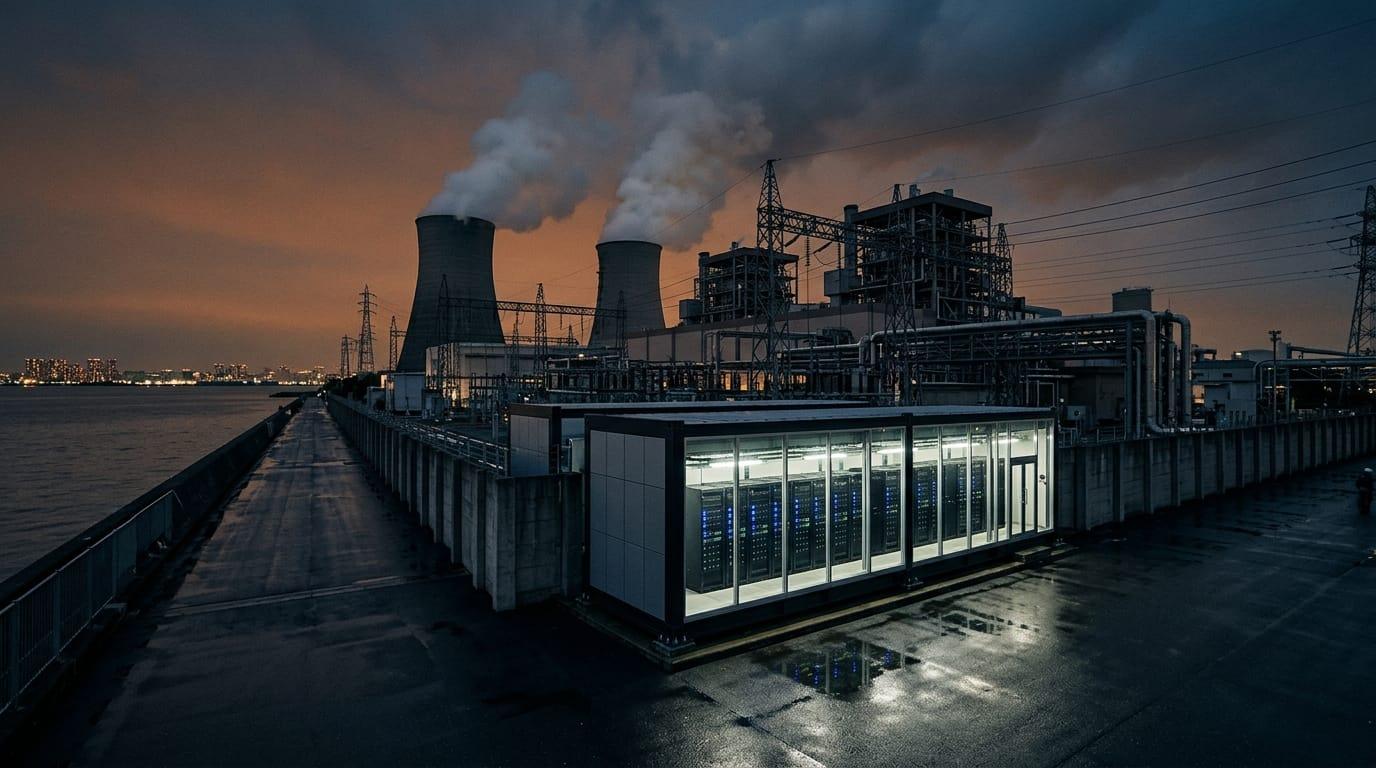
The structure JERA is proposing is what the industry calls "behind the meter": the data center sits on plant grounds and draws power directly from the generator, before it ever touches the public grid. JERA says this delivers capacity years ahead of a conventional grid hookup. That gap, permitting backlogs and interconnection queues measured in years, is exactly the 32 GW power shortfall Morgan Stanley has flagged for US data centers through 2028.
JERA is a 50-50 joint venture of Tokyo Electric Power and Chubu Electric, and Japan's largest LNG buyer. Its Tokyo-area plants run on imported gas.
The company already has a concrete anchor deal. On October 1, 2026, JERA signed a memorandum of understanding with Dell Technologies and UK-based developer RHAELM for a data center at its Chiba Thermal Power Station: up to 400 MW, more than $15 billion (approximately 2.3 trillion yen) across all phases, with first operations targeted around 2028 and full 400 MW capacity by 2029. The Chiba plant's LNG-fired output is approximately 4.38 GW, per Data Center Dynamics. Apollo Global Management is lined up as RHAELM's strategic investment and financing partner, though that financing has not yet closed. The partners have stated plans to extend the model to other JERA sites, targeting several gigawatts of AI capacity across Japan in the 2030s.
"JERA is uniquely positioned to power Japan's AI ambitions," Kani said at the Chiba MoU signing.
Capital Is Already Moving
Trump told reporters at a White House briefing on November 20, days before Kani's comments surfaced, that overseas data center builds would face consequences. "We're not going to allow companies to build data centers in other countries. But we're going to put a tremendous tax on them if they do." He added: "I haven't even said that to my people, but I'm telling them now."
That admission is the tell. The threat has no codified rate, no enacted legislation, and no enforcement mechanism. Per AP and NBC News, the remark was made ad hoc, and analysts have questioned how such a restriction would even function given data-localization laws in markets like Japan that legally require certain data to stay within their borders. Capital does not wait for mechanism clarity. The labs are already in Japan.
The Trump tax threat is a data point in a longer pattern: coercive signals without legislative teeth accelerate the capital reallocation they claim to prevent.
What This Means for Power Markets and Bitcoin Miners
The JERA play is a direct read on US domestic energy infrastructure. Morgan Stanley projects a 32 GW net power shortfall for US data centers through 2028, driven by AI, even after accounting for behind-the-meter generation. The bottleneck is not generation capacity; it is interconnection and permitting. JERA's pitch to five of the largest AI spenders alive is essentially: we have dispatchable gas power, we can connect you in years not decades, and we do not have a community revolt problem.
That matters to Bitcoin miners. Behind-the-meter co-location at power plants is a structure miners pioneered globally to access curtailed and stranded power at low cost. JERA is now packaging that exact model for AI at hundreds of megawatts per site, with gigawatts targeted across Japan by the 2030s. Anthropic alone has disclosed approximately $895 billion in compute and infrastructure commitments in its amended IPO filing. When that scale of capital chases the same plant-adjacent, behind-the-meter power sources miners rely on, the arbitrage compresses. Not a death blow to mining economics, but a signal the window is narrowing faster than expected.
What to Watch
The five conversations with JERA are still at the discussion stage. Watch for a signed MoU or offtake agreement with any of the five as the signal that the behind-the-meter model scales beyond Chiba. If instead all five redirect capital back to US domestic sites at comparable scale and timelines, the capital-flight thesis weakens and the Trump threat deserves more credit than the market is currently giving it. Apollo's financing close on Chiba is the nearer-term milestone.
Sources
- Nikkei Asia, first reported by Nikkei Asia (Shimpei Nakamura, Nov. 27, 2026)
- Data Center Dynamics, JERA, Dell, RHAELM Chiba MoU
- AP via WRTV, Trump White House remarks, Nov. 20, 2026
- NBC News, Trump White House remarks, Nov. 20, 2026
- JERA homepage
Frequently Asked Questions
What does "behind the meter" mean for a data center?
A behind-the-meter data center sits on or immediately adjacent to a power plant's property and draws electricity directly from the generator before it reaches the public grid. It bypasses the interconnection queue entirely, which in the US and Japan can run years, allowing the facility to come online significantly faster than a grid-connected site.
Does Trump's threatened tax on overseas data centers have any legal force yet?
As of November 20, 2026, the threat has no codified rate, no enacted legislation, and no defined enforcement mechanism. Trump acknowledged he had not briefed his own staff before making the remark. Analysts have questioned how such a restriction would function in practice, given that some countries legally require certain data to stay within their borders.
How does this affect Bitcoin miners competing for power?
AI labs pursuing behind-the-meter co-location at scale are now direct competitors for the same curtailed and plant-adjacent power sources that underpin Bitcoin mining economics globally. As hyperscale AI capex targets hundreds of megawatts per site and gigawatts across a single country, the low-cost stranded-power arbitrage miners have relied on faces increased competition for the same underlying resource.