Iran Threatens South Korean Assets Over Hormuz Coalition
Tehran threatened to treat South Korea as an enemy and destroy its economic and military assets across five Gulf states if Seoul joins the US-led Hormuz freedom-of-navigation mission. South Korea's presidential office says nothing has been decided, but parliament is the real chokepoint.
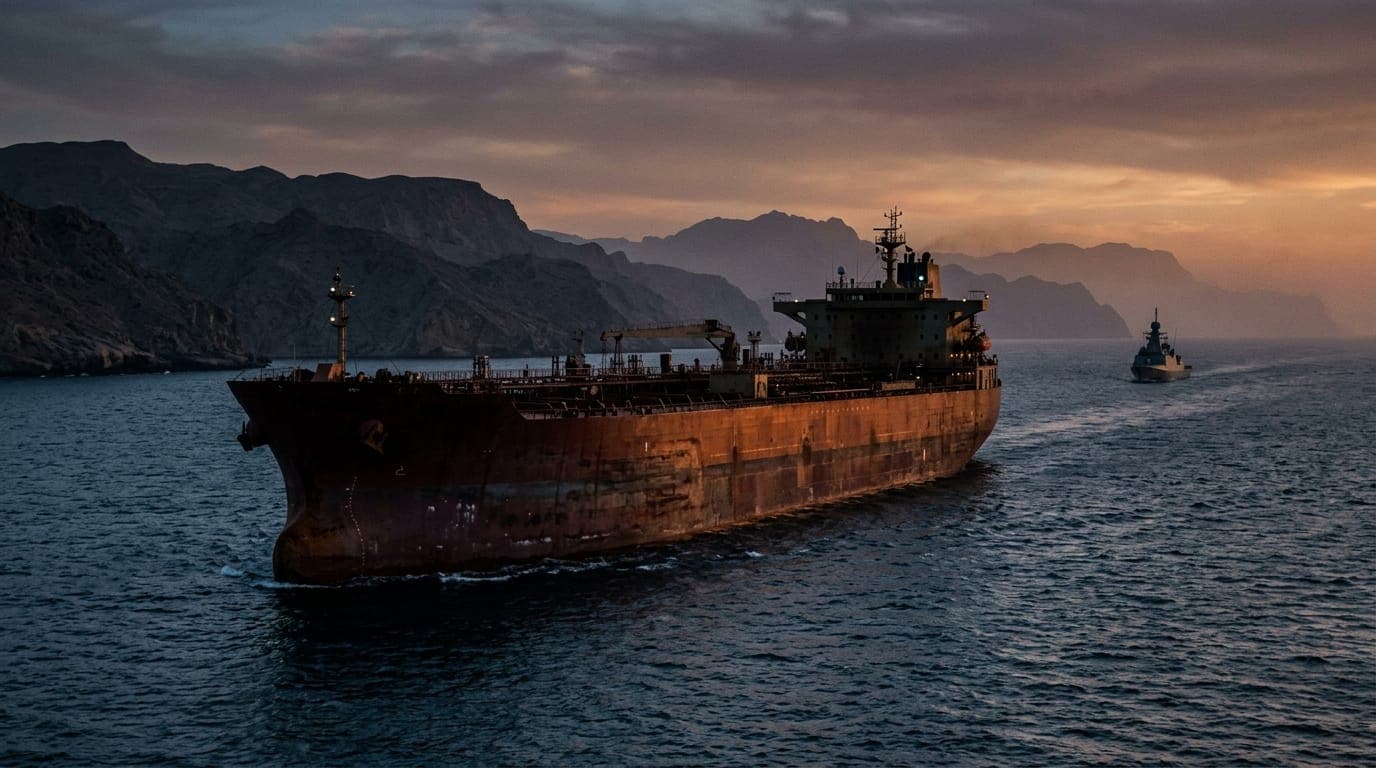
Tehran's warning targets civilian infrastructure in Saudi Arabia, Bahrain, Kuwait, the UAE, and Qatar, not just military hardware.
Key takeaways
- Mohammad Marandi, University of Tehran professor and former Iranian nuclear negotiating team adviser, warned September 4 that Tehran would treat South Korea as an enemy and destroy its assets across five Gulf states if Seoul joins the US-led Hormuz mission.
- South Korea sources 61% of its crude oil and 54% of its naphtha through the Strait of Hormuz, yet its presidential office says no deployment decision has been made and any move requires National Assembly approval, where 55% of the public is opposed.
- The threat is calibrated to price coalition membership high enough to keep the US-led group thin, raising the probability of a sustained Hormuz disruption, an oil shock, and the stagflationary monetary chaos Bitcoin was built to survive.
Iran delivered a pointed warning on September 4, 2026: if South Korea joins the US-led effort to secure freedom of navigation through the Strait of Hormuz, Tehran will consider Seoul an enemy and move to destroy its assets across the Persian Gulf. The threat, first reported by Middle East Eye, was made by Mohammad Marandi, a University of Tehran professor who served as a media adviser to Iran's nuclear negotiating team during the 2021-2022 JCPOA talks. It landed at a moment when South Korea's presidential office is actively weighing military options and Washington is publicly pressuring Seoul to contribute.
What Iran Actually Threatened
Speaking on Al Mayadeen's The Grand Standoff, Marandi was unambiguous. "If the South Koreans participate in this war against Iran, Iran will see it as the enemy," he said, adding that Tehran would seek to "destroy whatever assets South Korea has in this region." He named specific geography: South Korean assets in Saudi Arabia, Bahrain, Kuwait, the UAE, and Qatar. Then the critical line: "Those targets would not necessarily be military installations."
"Iran will not only target the South Korean military assets, but Iran could easily destroy their economic assets across the Persian Gulf region," Marandi said. "So the Koreans are very vulnerable to Iran. Iran can hurt them very badly."
Marandi dismissed the military logic of any Korean contribution outright. "What is a ship or two from South Korea going to do? It's foolish." The threat is calibrated to raise the cost of participation to a level that deters fence-sitters.
South Korea's presidential office confirmed Friday, September 4, that options including combat participation, noncombat roles, and search operations had been discussed, but issued a firm caveat: "Please be advised that nothing has been decided yet concerning actual contributions." South Korean broadcasters reported that options under consideration include a maritime patrol aircraft, a naval logistics support ship, and a navy explosive ordnance disposal team. Any deployment requires NSC review, a cabinet resolution, and National Assembly approval.
The Coalition Math Iran Is Running
Iran's target selection, civilian and corporate infrastructure across five US-allied Gulf states, is deliberate. Marandi's own framing confirms the military contribution is irrelevant. The real calculation is whether threatening South Korean petrochemical plants, energy contracts, and corporate facilities in Riyadh, Manama, and Abu Dhabi is enough to keep Seoul out. If it works on Seoul, it signals the same price to Tokyo, Canberra, and any other energy-dependent US ally watching from the sideline.
A thin coalition means heavier US burden-sharing, longer conflict duration, and a higher probability that Hormuz disruption extends well past any near-term de-escalation. South Korea runs 61% of its crude imports and 54% of its naphtha through the strait. An actual closure scenario is an energy shock. Energy shocks are historically stagflationary: prices spike while growth stalls, and central banks face the impossible choice between fighting inflation and cushioning a recession.
The 1970s is the last time the Fed ran that gauntlet. It ended with the most destructive monetary experiment in modern history. Bitcoin didn't exist then. It does now, with a fixed supply, no counterparty risk, and no central banker to make it worse.
The commodities-versus-equities reversion playing out in hard assets right now fits cleanly into that backdrop.
The Parliamentary Chokepoint
The gating mechanism here is the National Assembly in Seoul. South Korean law requires a full legislative process for any new overseas military deployment. A Gallup Korea poll from March 2026 found 55% of South Koreans oppose sending warships to Hormuz, with only 30% in support. Seoul's presidential office acknowledged the constraints directly: any decision must account for "domestic legal procedures, military readiness on the Korean Peninsula and parliamentary approval."
There is a precedent for avoiding that process. In 2019, under US pressure, Seoul expanded its existing Cheonghae anti-piracy unit from Gulf of Aden operations into Hormuz waters without requiring fresh parliamentary authorization. Whether that same workaround is available for a substantially different mission is contested. South Korea's defense minister has indicated that any meaningfully different Hormuz mission would require parliamentary consent.
If parliament blocks or delays, Trump's public frustration with Seoul hardens into a genuine US alliance rupture. That adds geopolitical instability on top of the energy risk, not instead of it.
What to Watch
The National Assembly vote is the trigger. If South Korea deploys and Iran does not follow through on strikes against South Korean commercial assets in the Gulf, the asymmetric-targeting deterrence logic falls apart and Marandi's warning reads as theater.
If Seoul stands down and the coalition stays thin, watch the Hormuz disruption timeline extend further and the oil-shock probability climb. Either outcome resolves the thesis. Nothing in between does.
Update, September 23, 2026
Iran's Supreme National Security Council escalated its regional threat posture on Wednesday, moving beyond the military and economic asset targeting already on the table. Mohsen Rezaei, secretary of the Supreme National Security Council, told Iranian state TV that if neighboring countries cooperate with the United States by stopping Iranian flights, Iran will ensure their airports cannot function. The threat is explicit and targets civilian critical infrastructure, the same playbook Iran signaled against South Korean corporate assets in the Gulf.
The trigger is the Bessent "Economic D-Day" aviation pressure campaign. US Treasury Secretary Scott Bessent said Monday that all Iranian airlines would effectively be forced to stop operating from September 23 under the threat of secondary sanctions against companies providing aviation services.
Iranian airlines were forced to cancel some international flights Wednesday after Washington tightened those sanctions, with Georgia and Azerbaijan officially confirming suspension of Iranian flights, and routes to Baghdad, Muscat, and Qatar also halted.
Iran's framing makes the regional coercion logic plain. Rezaei stated via the Supreme National Security Council: "We ask all the countries of the region not to join America's adventure. If they do not allow Iranian aircraft to travel, their own airports will not be able to have flights either," adding, "You are our friends, but you should not join America's ranks. You should prevent the war from spreading." The Gulf states named in the earlier South Korea threat -- Saudi Arabia, Bahrain, Kuwait, the UAE, and Qatar -- are precisely the neighbors now being warned off compliance with US aviation sanctions, and Iran simultaneously presented seven preconditions for lifting its blockade of the Strait of Hormuz , tying the aviation and energy pressure tracks together into a single coercive framework.
Sources
Frequently Asked Questions
What would Iran actually target if South Korea joins the Hormuz mission?
Marandi explicitly named non-military targets: South Korean corporate and energy assets in Saudi Arabia, Bahrain, Kuwait, the UAE, and Qatar. The threat covers civilian and economic infrastructure, not only military installations.
Does South Korea have to join the US-led coalition?
No. Under South Korean law, any new overseas military deployment requires National Security Council review, a cabinet resolution, and National Assembly approval. A March 2026 Gallup Korea poll showed 55% of South Koreans oppose sending warships. Seoul's presidential office has confirmed nothing has been decided.
How does a Hormuz closure feed into monetary policy?
The strait carries roughly 20% of global oil supply. A sustained closure triggers an energy price spike that pushes central banks into a stagflation corner: inflation is too high to cut rates, growth is too weak to raise them aggressively. That policy paralysis historically precedes emergency liquidity measures. Every round of fiat accommodation strengthens the case for a fixed-supply asset with no counterparty risk.