Singhai Marine Offers Tanker Crews Double Pay to Transit Hormuz
A Singapore-based maritime crewing agency is reportedly offering tanker crews a Hormuz transit bonus equal to one additional month's full salary on top of base pay, signaling that ship operators are struggling to staff voyages through the strait and that disruption costs are already embedded in
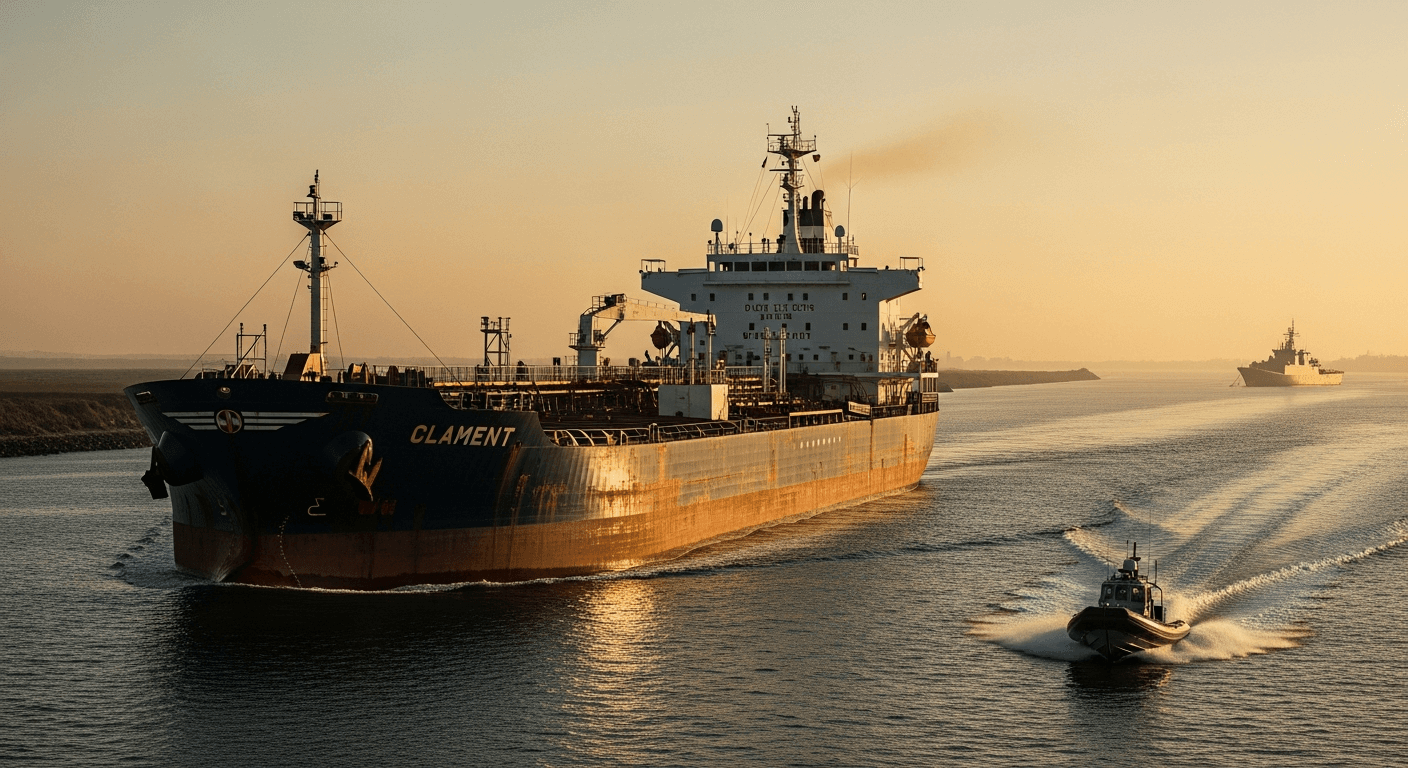
A recruitment ad surfaced on X shows a Singapore crewing agency offering a full extra month's salary as a Hormuz transit bonus, confirming that ship operators are struggling to staff the world's most critical oil chokepoint.
Key takeaways
- Singapore-based Singhai Marine Services is reportedly recruiting a full crew for a VLCC on the Dubai-Oman route, reportedly offering salaries from approximately $1,600 (ordinary seaman) to $16,000 (captain) plus a separate high-risk allowance and a Hormuz transit bonus equal to one additional month's full salary, details sourced from ZeroHedge and not yet confirmed against the primary post.
- The ad, first reported by ZeroHedge after Flexport CEO Ryan Petersen (@typesfast) posted what appears to be the recruitment document on X, is unverified but consistent with documented market conditions: the Baltic Exchange's TD3C MEG-China VLCC index reached approximately $423,000/day in early March 2026, and the IMO has confirmed multiple seafarer deaths and dozens of verified attacks on vessels in and around the strait since the crisis began.
- Labor pricing leads energy pricing. When crews demand a 100% pay premium to do a routine job, that cost is already embedded in every barrel moving through Hormuz and every downstream product priced off it, months before CPI prints reflect it.
Flexport CEO Ryan Petersen (@typesfast on X) posted what appears to be a recruitment ad from Singhai Marine Services, a Singapore-registered, Maritime Port Authority-licensed crewing agency, offering double pay to tanker crews willing to transit the Strait of Hormuz. The post was first reported by ZeroHedge. The specific post URL was not independently confirmed at time of filing, and ZeroHedge itself hedges the ad as appearing authentic. All details from the recruitment document should be treated as conditional on the primary post being verified.
Per the reported ad, Singhai is reportedly recruiting a full crew to operate a very large crude carrier on a Dubai-Oman route through the strait on a one-month contract. Salaries are reported to range from approximately $1,600 per month for an ordinary seaman to $16,000 per month for the captain. On top of base pay, the offer reportedly includes a separate high-risk allowance and a "Hormuz transit bonus" equal to one additional month's full salary. Applicants must accept high-risk deployment; tanker experience is preferred.
Singhai Marine Services (S) Pte. Ltd. is confirmed real: Singapore UEN 200409907G, incorporated August 6, 2004, licensed under the Employment Agencies Act and the MPA.
The Math the Ad Makes Plain
The transit bonus structure, if authentic, is a 100% premium above base pay for a single month's work. For a captain, that is reportedly $16,000 on top of $16,000. That is a market explicitly pricing the probability of a drone strike into a hiring document.
The backdrop validates the scale of the premium. The Hormuz crisis began February 28, 2026, following U.S. and Israeli strikes on Iran. The Baltic Exchange's MEG-China TD3C index went parabolic after the outbreak of war, coming in at a record $423,736 per day on Monday, March 2, 2026, per Lloyd's List reporting on Baltic Exchange data. War-risk insurance either disappeared or spiked to punitive levels within days.
The IMO has confirmed multiple seafarer deaths and dozens of verified incidents on vessels in and around the strait; figures are updated at imo.org and should be checked against the current release before citing specific totals.
What Labor Pricing Tells You That CPI Won't
Wire coverage will frame this as a human-interest story about sailors braving drones for combat pay. The economic read is more important.
Labor costs are a leading indicator. When a crewing agency has to offer a 100% bonus to staff a vessel, that cost is already baked into the voyage. It flows into freight rates, which flow into oil delivery costs, which flow into refined products, petrochemicals, fertilizer, and the shipping rates for everything else moving on the water. The energy index increased 15.7 percent for the 12 months ending June per the BLS June 2026 CPI release. The hazard pay embedded in this ad will show up in those numbers later.
This is the supply-side inflation dynamic that has no interest-rate fix. The Fed can pause, hike, or cut; none of those moves put tanker crews back on the water at pre-crisis wages or reopen Hormuz. The bond market has been signaling this for months. The crewing ad is the ground-level confirmation.
A Hormuz bypass could eventually offer a partial alternative, but any such project sits years away from operational capacity. In the meantime, every barrel that moves through the strait carries a hazard premium, and that premium is now showing up in hiring documents, not just day-rate indexes.
What to Watch
The ad's authenticity needs to be confirmed against Petersen's original X post. If verified, watch for competing crewing agencies publishing similar structures, which would signal that the Singhai terms are market-clearing, not an outlier.
If the ad proves fabricated, the broader freight and day-rate data still stands on its own. A durable ceasefire that restores full Hormuz transit would collapse the hazard premium and disprove the embedded-cost thesis. Until that happens, labor markets are telling you what the next few CPI prints will confirm.
Update, August 24, 2026
The double-pay recruitment ad now has a hard number to go alongside it. TotalEnergies CEO Patrick Pouyanne put the figure on the table at ONS 2026 in Stavanger, Norway, where the ONS Foundation and Munich Security Conference hosted a joint energy-security summit. His takeaway: moving a VLCC carrying roughly 2 million barrels through the Strait costs about $20 million for a round trip, including freight and insurance , which Bloomberg reported works out to about $10 a barrel in additional freight costs.
The spread TotalEnergies is capturing explains why anyone is still making the crossing. Pouyanne said the company is buying barrels at $50 to $60 inside the Persian Gulf as producers are desperate to get their supplies onto the market following six months of conflict, while Brent futures were trading above $90. That is a $30-plus gross margin per barrel before operating costs, which is what it takes to justify the transit risk premium that the Singhai Marine crew bonus already made visible on the labor side.
Refined products are a different story. The picture is markedly less favorable for refined petroleum products: due to smaller vessel capacities and disproportionately high transit costs estimated at around $50 per barrel, shipping refined fuels through the Strait remains uneconomical, contributing to supply tightness in refined product markets and helping sustain elevated global prices for gasoline, diesel, and other distillates. The bifurcation matters: crude can still move at a profit, but the downstream products most consumers actually pay for remain structurally constrained, which is exactly the inflation transmission mechanism the crew-pay story pointed to before anyone had a per-barrel number to anchor it.
Update, August 28, 2026
The freight number has a new ceiling. Per Bloomberg via gCaptain, earnings for ships on the world's benchmark oil tanker route approached $650,000 a day, with the Saudi Arabia-to-China route printing a record $647,000 a day on Thursday.
That is more than ten times the rate a year ago and nearly 27% above the $510,000 level reached just ten days prior. The $423,000 record the article captured at the crisis outbreak in early March is now a historical footnote.
The driver is a supply crunch compounding on itself. Persian Gulf producers are actually increasing crude shipments through the strait, which should in theory ease the oil supply crunch -- instead it has created another one: ships. Few tanker owners are willing to send vessels through Hormuz, leaving exporters competing for the smaller pool that will take the risk.
The latest rate climb was triggered late last week when Sinokor Group told market participants it had hired out ships at elevated rates. Earlier this year, the company led by Ga-Hyun Chung embarked on the biggest oil tanker bet ever, buying dozens of ships before the Iran war began.
The contagion is spreading beyond the strait itself. Even outside Hormuz, rates are climbing: a tanker traveling from Oman to China now commands roughly $220,000 per day, up from $131,000 a month ago.
Houthi attacks in the Red Sea are amplifying the squeeze, forcing Saudi Arabia to redirect some barrels through the Mediterranean and around Africa, adding roughly 30 days to voyages bound for Asia. Every ship diverted to a longer route is a ship removed from the pool willing to make the Hormuz crossing, which tightens the screws further on the crew-pay premium this story started with.
Update, September 11, 2026
The rate ladder keeps getting extended. Baltic Exchange benchmark data via ZeroHedge puts the Middle East-to-China VLCC route at $800,000 a day, with U.S. forces having destroyed five Iranian-linked tankers and Tehran threatening further escalation, leaving prospects for near-term stabilization limited. The previous record of $647,000 printed less than two weeks ago and is already a historical footnote.
The per-voyage math has moved with it. Bloomberg puts U.S. Gulf-to-Asia VLCC shipments at roughly $29.5 million per voyage, equivalent to $15 a barrel before war-risk surcharges or delays are added. That is 50% above the $10-per-barrel figure TotalEnergies CEO Pouyanne cited at ONS Stavanger in late August, showing how fast the cost floor is shifting. A new Baltic Exchange Gulf of Oman-to-East Asia benchmark, stood up to track the ship-to-ship transfer workaround traffic, has itself surged 85% since inception and is already printing near $386,000 a day.
The forward curve is not pricing relief. Kpler expects VLCC earnings to hold above $100,000 a day into early next year compared with historical levels above $45,000, and Morgan Stanley analysts see two-year leasing rates climbing another 20% to 30% from here. Every dollar of that gets priced into freight, then into crude delivery costs, then into refined products. The Singhai Marine transit bonus that started this story was a leading indicator; the freight market is now confirming it with nine-figure precision.
Update, September 19, 2026
CENTCOM Commander Adm. Brad Cooper put a headline number on the U.S. naval escort operation Saturday. Cooper announced that U.S. forces supported the transport of over 1 billion barrels of crude oil through the Strait of Hormuz "in the last couple of months" while assisting over 2,000 commercial ship transits through coordinated protection.
Cooper's statement was explicit: "Over one billion barrels of crude have been shipped from Gulf partners through the Strait of Hormuz, and Iran has exported zero barrels thanks to our ironclad blockade."
Iran has disputed the zero-export claim, with Iranian Oil Minister Mohsen Paknejad saying exports had declined but that Iran was continuing to deliver oil to customers outside its territorial waters.
Cooper said the volume of crude oil, cargo, and liquefied natural gas moving through the strait during the past two weeks was higher than at any point in the past six months, and that CENTCOM is working with all six Gulf Cooperation Council partners along with insurance and shipping companies to increase commercial traffic.
He added that the main transit lanes in the Strait of Hormuz are demined and that thousands of vessels continue to use the waterway. That operational posture, however, did not prevent fresh attacks Friday, with two vessels hit by projectiles and Iran claiming responsibility for striking one over an alleged illegal crossing.
The billion-barrel milestone lands as Brent sits well off its recent highs. Crude has fallen for three consecutive sessions as traders weigh possible de-escalation between Washington and Tehran, with Brent near $103 a barrel, down roughly 2.6% on the week. The softness is not a structural reprieve. Trump noted the possibility that the U.S. could re-escalate attacks against Iran after recent attempts at dialogue between Tehran, Washington, and GCC states have not restored maritime oil exports. A billion barrels escorted through at gunpoint is not a normalized shipping lane; it is a demonstration that the cost of keeping energy moving has simply been socialized onto the U.S. Navy, and the crew-pay premium that started this story is the private-sector version of the same calculation.
Sources
- Singhai Marine Services official website
- U.S. Bureau of Labor Statistics CPI, June 2026 release
- IMO Middle East / Strait of Hormuz incident tracker
- First reported by ZeroHedge (Petersen's original X post URL not confirmed at time of filing)
Frequently Asked Questions
What is a Hormuz transit bonus and how much is it worth?
Per the reported Singhai ad, the Hormuz transit bonus is one additional month's full salary paid on top of base wages for a single voyage through the strait. If the reported figures are accurate, on a $16,000 monthly captain's salary that would add another $16,000 for one transit, bringing total compensation to $32,000 for the month. At the ordinary seaman level, the bonus would add approximately $1,600 on top of a roughly $1,600 base, for around $3,200 total. The structure reportedly doubles pay across all crew ranks for any voyage through the strait. These salary and bonus figures come from ZeroHedge and have not been confirmed against the primary post.
Is the Strait of Hormuz still dangerous to ship through in 2026?
Yes. The crisis began February 28, 2026. The IMO has confirmed multiple seafarer deaths and dozens of verified attacks on vessels in and around the strait; for current figures check the IMO's dedicated page at imo.org.
War-risk insurance spiked to punitive rates in early March and has not normalized. VLCC day rates remain multiples of pre-crisis norms. The recruitment ad is a direct consequence of those conditions.
How does the Hormuz shipping crisis affect oil prices and inflation?
Hormuz handles roughly 20% of global oil trade. When transit drops sharply, vessel day rates surge and crew costs rise, both of which flow into the delivered price of crude. That cost passes into refined fuels, petrochemicals, and fertilizer, and then into consumer prices.
The energy index increased 15.7 percent for the 12 months ending June per BLS CPI data. The hazard premiums being offered in crewing ads like this one will compound that figure in future prints. There is no central bank tool that resolves a physical shipping disruption.