Trump Claims Hormuz as US Territory While Tanker Burns and Talks Sit Empty
Trump posted a map of the Strait of Hormuz labeled 'New US Territory' on August 18, the same day an outbound tanker was struck by a projectile and the US confirmed no Iran talks are scheduled or even planned.
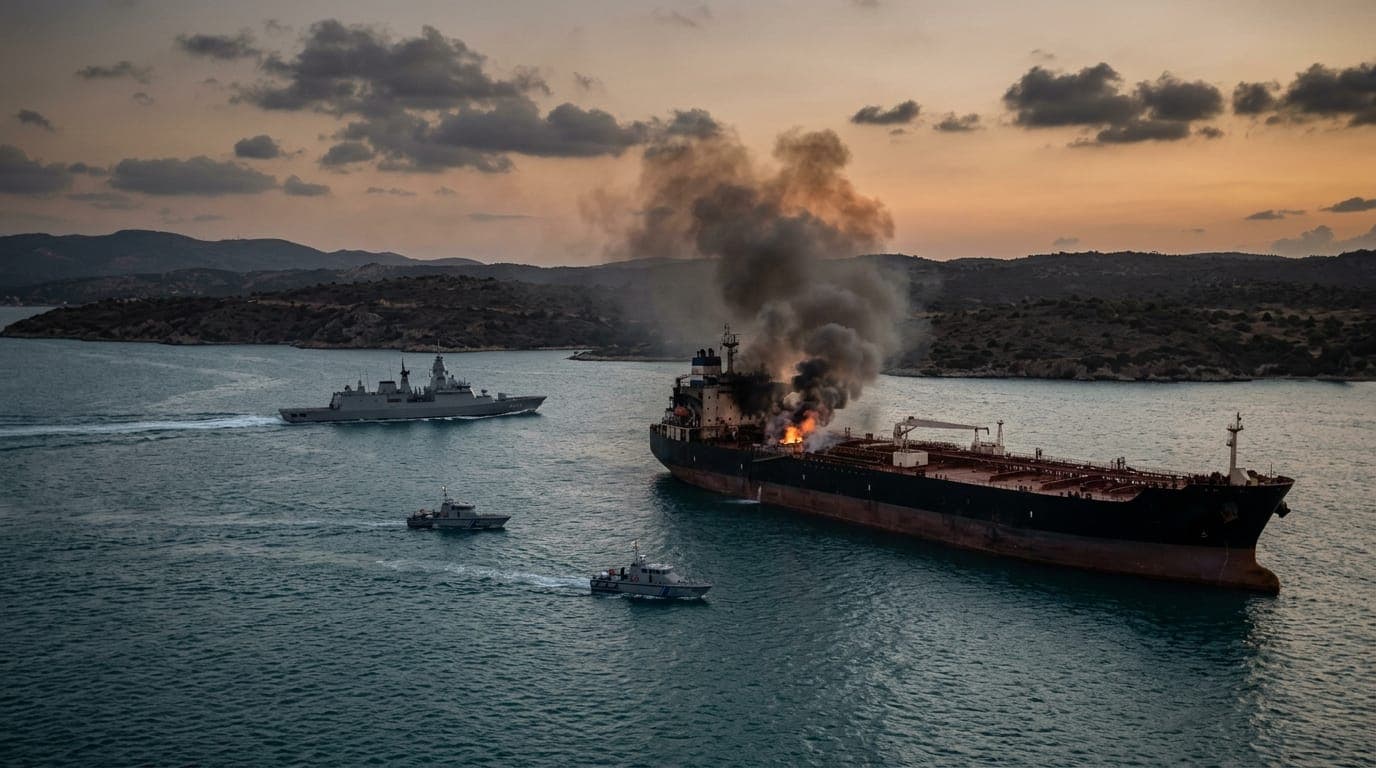
Trump's territorial posturing over the world's most critical oil chokepoint collided with reality on August 18: a tanker struck, one crew member killed, and no US-Iran negotiations on the calendar.
Key takeaways
- President Trump posted a map to Truth Social on August 18 labeling the Strait of Hormuz "New US Territory," the same day UK Maritime Trade Operations confirmed an unknown projectile struck an outbound tanker, killing one crew member.
- Strait traffic sat at 6 commodity ships on Monday, August 17, per Kpler data reported by Reuters, against a pre-war norm of roughly 20 million barrels per day transiting daily. Both COSCO and China Merchants have rerouted away from Hormuz in recent weeks.
- Qatar's Foreign Ministry says mediation between Washington and Tehran will not resume until the Iran-Oman transit deal is formally signed. Trump confirmed no talks are scheduled or ongoing.
President Trump posted an unlabeled map to Truth Social on August 18, 2026, showing the Strait of Hormuz circled and stamped "New US Territory." Hours later, he posted separately that "The Hormuz Strait is open and operating. All water mines have been removed or detonated." The same day, UK Maritime Trade Operations reported an unknown projectile struck a foreign tanker on the outbound transit route, causing engine-room damage and one crew fatality. The remaining crew were assisted by Oman's Coast Guard.
Trump had been escalating the rhetoric for days. At a Long Island police academy on August 14, he told the crowd: "After we finish defeating Iran, which is being very badly defeated, pretty soon I'll be declaring the Hormuz strait a territory of the United States." In the Oval Office on August 17, he told reporters he liked the idea, adding: "We control it with the blockade." On Tuesday he confirmed to reporters there are no talks with Iran, none scheduled.
The Gap Between the Claim and the Reality
Iranian Deputy Foreign Minister Kazem Gharibabadi answered the territorial claim directly on X: "The Strait of Hormuz has been Iranian, is Iranian, and will remain Iranian." He added that Trump's position is "a delusion" that will be "corrected."
The gap between Trump's "open and operating" assertion and actual traffic is the number that matters. Only 6 commodity ships crossed the strait on Monday, August 17, against a pre-war 10-day average of 11, per Kpler data reported by Reuters. Pre-war, Hormuz handled roughly 20% of global seaborne oil, around 20 million barrels per day.
Two of the world's largest state-controlled tanker operators, COSCO Shipping Energy Transportation and China Merchants Energy Shipping, have stopped sending vessels through Hormuz and Bab al-Mandeb, per Reuters. Brent crude settled above $90 per barrel on Monday before sliding slightly on Trump's "open" claim Tuesday.
The Hormuz transit bonus crews are commanding tells the same story from the labor side: the market is pricing real danger into every passage.
Both Chokepoints Are Broken
Hormuz is not the only artery under pressure. The Houthis this week forced closure of Yemen's port of Mokha and are pushing toward the Bab al-Mandeb Strait. Adam Baron, a Yemen expert with New America, described the Mokha closure to the Wall Street Journal as "the most significant escalation in quite a few years, maybe since 2020."
On the Iran track, Qatar's Foreign Ministry spokesman Majed al-Ansari confirmed at a news conference that mediating countries will not push for resumed Washington-Tehran negotiations until Iran and Oman formally announce a Hormuz transit agreement. That deal is still being finalized.
The 60-day diplomatic window set by the June MoU has expired. Tehran has declared it "irrelevant," blaming Washington for violating its terms. Iran's foreign ministry says negotiations with Oman are proceeding "in all seriousness" but attributes delays to outside actors.
What This Means for Energy and Sound Money
The monetary transmission is direct: Hormuz is not just a map feature; it is a fiat-system pressure valve. Sustained disruption to 20% of global seaborne oil does not produce a supply shock that a central bank can wait out. It produces structural, war-duration energy inflation that raises the cost of everything that runs on energy.
The Fed cannot fight supply-side, war-driven price pressure without wrecking demand. Above-$90 Brent at a fraction of normal Hormuz throughput is the setup for a prolonged inflation dynamic that erodes fiat purchasing power regardless of rate decisions.
The Chinese angle compounds it. Beijing is the world's largest oil importer, and its two biggest state tanker companies are already routing around both straits. That means China is either absorbing significant rerouting costs (inflationary) or accelerating yuan-denominated oil settlement infrastructure (a dollar-weaponization accelerant).
Both outcomes are structurally hostile to fiat and structurally supportive of non-sovereign monetary assets. The Bitcoin stocks decouple dynamic that emerged when Hormuz talks last collapsed is the market pricing exactly this transmission.
Trump's territorial claim confirms the conflict has entered a sovereignty phase with no near-term diplomatic offramp, and energy-market disruption is structural for the duration. The trigger that would break it: the Iran-Oman deal is formally signed within 30 days, Hormuz traffic recovers above 50% of pre-war levels within 60 days, and Trump publicly walks back the territorial claim to facilitate the agreement. Until all three happen, the disruption thesis holds.
What to Watch
The Oman deal is the critical variable. Qatar has made its mediation contingent on it. Iran says talks are serious but blames delays on outside actors.
Trump's territorial claim makes any Iranian concession on Hormuz politically harder to sell in Tehran. Watch whether Oman announces a formal signing date, whether Hormuz daily ship counts recover toward double digits, and whether the dual chokepoint squeeze (Hormuz plus Bab al-Mandeb) pushes Brent through the $95 threshold that would start forcing central bank responses.
Update, August 20, 2026
Trump escalated the pressure campaign overnight with a Truth Social post declaring "Economic Warfare and Isolation on an unprecedented scale" against Iran, which he called "an economic D-Day."
He threatened "TREMENDOUS Economic Consequences" on any country that provides "any lifeline to Iran." Markets absorbed the post immediately. Brent crude rose more than 3%, peaking at $94.67 a barrel.
The energy shock is now bleeding directly into Europe's winter calculus. European natural gas prices surged to levels last seen during the energy crisis triggered by Russia's invasion of Ukraine, with the catalyst being Trump's overnight "Economic D-Day" post.
Dutch front-month futures, Europe's gas benchmark, [rose as much as 2.5% and] soared above 65 euros per megawatt-hour, a level last seen in Q1 2023. That is not a ceiling Europe has much runway above: TTF has already climbed roughly 120% since the start of 2026.
Continued Hormuz disruptions would constrain European access to Gulf LNG and intensify competition for seaborne cargoes, with storage already well below seasonal norms and the winter replenishment window narrowing.
China, which stands to absorb the secondary sanctions threat most directly, pushed back fast. Iran's largest trading partner buys more than 80% of Iranian exported oil, roughly 1.4 million barrels per day, and Beijing's Foreign Ministry told reporters: "Imposing sanctions and pressuring do not help to solve the issue." The UAE moved in the opposite direction: the United Arab Emirates suspended all financial and economic transactions with Iran as the "D-Day" post hit. Every actor is now picking a side, and the commodity markets are pricing accordingly.
Update, August 25, 2026
Goldman Sachs put a hard number on what was previously a directional threat. Goldman commodities strategist Samantha Dart warns that European natural gas prices may need to more than double from her base-case forecast if LNG exports through the Strait of Hormuz remain constrained. The base case is €50/MWh. In a scenario where Middle East energy exports normalize only gradually through 2027, Goldman estimates December 2026 TTF would need to move above €100/MWh -- 110% above that base case.
The storage math behind the forecast is brutal. Current European storage sits at roughly 62% full, the lowest level for this time of year in nearly two decades and well below the five-year average.
Dart said reduced Qatari LNG loadings have forced Europe to compete more aggressively with Asia for available cargoes, and even the recent rally in Dutch front-month futures won't be enough to divert sufficient LNG from Asia if Middle East supply disruptions extend into next year, Goldman analysts Dart and Laura Cyr wrote in their note.
As of Monday morning, TTF was trading around €66.85/MWh, well below the €100/MWh Goldman estimates would incentivize the accelerated stockbuilding Europe needs before winter.
The Goldman note converts the Hormuz disruption from a geopolitical headline into a priced sovereign stress event. A market forced to €100 TTF by December means industrial curtailments, energy subsidy expansion, and fiscal pressure on governments already carrying post-pandemic debt loads. That is the policy desperation window: price controls become politically tempting, emergency central bank facilities get floated, and the inflation-versus-recession tradeoff facing the ECB sharpens considerably. Every day the Hormuz transit question remains unresolved, the window to refill storage at manageable cost narrows.
Update, September 10, 2026
The supply-side data that markets had been pricing on a forward basis just became official. Saudi Arabia reported to OPEC that its crude oil production plunged to the lowest since 1990, with Riyadh notifying OPEC's secretariat that output tumbled by 1.9 million barrels a day to 6.238 million bpd in August.
That is an even lower level than the previous wartime nadir reached in April, which was itself the lowest figure reported by the kingdom since the beginning of the Gulf War. The cause is straightforward: the kingdom has been forced to manage output around export constraints affecting both the Strait of Hormuz and Red Sea routes, rather than simply around production targets agreed with OPEC+ partners.
Tanker-tracking data compiled by Bloomberg showed Saudi crude exports fell by approximately one-third in August to around 3 million barrels per day, supporting the kingdom's reported production figures.
The escape routes are gone. The kingdom had diverted much of its crude through its East-West Pipeline to its Red Sea port of Yanbu to avoid Hormuz disruption, but in July Yemen's Houthi rebels declared a maritime blockade of Saudi Arabia, attacking ships and disrupting Red Sea and Bab el-Mandeb traffic, further constraining the kingdom's export options.
In the past week only two Saudi cargoes passed through Bab el-Mandeb, and the Houthis said they had targeted Khamis Mushait and Saudi Aramco sites in Abha, Najran, and Jizan.
The OPEC data hit the tape as prices crossed a threshold. WTI topped $100 this morning for the first time since May, fueled by the Saudi output data and Houthi attacks on Saudi energy facilities.
Hormuz crude flows have plunged below 2 million bpd, down from roughly 8 to 9 million bpd before fighting resumed, while alternative export routes are increasingly exposed to attacks.
Falling inventories and prolonged supply disruptions could keep oil elevated, with physical benchmarks already above $100 and no clear path toward US-Iran de-escalation. The Goldman €100/MWh TTF scenario outlined in the August 25 update now has a harder production floor underneath it.
Update, September 16, 2026
The drone strikes on Saudi Arabia's East-West Pipeline that forced a shutdown on September 10-11 have now fully cascaded into the export layer. Saudi Arabia has informed European customers that some September-loading crude cargoes will be canceled and oil loadings at the Red Sea port of Yanbu have been suspended.
With a storage capacity of 35 million barrels, Yanbu's existing stocks are sufficient to maintain exports for only five to seven days before running completely dry. The arithmetic is brutal: Saudi Arabia had rerouted about 5 million barrels of oil per day that would otherwise have moved through the Gulf, sending it instead via the 1,200 km East-West pipeline to Yanbu, and that bypass is now closed at both ends simultaneously.
LSEG data showed some physical oil cargoes in Europe trading above $130 a barrel as buyers searched for alternatives, with North Sea Forties crude rising to $136.75 a barrel, approaching the record level of $147.37 reached on April 13.
Goldman's Rich Privorotsky confirmed that distillates have gone vertical again and physical markets remain incredibly tight.
Chartering a VLCC in the Persian Gulf now costs $30 to $32 per barrel, with war risk premia and additional insurance coverage added on top, forcing Middle Eastern producers to risk transiting Hormuz with their own fleet. The futures strip has not caught up to where physical crude is already clearing.
Poland's Orlen was rushing to find crude oil cargoes from the North Sea and further afield to replace disrupted Saudi imports; Aramco became Orlen's top supplier in 2022 and now supplies around 40% of its oil. That dynamic is playing out across European refining. Futures prices on China's Shanghai Futures Exchange rose to $138 per barrel, the highest reading on record, as Chinese refiners scramble for available October supply. Every buyer is now competing for the same thin pool of non-Gulf crude at the same moment.
The Houthis' newfound control of Yemen's Red Sea coast and Perim Island in the Bab al-Mandeb strait poses further challenges to getting stored western crude out of Saudi Arabia, even if longer journeys around South Africa's Cape of Good Hope are considered viable. The Goldman €100/MWh TTF scenario from the August 25 update was premised on gradual normalization through 2027. Reuters sources said repairs to the East-West pipeline could take five to six weeks and Yanbu stocks could sustain exports for only five to seven days. If those numbers hold, the Goldman scenario now has a harder floor under it than any prior data point in this story has provided.
Sources
Frequently Asked Questions
What would it legally mean for the US to declare the Strait of Hormuz a US territory?
Almost nothing under current international law. The Strait of Hormuz falls under the UN Convention on the Law of the Sea (UNCLOS), which guarantees transit passage rights through international straits regardless of which nations border them.
A unilateral declaration of territorial sovereignty has no recognized legal mechanism, particularly over waters Iran and Oman both claim administrative jurisdiction over under their still-unfinalized transit deal. What the US does have is a naval blockade, which is a military fact, not a legal title.
How much of the world's oil supply flows through the Strait of Hormuz, and what happens if it stays disrupted?
Pre-war, roughly 20% of global seaborne oil trade transited Hormuz daily, around 20 million barrels. At current throughput (6 ships Monday versus a recent average of 11, per Kpler), the strait is operating at a fraction of that volume.
Sustained disruption at these levels means every barrel rerouted adds cost and delay, bidding up global energy prices. Those higher input costs flow through every supply chain that touches energy, which is every supply chain. There is no short-term substitute route for the volumes Hormuz normally handles.
Why are Chinese shipping companies avoiding Hormuz and Bab al-Mandeb, and what does that mean?
COSCO Shipping Energy Transportation and China Merchants Energy Shipping have both rerouted away from Hormuz and Bab al-Mandeb, per Reuters. China is the world's largest oil importer, so its state tanker companies are the most exposed to chokepoint risk. Their exit signals Beijing has made a policy decision that the risk of asset loss in the straits outweighs rerouting costs.
The longer those companies stay out, the more pressure builds on global oil supply chains and the more Beijing is incentivized to accelerate non-dollar oil settlement to protect its energy access from US-enforced chokepoint control.