IRGC Strikes Togolese Tanker in Hormuz as Trump Weighs Annihilation
The IRGC struck the Togolese-flagged tanker Trend in the Strait of Hormuz on September 17, the same day Trump told Axios he faces a 'big decision' on whether to annihilate the Iranian regime. Seven months in, the war has no defined endgame and the energy shock keeps compounding.
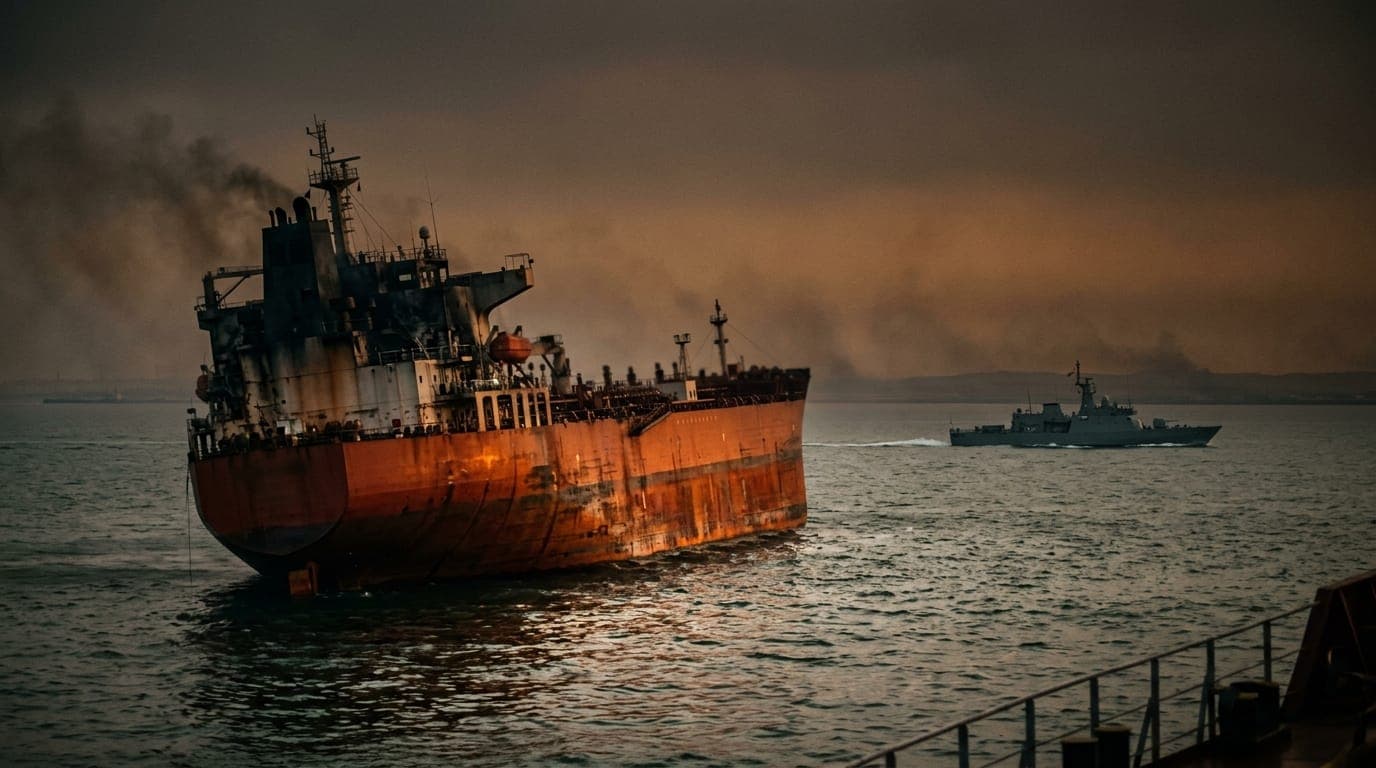
Seven months into a war with no endgame, Iran hit another vessel and Trump went on the record about whether to end the regime.
Key takeaways
- Iran's IRGC struck the Togolese-flagged tanker Trend in the Strait of Hormuz on September 17, claiming the vessel attempted an unauthorized transit; UK Maritime Trade Operations confirmed the fire was extinguished and crew is safe.
- The same day, President Trump told Axios he faces a "big decision" on whether to "annihilate" the Iranian regime or pursue a different path, ahead of a Tuesday UNGA meeting with six Gulf-state leaders.
- With Hormuz interdiction entering its seventh month and Houthi pressure building on Bab el-Mandeb, the sustained energy-supply shock is constructing the exact stagflationary macro environment where fixed-supply assets function as insurance.
Iran's Islamic Revolutionary Guard Corps struck the Togolese-flagged oil tanker Trend in the Strait of Hormuz on the night of September 17, 2026, according to an IRGC statement carried by IRNA. The vessel caught fire and halted; UK Maritime Trade Operations (UKMTO) confirmed the fire has since been extinguished and the crew is reported safe.
The IRGC's statement, released via Sepah News and translated from Telegram, was unambiguous: "Last night, the offending tanker Trend, flying the flag of Togo, attempted an illegal passage through the Strait of Hormuz under the instigation and deception of the child-killing U.S. military; it was struck and came to a halt after a fire broke out on board." The IRGC characterized the transit as U.S.-instigated via what it called the "Omani Route," a corridor through the strait's southern edge that commercial vessels have been attempting to use to skirt the core interdiction zone.
Trump's Binary, Stated Out Loud
Hours before the tanker was struck, President Trump told Axios reporter Barak Ravid that he is approaching a decision point on the war's direction. The quote, confirmed by Axios:
"I have a big decision coming up. Do I want to go in and annihilate them [the Iranian regime] or do I not? It's a big decision. Anything could happen with me."
Trump declined to say whether the decision comes before or after the November midterms. He and Defense Secretary Hegseth have ordered U.S. forces to maintain current Middle East force levels through year-end, keeping the military ready for a return to full-scale combat. Formal U.S.-Iran negotiations have not taken place since a memorandum of understanding collapsed in June 2026.
Trump is scheduled to meet Tuesday with leaders of Saudi Arabia, UAE, Qatar, Bahrain, Kuwait, and Oman on the sidelines of the UN General Assembly in New York. That meeting is the nearest identifiable inflection point for the war's next phase.
The war, which Trump initially projected would last four to five weeks, is now in its seventh month.
The Choke Point Math Keeps Getting Worse
Before the war began February 28, roughly 25% of global seaborne oil trade and 20% of global LNG moved through the Strait of Hormuz. That baseline hasn't recovered. U.S. forces have redirected 103 commercial vessels through the strait as of September 15, per CENTCOM, but that is a trickle against pre-war traffic volumes.
The picture deteriorated further this week. Houthi forces reportedly dug approximately 20 km of trenches in mountains above Bab el-Mandeb, with positions overlooking the strait's narrowest point near Dhubab and Perim, per The Hormuz Letter on X. Saudi Arabia's East-West pipeline also sustained drone damage and was shut down; Saudi officials say the kingdom can restore around half its pipeline capacity within days, per OilPrice.com and Trading Economics. U.S. crude futures had been above $100 per barrel; WTI briefly dipped below $100 on Friday on signs that additional Saudi supply could reach global markets, per CNBC.
That oil price sensitivity to a single headline is the tell. This is a structural repricing of energy risk, now nearly seven months old. The EIA's extended disruption forecast through 2027 puts a timeline on what that means for inflation.
The Houthi advance on Bab el-Mandeb means two of the region's three major energy arteries are simultaneously under pressure. Layer in Saudi pipeline damage and the supply-side shock has no quick release valve.
The Federal Reserve cannot cut its way through an oil supply shock. Rate cuts don't produce barrels. What they do produce, in a stagflationary environment, is more debasement chasing a problem that monetary policy cannot solve.
Raising rates into a war-distorted economy accelerates damage to growth; holding lets energy-driven CPI run. Neither path preserves purchasing power in fiat terms.
Trump's stated optionality compounds the problem. Markets price uncertainty, and a sitting president saying "anything could happen with me" regarding whether to annihilate a sovereign government is maximum optionality held by a single actor. Risk premia on energy assets, Middle East sovereign exposure, and dollar-denominated anything stay elevated until that optionality closes. Bitcoin carries no sovereign geography and no Hormuz exposure.
The Thesis and Its Breaking Point
The IRGC's attack on the Trend is a deliberate, repeated demonstration that Iran retains interdiction capability regardless of U.S. escort operations. Every vessel struck is a message to Gulf states, Beijing, and Washington: the cost of forcing the strait keeps compounding. Iran's most credible deterrent against escalation is the credible threat to sustain that cost indefinitely.
That thesis breaks under one condition: if the September 22 UNGA Gulf-state summit produces a Chinese commitment to condition economic support for Iran on halting Hormuz attacks, and Iran complies. A ceasefire or negotiated framework before end of October would also close the energy-risk premium. If either happens, oil retreats, the Fed gets cover, and the stagflation-to-debasement chain doesn't close.
Until then, the commoner is paying the tab at the pump while the decision hangs.
Sources
- IRGC statement via IRNA, September 17-18, 2026
- Trump-Axios interview, Barak Ravid, September 17, 2026
- UKMTO advisory, September 18, 2026 (via UK Maritime Trade Operations)
- CENTCOM, 103 vessels redirected, via GlobalSecurity.org Day 201 OPREP
Frequently Asked Questions
The Omani Route is a transit corridor through the southern Strait of Hormuz skirting Omani territorial waters. Commercial vessels have been attempting to use it to bypass the IRGC's primary interdiction zone. Iran's position is that any transit it has not authorized is illegal, regardless of the corridor used.
Before the war began February 28, 2026, approximately 25% of global seaborne oil trade and 20% of global LNG transited the strait. Since the IRGC closed it to unauthorized shipping, traffic has fallen sharply, with the U.S. Navy escorting a limited number of commercial vessels through.
An energy-supply shock of this duration is a supply problem that rate policy cannot address. The Fed's options narrow to raising rates into a war-stressed economy or holding and watching energy-driven inflation erode purchasing power. Both paths accelerate real-terms losses for dollar holders.