Heat Your Home With Bitcoin Mining: The 2026 Guide
Every watt a miner draws comes out as heat. Whether that beats your furnace depends on what you burn now, how long your winter is, and what you were going to buy anyway.

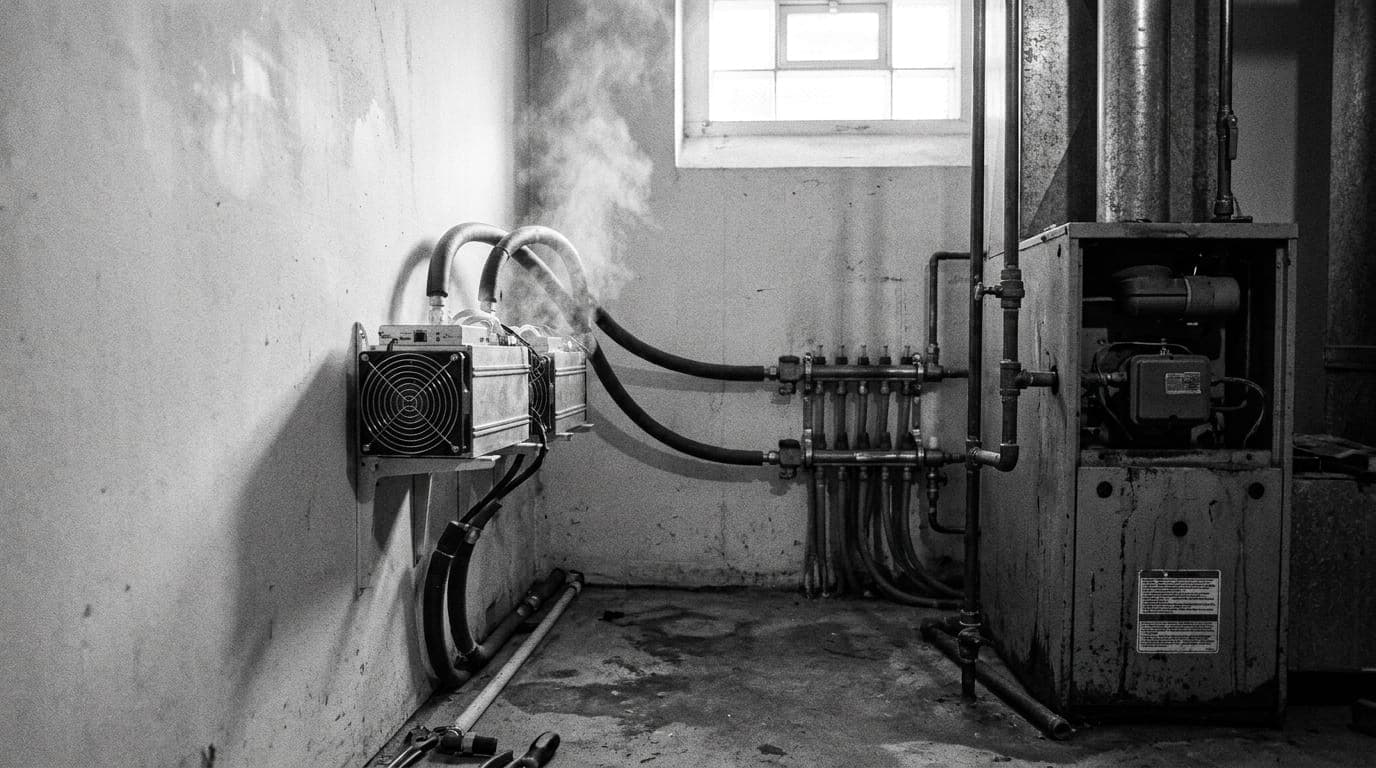
I have been stacking hash rate for almost a decade. It is masochistic and it is completely addicting, and for most of that time the idea of miners as home heating infrastructure got waved off as a hobbyist curiosity. I never bought that framing. The case was always there.
Back in January 2023 I was talking to Rick V of CryptoCloaks about people cutting holes in the side of their furnaces to duct miner exhaust straight in, and I said on tape that if somebody built a plug-and-play version for the home, I would love it and we should be pushing for it.
Three years later the hardware is cheap, the control software is solved, and there are people installing these systems for a living. What has been missing is a straight answer to the question that actually decides it for you, which is whether this beats what you are already burning.
This is that answer. No firmware to sell you, no hardware in the cart.
Key takeaways
- A miner is already a heater. Effectively every watt you put in comes out as heat. You are not splitting power between two jobs.
- The fuel you burn today decides everything. Cheap piped natural gas is very hard to beat. Propane, heating oil and electric resistance are where the savings live.
- Duty cycle is the go/no-go gauge. A long cold season pays back the hardware. One brutal week in an otherwise mild winter does not.
- Do not rip out your furnace. Size the miner for your average heat load and let the existing system handle the coldest nights.
- US homes are single-phase, which limits your options. Most of the good hydro hardware is three-phase and built for Europe.
Why a Bitcoin miner is already a heater
Tyler Stevens of Exergy credits his friend Rob Warren with the cleanest description of proof of work I have heard: Satoshi invented a way to make a computer sweat.
Energy does not disappear. Push electricity into an ASIC and it comes back out as heat, because the machine has no screen, no motor and nowhere else to put it. Physically this is the same thing a resistive heater does when it runs current through nickel chromium wire. The only difference is which path the electrons take, and the fact that a network of other computers pays you when your path finds a block.
The misconception worth killing first is that a mining heater divides its power, some to warmth and some to hashing. It does not. It is one pool of energy doing both jobs at once.
What makes Bitcoin suited to this in a way other computing is not is granularity. You cannot break an AI data center into pieces and make one of them your water heater, because those workloads need coordination and uptime. Mining rewards are proportional to the electricity you feed in, and the machine does exactly one thing, so you can switch it on when the room is cold and off when it is not. It behaves like a heater because you can treat it like one.
The scale here is genuinely large. K33's research puts the heat the mining industry throws off at roughly 100 TWh a year, which is enough to heat Finland. Almost all of it goes into the sky.
The only question that matters: what are you burning now
Dylan Seib of Exergy asks every person who contacts him the same thing first, and it is the right question. What heats your building today?
Most people have never priced their heating fuel on a common basis, and it is the single variable that decides whether any of this makes sense.
| What you heat with | Roughly, per kWh equivalent | Verdict |
|---|---|---|
| Piped natural gas | ~2 cents | Very hard to beat on cost alone |
| Heat pump | Effective cost divided by ~3 | Strong in mild climates, weakens in deep cold |
| Propane | ~9 to 13 cents | Where the savings live |
| Heating oil | ~11 to 13 cents | Same |
| Electric resistance | Your full electric rate | Easiest switch of all |
Figures are approximate and vary by region and season. Price your own bills before trusting anyone's table, including this one.
Natural gas is the hardest case. If you have cheap piped gas, the arithmetic is tight and no amount of enthusiasm fixes that. Stevens puts gas near two cents per kilowatt hour equivalent against propane and heating oil at eleven to thirteen, and that gap is the entire opportunity.
Dylan's napkin math on propane: it works out around nine cents per kilowatt hour equivalent, and running an electric miner at ten cents with three to five cents coming back in sats nets out to a forty to fifty percent reduction in effective heating cost. That is one customer scenario from Exergy's calculator rather than a promise for every house, but it shows the shape.
If you already heat with electric resistance, this is the easiest decision in the category. You are swapping one resistive element for another that also produces Bitcoin. Worth knowing that Forbes reports seven to eight percent of comfort heating is already electric resistive, which is the slice of the market where this needs no argument at all.
Solar changes the maths even against gas. Excess generation sold back to the grid earns you pennies, worse than airline miles as Tyler puts it. Running that surplus through a miner instead captures real value from power you were giving away.
I will give the counterweight its due. When CNBC covered this last November they were careful to say it will not necessarily save you money, because the economics swing hard on local rates and machine efficiency. That is correct and you should hold it in mind. The people for whom this works are a specific group, not everybody.
Duty cycle decides your payback
The second variable is how often the thing actually runs.
Miners call it uptime and HVAC calls it duty cycle, and they mean the same thing. A miner that heats your house for five months pays back its hardware cost. A miner that runs hard for one cold week in February does not.
Denver in January is a different proposition from Phoenix. What you want is a long season rather than a severe one, because the total hours of heat demand is what converts the upfront spend into savings. Somewhere that is cold for months beats somewhere that is briefly brutal.
This is also why the summer question has a boring answer. In warm months you either switch the miners off or, if you have solar surplus worth monetising, run them and dump the heat outside. Neither is complicated, but nobody writing about this seems to mention it.
Where to start, based on your situation
| Your situation | Verdict | First step |
|---|---|---|
| Propane or heating oil, long cold winter | Strongest case | Get a heat audit and price your fuel per kWh equivalent |
| Electric resistance heat | Easy yes | Swap one element for a miner, start with space-heater class |
| Grid-tied solar with real surplus | Worth it even on gas | Size to your export volume rather than your heat load |
| Cheap piped natural gas, no solar | Probably not | Revisit if your rates move or you add solar |
| Curious, not ready to touch the furnace | Start small | A plug-in unit or a Bitaxe teaches you the behaviour |
| Mild climate, low altitude | Heat pump first | Around 300% efficiency. A miner can be the resistive backup |
| Pool, hot tub or small commercial load | Very strong | Large steady demand is what makes payback work |
The hardware, and the $50 window
What you buy depends entirely on what you are trying to do, and the honest answer for most people is to start smaller than they think.
To tiptoe in, space-heater class machines around 850 watts do the job. The Avalon Mini 3, the Stealth and the Slim 19 are all in that range. They are small enough to move between rooms, they need no electrical work, and you can plug one in and pair it with a smart thermostat in an afternoon.
For baseload integration into a furnace or boiler, the S19 is the obvious pick right now purely on price. Tyler's example makes the point better than I can. If your building needs five thousand watts of baseload heat, you can buy one new five thousand watt miner for around three thousand dollars, or two S19s at around fifty dollars each and have six thousand watts of heat-producing hash rate for under two hundred.
The reason those machines are that cheap is the best structural news home mining has had in years. AI compute is paying something like sixty times what Bitcoin mining pays for the same megawatt hour. CleanSpark, Riot and Core Scientific are all pivoting toward AI hosting, which is the correct decision when the economics are that lopsided, and it is flooding the secondhand market. Every one of those announcements drops network hash rate, adjusts difficulty down, and hands more sats per kilowatt hour to whoever is still mining at home.
Prices in the fifty to one hundred dollar range are what I am seeing as of August 2026. That window will not stay open forever, so check current pricing before you plan around it.
Size for your average load, not your worst night. This is the mistake that makes projects expensive. You are not replacing your furnace, you are displacing the hours it would otherwise run. Dylan's Denver setup handles average winter days in the mid-twenties to thirty degrees on a couple of Mini 3s and lets the furnace step in when it drops to single digits. Keeping the furnace keeps your upfront cost low and your duty cycle high.
The constraint nobody outside the US worries about is single-phase power. Bitmain's newest machines are three-phase hydro units, which is fine for European homes and useless for North American ones. Stevens says the MicroBT M64 is the only single-phase hydro miner on the market, which is why the best published build guides do not translate. Braiins has an excellent writeup of a three-loop hydro system with a full year of real data behind it, and it is worth reading, but it is a European three-phase installation. For a US house, single-phase S19s and earlier hardware remain the practical option.
Firmware matters more than people expect when selecting hardware. Most miners ship with closed firmware from the manufacturer. Braiins and LuxOS both give you real API access, which is the difference between integrating a miner into a smart building and fighting it.
The building brain
Once there are miners in a building, something has to decide when they run. That coordination layer is the piece most people have never considered and the one that makes the difference between a space heater and a system.
Tyler explains it with a hybrid car. A RAV4 hybrid does not carry two full powertrains. It has a small battery, a small motor, a gas engine, and a brain that picks between them moment to moment. The result beats either system running alone.
A building brain does the same job. It knows your thermostat is calling for heat, what your solar array is producing right now, what hash price is doing, what your electricity costs at this hour, and what your gas costs. Then it chooses.
Dylan built his on Home Assistant running on a Raspberry Pi. Local matters here. The logic that controls your heat should live in your building rather than on somebody's cloud subscription, and Home Assistant connects directly to thermostats, solar inverters and miners.
The automations are where it becomes real. During a recent ten percent downward difficulty adjustment, Dylan's system worked out that hash value was excellent and his solar was running, and told him to crank every miner and dump the heat outside. One Exergy customer configured his the other way, prioritising sats over gas at all times, because he would rather stack than save the marginal dollar.
The barrier to building this has collapsed. Tyler fed a draft of the playbook to Claude with the Home Assistant connector running and asked it to find the sensors in his house, locate the miner, and write the automations. That was it. The technical knowledge required is falling at the same moment the hardware is getting cheap, and those two curves running together is the actual story of 2026.
What it looks like installed
At The Space, the Denver building Stevens runs, the demo is a single M64 hydro unit pushing eighty degree Celsius water into PEX tubing that a plumber ran through the exposed floor joists. One machine heats roughly three thousand square feet. People consistently underestimate how power dense these things are.
The install produced the kind of detail you only get from doing it rather than modelling it. Stevens asked for a mixing valve and the plumber fitted it backwards, because gas boilers need protecting from water that is too cold and he had never met the opposite problem. Miner output at eighty degrees will cook the adhesive under laminate flooring, so it has to come down to about a hundred and twenty Fahrenheit.
For a costed example at the commercial end, Stevens ran the numbers on a mountain hot springs resort with forty thousand gallons of pool kept at hot tub temperature, geothermally warmed and topped up with propane. They spend twenty two thousand dollars a year on propane and have thirteen cent power. Moving the supplemental load to four Auradine hydro units raises the electricity bill to roughly twenty four thousand, and those machines mine about twenty seven thousand dollars of Bitcoin a year running only when heat is called for. A business that was paying twenty two thousand to stay warm ends up around three thousand ahead, with the hardware paid off in roughly thirty months.
Getting the Bitcoin out
Dylan tells a story about someone at an Exergy event asking how you actually get the Bitcoin out of the miner. It is a fair question and it stuck with him.
The answer is a pool, and the thing to select on is not the brand. It is whether you get to build your own block template.
Under Stratum V1, which the four dominant pools still run, you supply the computation and the operator decides which transactions go in the block. You have no say in what your machine helps confirm. That is the part of mining that is genuinely centralised, and it is a censorship problem rather than a hashrate one. Four pools controlled more than 70% of hashrate as of June 2026 and the Nakamoto coefficient sat at 3.
Two pools have actually shipped miner-side template construction into production: Ocean, running the DATUM protocol, and Braiins Pool on Stratum V2. Those are the options where the template stays yours. Fee structures and payout models differ between them, so run your own numbers rather than taking either as a default.
Dylan Seib's pick for the Exergy setups is Ocean, largely for the payout mechanics. You give it an address you control and it pays on-chain once you clear the minimum, which is worth checking before you configure anything because the threshold changes. If you are running low enough hash rate that waiting for the on-chain minimum is painful, Ocean also does Lightning payouts, so a Core Lightning node or a Coinos account with a Bolt 12 offer gets sats moving as you earn them.
Either way there is no exchange, no KYC and nobody holding your coins in between. Your subsidy for running infrastructure you were paying for anyway lands as spendable Bitcoin in a wallet you own, and even a partial redirect of hash rate away from the dominant four sends a signal worth sending.
What is still missing
I would rather be straight about the gaps than pretend this is finished.
The firmware will not talk to your thermostat. Braiins has dynamic performance scaling and Luxor has automatic thermal management, but both were built to stop machines cooking themselves rather than to hold a room at a set temperature. As Stevens puts it, you end up commanding your heater by how close the furnace is to blowing itself up. Auradine's machines retune within thirty seconds, which is the responsiveness this needs, and the open source work at the 256 Foundation is building toward miners that take a temperature target directly.
There are no tradesmen who can size this. Nobody picks their own boiler. You call a heating company, and right now you cannot call one and ask for a hash rate heater. Exergy currently acts as the translator between your utility bills and a machine list, which works but does not scale. The fix Stevens keeps coming back to is giving installers one or two percent of the hash rate from every system they fit, which would flip a trade that waits for your boiler to break into one that monitors a fleet it wants running perfectly.
The paperwork is unresolved. Not every machine carries UL certification. Insurers will quote you eight times the premium if you describe the installation as Bitcoin mining rather than electric heating, for hardware that is doing the same thing either way.
None of these are reasons not to do it. They are reasons it has not happened at scale yet, and they are all solvable.
Related reading
- Bitcoin Home Mining Playbook with Exergy. The full how-to with Tyler Stevens and Dylan Seib: candidate assessment, the building brain, hardware selection.
- Heating With Bitcoin Miners: What It Actually Costs. The economics and the route through the trades.
- The Bitaxe, Explained. The cheapest way to get hash rate into your house, with no heat to speak of.
- Is Bitcoin Mining Worth It in 2026?. Home versus hosted, and whether you want mining exposure at all.
- Bitmain S21 Review. If you are pricing new hardware rather than secondhand.
- Best Bitcoin Mining Hosting Companies. If you want hash rate without hardware in your house.
- A conversation we published with Alex Busarov of Heatbit covers the consumer appliance route, and our sister site has a full Heatbit review.
Frequently Asked Questions
Can you really heat a house with a Bitcoin miner?
Yes. Effectively all the electricity a miner draws leaves it as heat, which is exactly what an electric heater does. A single hydro-cooled miner heats roughly three thousand square feet at Exergy's demo site in Denver.
Is it cheaper than natural gas?
Usually not. Piped natural gas runs around two cents per kilowatt hour equivalent and mining income struggles to close that gap. The case is strong against propane, heating oil and electric resistance, which cost several times more.
How much can you actually save?
Exergy's figures put a propane replacement at a forty to fifty percent reduction in effective heating cost, based on propane near nine cents per kilowatt hour equivalent against a miner at ten cents with three to five cents returning in sats. That is one customer scenario. Your fuel prices, electricity rate and season length all move it.
Do I need to replace my furnace?
No, and you should not. Size the miner for your average heat load and let the existing furnace cover the coldest nights. That keeps the upfront cost down and the miner running more hours, which is what pays it back.
What miner is best for home heating?
For a first attempt, space-heater class machines around 850 watts such as the Avalon Mini 3. For heating a whole building, secondhand S19s are the value option at current prices. US homes run single-phase power, which rules out most of the newer three-phase hydro hardware.
Do I need a plumber or an electrician?
For anything integrated into a boiler or ductwork, yes. Modern hydro units have hot and cold hookups a plumber will recognise, but sizing the system and configuring the mining side is not yet something the trades can do for you.
How do you get the Bitcoin out?
Point the miner at a pool that pays to an address you control. Select on whether the pool lets you build your own block template, which as of mid-2026 means Ocean running DATUM or Braiins Pool on Stratum V2. Ocean supports on-chain payouts to your own address and Lightning payouts via Bolt 12 for lower hash rates, with no exchange or KYC involved.
What happens in summer?
You either turn the miners off or, if you have solar surplus worth monetising, keep them running and vent the heat outside. Your heating season length is what determines the payback, so a short summer helps.