TFTC – Truth for the Commoner
Bitcoin Brief
|
|
Sup, freaks.
Reporting live from the floor of Bitcoin 2026 in Las Vegas. Bitcoin is at $77,000 and the conference energy is palpable. Saturday's podcast with Matthew Mezinskis was a deep dive into the power curve, where Bitcoin sits on it today, and a thought experiment about what happens when Bitcoin's power law growth rate eventually crosses the exponential growth of traditional equities. That's the lead today.
|
|
LEAD STORY
|
The Essential Singularity: When Bitcoin's Power Curve Crosses Traditional Markets
If you haven't listened to TFTC 739 with Matthew Mezinskis, it's worth your time. Matty has been tracking Bitcoin's power curve for over seven years and the model now has a 96% R-squared fit. That means 95% of Bitcoin's price movement is explained by network adoption alone. Not the Fed. Not Trump. Not the ETFs. Pure adoption math.
Here's the framework worth sitting with. Traditional financial markets, stocks, bonds, real estate, grow exponentially. The S&P 500 compounds at roughly 7-10% per year. Fiat monetary bases grow at about 10.5% per year (99% R-squared, as Mezinskis has documented across 170+ fiat currencies). That's the nature of compound interest and inflation. Bitcoin, by contrast, follows a power law trend, currently growing at roughly 45% per year but with a decelerating growth rate built into the math. It doubles approximately every 760 days.
The essential singularity is the intersection point where these two curves cross. Traditional markets grow in a straight exponential line. Bitcoin's power curve starts steeper but decelerates over time, though it remains above exponential for decades to come. As Mezinskis put it: "Bitcoin will likely pass fiat base money by 2043. But does Bitcoin shift to exponential, or does the world shift to power?"
That question is the real takeaway. Compound interest, the foundation of modern finance, is mathematically incompatible with power law growth. When TradFi institutions buy an asset that moves in power, not exponentially, their models break. Their risk frameworks don't apply. Their return assumptions fail. Mezinskis argues this convergence will reshape contracts, debt structures, and the entire financial architecture. It's not a matter of if. The math says it's a matter of when.
Right now, the power curve trend line sits at about $125,000 for end of year, with the 90th percentile (2x trend, a level Bitcoin has hit every single cycle) at $250,000. As Matty said: "Internalize this power trend. Block out the day-to-day noise. Build your business. Stack sats."
Listen to the full episode here.
|
|
|
SIGNAL
|
Block Ships a Wall of Bitcoin Upgrades: New BitKey, Proof of Reserves, Cash App Cashback
Block dropped a massive batch of bitcoin-focused updates today. The headline: a new BitKey hardware wallet with a built-in screen, no seed phrase, multisig by default, and built-in inheritance. I set mine up yesterday and the design work is genuinely impressive.
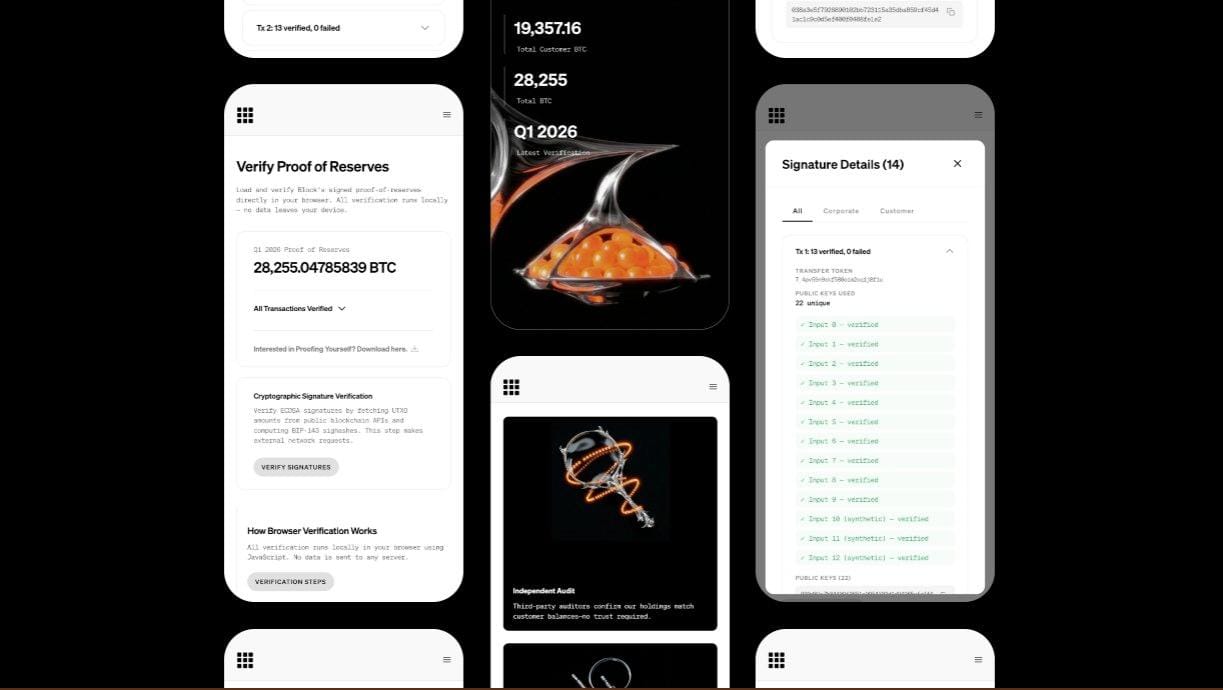
But that's not all. Cash App now lets you auto-convert incoming payments to bitcoin, launched a "Bitcoin Back" program with 5% cashback in BTC on eligible Square merchant transactions, raised withdrawal limits to $10,000/day and $25,000/week, and removed fees and spreads on purchases above $2,000. They also launched a Proof of Reserves system covering Block's corporate treasury and customer holdings across Cash App and Square, using on-chain signatures for public verification of 8,883 BTC ($681M) in real-time, not historical snapshots. And at the conference, they're demoing bitcoin payments through Square using NFC tap-to-pay on Lightning with zero processing fees through 2026.
|
|
Bitcoin 2026 Opens in Las Vegas
Bitcoin 2026 kicked off in Las Vegas today and BTC touched $79,000 during the opening. This year's lineup spans the Freedom Go Up stage, open-source developer showcases, and a full slate of product announcements and network updates. There's a real sense that the industry is maturing. New hardware. Better tooling. More builders shipping. And hopefully, progress on pardons for imprisoned developers like Keone Rodriguez, Bill Hill, and Roman Storm, who should have never been charged in the first place. The conference floor feels like a snapshot of where Bitcoin is headed: more products, more builders, more freedom tech.
|
|
Soft-on-Crime Policies Are Raising America's Time Preference
Started reading Hans-Hermann Hoppe's Democracy: The God That Failed on the flight to Vegas, and it crystallized something that's been bothering me. The soft-on-crime judges in the U.S. are doing real, measurable harm to the economy. When crime increases because there are no longer consequences associated with it, society reflexively increases its time preference. Store owners board up. Businesses leave cities. People stop investing in their communities because the return horizon shortens when you can't protect your property. This is the mechanism Hoppe describes: democratic governance incentivizes short-term consumption over long-term capital formation. Crime without punishment is the purest expression of high time preference governance. Bitcoin fixes the monetary layer. But the institutional decay is something we need to confront directly.
|
|
Re-Industrialization Is Well Underway
This chart from Jordi Visser's weekly update tells a story the mainstream is largely ignoring. The ratio of capital goods to consumer goods imported into the U.S. is surging. America is importing more machines, equipment, and industrial inputs relative to finished consumer products. That's a re-industrialization signal. Factories are being built. Infrastructure is being upgraded. The physical buildout of AI, energy, and manufacturing is showing up in the trade data. This is the kind of structural shift that takes years to play out and compounds over time.

|
|
Iran Submits Peace Proposal to Reopen the Strait of Hormuz
Iran sent a new two-stage peace proposal to the U.S. via Pakistani mediators: reopen the Strait of Hormuz and end the war now, kick nuclear negotiations to a later date. European markets rallied on the news. Only 5 ships transited Hormuz in the last 24 hours, down from the normal 60-70 per day. The strait remains effectively closed under IRGC control while the U.S. Navy actively clears Iranian mines. FM Araghchi is heading to Moscow to brief Putin, adding another layer of complexity. No consensus inside Iranian leadership on whether to accept U.S. terms. The energy trade remains disrupted until this resolves.
|
|
Corporate Bitcoin Stacking Continues: Strategy and Strive Both Buy
Strategy purchased another 3,273 BTC for $255 million, bringing total holdings to 818,334 BTC at an average cost of $75,537 per coin. BTC Yield is 9.6% year-to-date. Meanwhile, Vivek Ramaswamy's Strive added 789 BTC, pushing their treasury to 14,557 BTC. The corporate accumulation playbook that Saylor pioneered is now standard practice. Every week, more companies are converting balance sheet cash into bitcoin. The supply squeeze continues.
|
|
|
PRESENTED BY
|
Bitkey
The new Bitkey makes self-custody simple. No seed phrase, multisig by default, built-in inheritance, and now with a screen. It's the easiest way to get your bitcoin off the exchange. Use code TFTC20 for 20% off.
Get Bitkey
Sponsor
|
|
|
DATA SNAPSHOT
|
| Bitcoin Price | $76,833 |
| Sats per Dollar | 1,302 |
| Block Height | 946,892 |
| Network Hashrate | 1,004 EH/s |
| Daily Fees | $137,058 |
|
| On-Chain Metrics |
| MVRV Z-Score | 0.84 Fair value range, not overheated |
| SOPR | 1.006 Coins moving at slim profit |
| STH Realized Price | $79,245 Short-term holders just underwater |
| NUPL | 0.309 Optimism zone, capitulation behind us |
| Realized Cap | $1.08T Aggregate cost basis of all coins |
|
|
|
|
|
|
If this landed, forward it to someone who could use more signal and less noise. The Bitcoin Brief is free, always will be.
See you tomorrow,
Marty Bent
|
|
|
Follow: @MartyBent · @TFTC21
Nostr: primal.net/marty
YouTube: TFTC · Podcast: tftc.io/podcast
|